Chinese Kangxi Period Famille Verte Porcelain Bowl with Yongji Tang Hall Mark中国清康熙时期五彩硬彩瓷碗,永济堂款
LANGUAGE UNLOCK
Glossary Roundup
Original Presentation Script
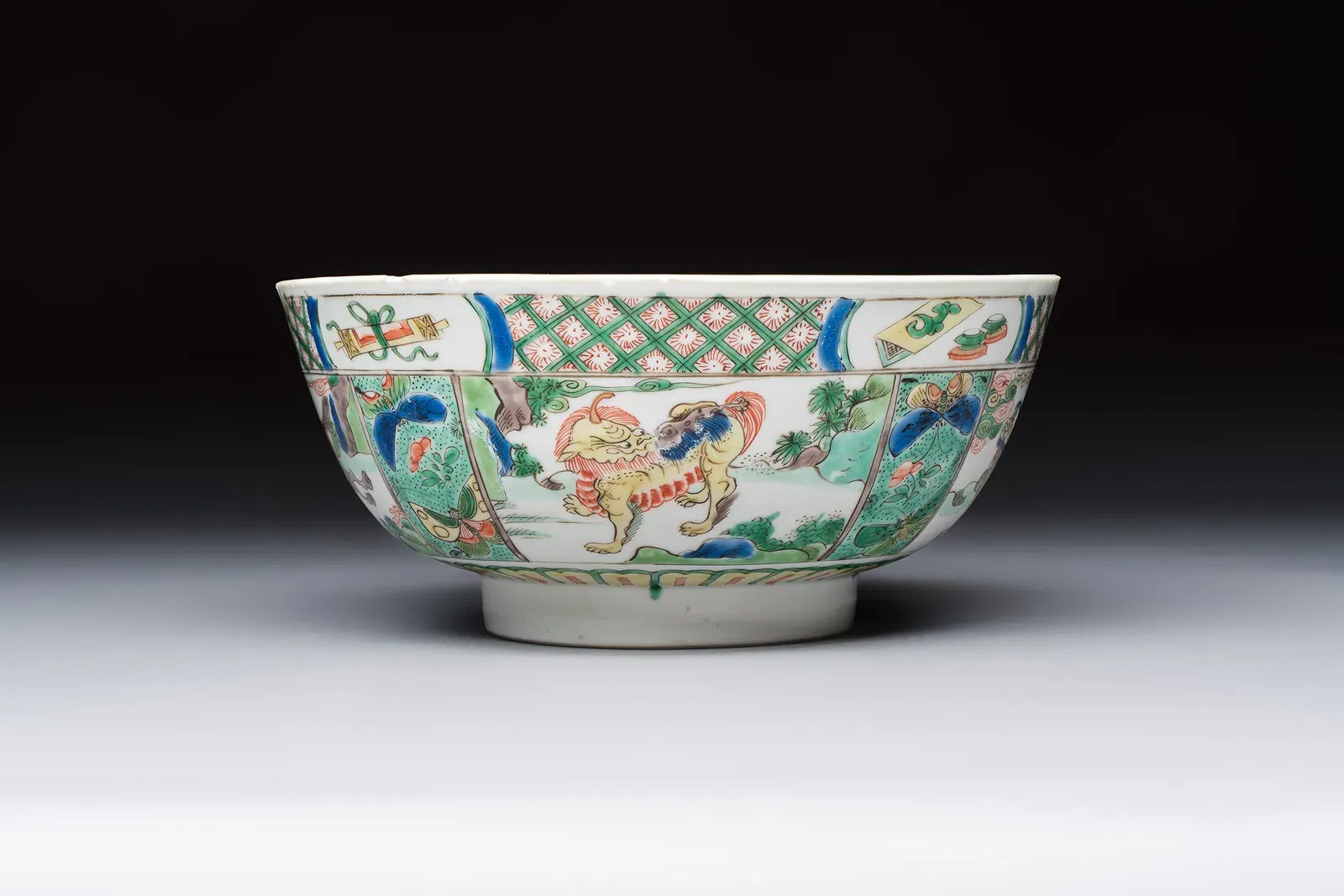
Here we have a rather delightful Chinese Kangxi Period famille verte porcelain bowl with a Yongji Tang hall mark—a bowl that manages to turn dinnerware into a miniature bestiary. Around the outside, lively auspicious animals romp through painted landscape reserves, while the rim is dressed with lattice diaper panels and ribbon-tied precious objects. Inside, the decoration quiets down to a single iron-red peony spray: elegant, confident, and very Kangxi.
Historically, I would place it around 1700 to 1720, in the Qing dynasty Kangxi period, when Jingdezhen potters were producing some of the most spirited overglaze enamel porcelains ever made. The palette is classic famille verte—what Chinese connoisseurs would call wucai or hard enamels—with green, iron-red, yellow, aubergine, and blue used in crisp, animated passages.
The physical clues matter. The bowl has a high foot ring, a recessed glazed base, double blue circles, and a three-character underglaze-blue mark reading 永济堂, Yongji Tang: a private hall mark, not an imperial reign mark. The slightly uneven hand-potted rim and lively brushwork support an early 18th-century attribution.
Condition is very good for age, with visible rim fritting, minor chips, and light enamel wear. These are not red flags; they are exactly the sort of honest survivals one hopes to see.
My authenticity score is 85%. At auction, I would estimate it conservatively at $5,000 to $9,000 if confirmed as Kangxi period. A later revival copy would be nearer $400 to $1,200. In short: a bowl with claws, hooves, petals—and real scholarly bite.
Used for this report's TTS and avatar presentation.
Item Report
Chinese Kangxi Period Famille Verte Porcelain Bowl with Yongji Tang Hall Mark
中国清康熙时期五彩硬彩瓷碗,永济堂款
By:Unknown Jingdezhen kiln; private hall mark Yongji Tang
Style:Kangxi famille verte / wucai porcelain, private hall-marked ware
Origin:China
Materials:Porcelain with clear glaze, underglaze cobalt-blue mark, and overglaze famille verte / wucai enamels
Age:Circa 1700–1720, Qing dynasty, Kangxi period
Condition:Very good (rim fritting, minor chips, light enamel wear, old base label)
Value:Conservative auction estimate if authentic Kangxi period: USD $5,000–$9,000. If determined to be a later 19th/20th-century revival or decorative copy: approximately USD $400–$1,200.
Maker's Marks / Writing:Underglaze-blue three-character mark: 永济堂, read Yongji Tang, literally “Hall of Eternal Aid/Benefit” or “Hall of Perpetual Succor.” This is a private hall or studio mark, not an imperial reign mark. An old handwritten collector label is also visible on the base, partially legible as a Kangxi famille verte inventory note.
Date:2026-06-21 03:54:35.073274
Description:
A Chinese porcelain bowl decorated in the Kangxi famille verte / wucai palette, with exterior reserves showing auspicious animals including Buddhist lions, deer, and other lively beasts in landscape settings. The border is filled with diaper-pattern panels and ribbon-tied precious objects, while the interior has a central iron-red peony spray with green leaves. The underside bears a three-character underglaze-blue private hall mark reading Yongji Tang, within double blue circles. Visible features include a high foot ring, slightly irregular hand-potted rim, translucent glaze, and characteristic green, iron-red, yellow, aubergine, and blue enamels.
此为中国康熙时期风格成熟的五彩/硬彩瓷碗。外壁以开光形式绘祥瑞动物,包括狮子、鹿及其他奔跃瑞兽,并配山石花草景致;口沿饰锦地纹、缠带博古图案。碗心绘矾红牡丹与绿叶。底部双青花圈内书三字青花堂名款“永济堂”。可见高圈足、口沿略有手工拉坯的不规则感、釉面清润,并采用绿彩、矾红、黄彩、紫褐彩及蓝彩等康熙五彩典型设色。
Curator Questions
Curated by Jade
Assessment:
This appears to be a genuine Kangxi-period famille verte porcelain bowl rather than a modern copy. The palette, compartmented exterior design, restrained interior peony spray, slightly uneven rim, high foot ring, and underglaze-blue private hall mark all cohere well with early 18th-century Jingdezhen production. The mark reads Yongji Tang, a private studio or hall mark rather than an imperial reign mark. The old handwritten collection label on the base is a useful supporting clue, though not proof by itself. Rim fritting and small losses are consistent with age and affect value, but they do not undermine the period attribution.
此碗较符合清康熙时期五彩瓷的特征,而非现代仿品。其设色、外壁分格开光构图、碗心简洁牡丹纹、高圈足、口沿微不规整以及青花堂名款等要素,与18世纪初景德镇瓷器相互协调。底款为“永济堂”,属于私人堂名款,并非帝王年号款。底部旧手写收藏标签是有益的辅助线索,但不能单独作为定论。口沿飞皮、细小磕损与轻微彩料磨耗符合年代使用痕迹,会影响价格,但并不否定其康熙时期属性。
Individual Images:
front bowl with Buddhist lion
front bowl with qilin
front bowl with spotted deer
front bowl with running horse
overhead bowl interior peony
underside bowl Yongji Tang mark
Provenance:
No formal provenance supplied. The underside shows an old handwritten paper inventory label, apparently identifying it as Kangxi famille verte; this supports earlier collecting history but remains unverified from photos alone.
Condition:
Very good (rim fritting, minor chips, light enamel wear, old base label)
Identification Score: 96%
The form, famille verte palette, auspicious animal panels, diaper border, interior peony, and Yongji Tang underglaze-blue hall mark strongly identify the object as a Chinese Kangxi famille verte porcelain bowl.
器形、五彩硬彩设色、瑞兽开光纹、锦地边饰、碗心牡丹以及青花“永济堂”堂名款,都强烈支持其为中国康熙时期五彩瓷碗的识别。
Authenticity Score: 85%
Visible evidence favors period manufacture: the enamels have Kangxi-style clarity and modulation, the decoration is hand-painted with lively but disciplined brushwork, the rim and body show slight hand-potting irregularity, and the base mark is a plausible private hall mark rather than a spurious imperial reign mark. A definitive judgment would require in-hand inspection of the foot paste and enamel surface under magnification.
可见证据偏向康熙本朝制作:彩料清亮而有层次,笔法生动且有规矩,口沿与器身有轻微手工拉坯不规整感,底款亦为合理的私人堂名款,而非牵强仿冒的帝王年号款。最终定论仍需上手检查圈足胎质、釉面与彩料表面氧化状态。
Image Memory Note
None
None
Keywords
Chinese porcelain, Kangxi period, famille verte, wucai, Yongji Tang, hall mark, Jingdezhen, Qing dynasty, auspicious animals, peony, China
中国瓷器,康熙时期,五彩,硬彩,永济堂,堂名款,景德镇,清代,瑞兽,牡丹,中国
The report was edited after initial Artmink draft. Original AI draft preserved in Artmink audit history.

Share: