Jade : Chinese Fine and Decorative Arts
Jade Presents
Premium upgrade: Jade delivers your appraisal as a guided podium narration with synced visuals and voiceover. Output is a narrated, animated slideshow with video intro and outro, sandwiching the autoplay voiceover sequence in actual video.

Original Presentation Script
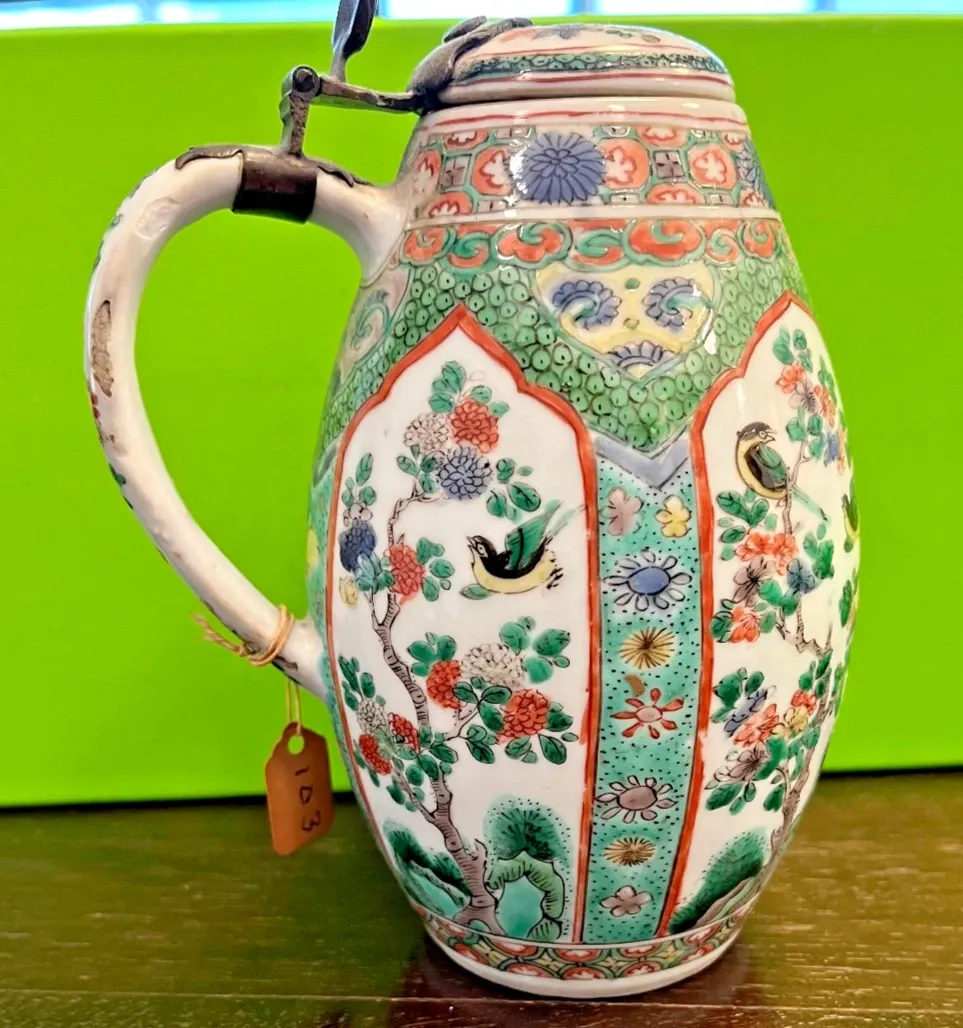
Here we have a Chinese export porcelain tankard in the famille verte palette, created in the late 19th to early 20th century in conscious revival of Kangxi-period taste. The shape is unmistakably European—a cylindrical drinking vessel with handle and hinged lid—while the decoration of birds among flowering branches and ornamental banding reflects the enduring appeal of early Qing export designs. The enamels appear hand-painted, and the base shows a smooth glazed interior with slight orange-peel texture and a small firing spot, features compatible with later Qing production. The unmarked base and the overall surface character support a revival dating rather than an early 18th-century origin. The grey metal mounts, likely pewter, exhibit oxidation and darkened patina. Such fittings were commonly applied in Europe, and without close inspection of attachment points or metal marks, their exact period relationship to the porcelain cannot be conclusively determined. As a decorative and historically evocative object, it represents the continued Western fascination with Kangxi-era export porcelain and the cross-cultural dialogue embodied in these hybrid forms. In today’s market, examples of this later revival type typically fall in the $150–$400 auction range, with substantially higher results reserved for securely documented Kangxi-period pieces with period mounts.
Used for this report's TTS and avatar presentation.
Item Report
Chinese Export Famille Verte Porcelain Tankard with Pewter Mounts
中国外销五彩瓷带锡镴盖执壶形酒杯
Merge Reports: Yes (reconciled). Approval remains manual.
By: Unknown
Style: Chinese export porcelain, Qing revival style, famille verte decoration, European market form
Origin: China, made for export to Europe
Materials: Porcelain, overglaze enamels (famille verte palette), pewter or pewter-alloy mounts
Age: Late 19th to early 20th century, in the Kangxi revival taste
Condition: Good (minor foot abrasion and dirt accumulation; oxidation and patina to mounts; no major cracks visible)
Value: Auction estimate: approximately $150–$400 as a later Qing-revival export example; if conclusively documented as early 18th century with period mounts, values for comparable examples have reached approximately $800–$1,800
Peer-Reviewed Market Values
- Dating Range
- Pending structured dating
- Auction Liquidation
- Pending structured market values
- Fair Market Value
- Pending structured market values
- Replacement Value
- Pending structured market values
- Comparables Used
- No saved comparables yet
- Research Confidence
- Not Run
Peer review completed, but this run did not return structured market value ranges.
Maker's Marks / Writing: No reign mark or maker's mark visible on the base. A small brown tag marked '163' appears to be an inventory label.
Date: 2026-04-17 18:19:49.808650
Description:
A Chinese export porcelain tankard of European form, decorated in a famille verte palette with birds among flowering branches within shaped reserves and geometric banding. The cylindrical body is fitted with a handle and mounted with a grey metal hinged lid and thumbpiece, consistent with pewter or a pewter-alloy. The decoration appears hand-painted in overglaze enamels. The foot rim shows minor abrasion and accumulated dirt, and the mounts display dark oxidation and patina consistent with age. 此件为中国外销瓷器,器形仿欧洲带柄带盖酒杯(tankard),通体以五彩设色,开光内绘花枝小鸟纹,并饰几何与花卉纹带。器身呈圆筒形,配有把手,并加装灰色金属铰链盖与拇指扳片,材质应为锡镴或类似合金。釉上彩绘应为手工绘制。足缘可见轻微磨损与积垢,金属构件表面呈现氧化与深色包浆,符合其使用年代特征。
Curator Questions
Curated by Jade
Assessment:
This object is a Chinese export porcelain tankard decorated in a famille verte palette and formed in a distinctly European drinking vessel shape with hinged lid and handle. The painted birds, flowering branches, and ornamental banding consciously echo Kangxi-period export wares of the late 17th and early 18th centuries. However, the base finish, the evenness of the glaze, the character of the enamels, and the absence of a reign mark all support a later production date in the late 19th to early 20th century, created in revival of earlier Qing export styles. The grey metal lid, hinge, and thumbpiece—likely pewter or a related alloy—show oxidation and patina. Such mounts were frequently added in Europe, sometimes at the time of import and sometimes later. From the available views, the relationship between porcelain and mounts appears functional but does not conclusively establish whether they are original to the first export sale. Overall, the safest attribution is a late Qing revival Chinese export famille verte tankard made for the European market, rather than a firmly Kangxi-period example. It remains an attractive example of cross-cultural decorative arts reflecting Western forms interpreted through Chinese ceramic craftsmanship. 此器为中国外销五彩瓷带盖执壶形酒杯,器形为典型欧洲饮用器造型,配有铰链盖与把手。花鸟与纹饰布局明显借鉴康熙时期(十七世纪末至十八世纪初)外销瓷风格。然而,其底部施釉状态、釉面均匀度、彩料质感以及无款特征,更支持其为十九世纪末至二十世纪初仿康熙风格之作品。 灰色金属盖、铰链与拇指扳片应为锡镴或类似合金,表面呈现氧化与包浆。此类金属构件常于欧洲加装,或在初次进口时配置,或稍后添配。仅凭现有图像,尚无法最终确认金属构件是否与瓷身同时期安装。 综合判断,应定为晚清仿康熙风格的中国外销五彩瓷酒杯,而非可确证为康熙本朝原制之例。其仍为一件体现中西交流背景下陶瓷工艺的优雅实例。
Individual Images:
- whole tankard front
- whole tankard reverse
- overhead tankard
- detail of hinge and handle
- base of tankard
Provenance:
No documented provenance provided.
Condition:
Good (minor foot abrasion and dirt accumulation; oxidation and patina to mounts; no major cracks visible)
Identification Score: 92%
The European tankard form, famille verte overglaze decoration, export-oriented shape, and comparative market examples strongly support identification as a Chinese export porcelain tankard in revival Kangxi taste. Uncertainty remains only regarding the exact period of the mounts and the precise dating within the late Qing revival window. 欧洲酒杯式器形、五彩釉上彩装饰、面向欧洲市场的造型,以及拍卖对比实例,均有力支持其为仿康熙风格的中国外销瓷酒杯。主要不确定因素仅在于金属构件的具体时期及晚清仿制范围内的精确断代。
Authenticity Score: 70%
The porcelain body, enamels, and construction are consistent with genuine late 19th to early 20th century Chinese export production in a Kangxi revival style. Surface wear, minor abrasion at the foot, and oxidation to the mounts support age. However, without physical examination—particularly of the enamel surface, glaze texture, and mount attachments—absolute confirmation of period and originality of the metal fittings cannot be made from photographs alone. 瓷胎、釉上彩及整体制作特征,与十九世纪末至二十世纪初仿康熙风格的中国外销瓷相符。足缘轻微磨损及金属构件氧化现象亦支持其年代感。然而,在未对彩料表面、釉质细节及金属连接结构进行实物检视前,仍无法仅凭照片完全确认其具体年代及金属构件是否原配。
Image Memory Note
Five images reviewed showing full views, mount details, and base. 共审阅五张图像,包括整体、金属细节与底部照片。
Keywords
Chinese export porcelain, famille verte, Qing revival, tankard, pewter lid, European form, birds and flowers, mounted porcelain 中国外销瓷, 五彩, 晚清仿古, 带盖酒杯, 锡镴盖, 欧洲器形, 花鸟纹, 镶嵌瓷器
Peer Review Summary
Peer Review
Key Visible Evidence
The object is clearly a European-form tankard with a handle, hinged lid, and thumbpiece (Images 1, 3, 4). The porcelain body is decorated with overglaze enamels in a palette consistent with *famille verte*, featuring birds among flowering branches within shaped reserves, and geometric/floral banding (Images 1, 2, 3). The painting appears hand-done. The metal mounts (lid, hinge, thumbpiece) are greyish, consistent with pewter or a similar alloy (Images 1, 3, 4), and show significant oxidation and dark patina. The porcelain handle exhibits some discoloration or wear where it joins the body (Image 1). The foot rim (Image 5) shows some dirt and minor abrasion, but the unglazed rim itself is relatively clean, and the glazed base interior is smooth with a slight orange peel texture and a small orange-brown firing spot. No reign or maker's mark is visible on the base (Image 5). A small brown tag with '163' is tied to the handle (Image 1).
Market and Source Support
The identification as a Chinese export porcelain tankard with *famille verte* decoration is well-supported by numerous comparables. The range of comparables, including Kangxi period examples with and without mounts (Rank 1, 2, 4) and 19th-century examples (Rank 3, 5), validates the report's assessment of stylistic emulation and the significant value differential between early 18th-century and later revival pieces. The report's cautious dating to 'late 19th to early 20th century, in the Kangxi revival taste' is consistent with the visual evidence and the market presence of later export wares emulating earlier styles, especially given the lack of a reign mark.
Needs Verification
1. **Exact Dating of Porcelain Body**: While the report's 'late 19th to early 20th century, in the Kangxi revival taste' is a reasonable assessment, definitively ruling out an earlier 19th-century date or a genuine Kangxi body with later mounts (as the report considers) requires further evidence. Specific evidence needed: UV light examination of the porcelain body to check for repairs or differences in glaze/enamel application, and macro photography of the enamel surface for precise pigment characteristics and firing details. 2. **Originality and Period of Mounts**: The report correctly identifies uncertainty regarding the mounts being 'later or possibly contemporaneous' and 'European additions, either period or later.' To verify this, detailed close-up images of the attachment points of the pewter to the porcelain, including any pins, rivets, or solder joints, would be crucial. Examination of the underside of the lid and hinge for maker's marks or hallmarks on the metal would also be beneficial. 3. **Material of Mounts**: The report states 'pewter or pewter-alloy mounts.' While visually consistent, a non-destructive material analysis (e.g., XRF) would confirm the exact composition. 4. **Nature of Foot Rim Wear**: The 'visible age-related wear to the foot' (Image 5) is present as dirt and minor abrasion. Distinguishing natural long-term wear from potential artificial aging or simple accumulation of grime requires tactile inspection and possibly cleaning.
Audit Conclusion
The report accurately identifies the object as a Chinese export porcelain tankard with *famille verte* decoration and European-style metal mounts. The visible evidence strongly supports the *famille verte* palette, European tankard form, and the presence of metal mounts. The report's cautious dating to the 'late 19th to early 20th century, in the Kangxi revival taste' is a well-reasoned assessment, given the lack of a reign mark and the overall appearance of the porcelain and enamels, which are consistent with later export production emulating earlier styles. The report correctly flags the uncertainty regarding the originality and period of the pewter mounts, acknowledging they could be later European additions. The value estimate appropriately reflects the significant difference between an 18th-century piece with period mounts and a later revival example. The audit finds the report's claims to be largely grounded in visible evidence and appropriately qualified where uncertainty exists, with specific requests for additional evidence to resolve remaining ambiguities.
Comparables (Similar Items)
No archived comparables matched this report yet.
Share: