Premium upgrade: Monique delivers your appraisal as a guided podium narration with synced visuals and voiceover.
Output is a narrated, animated slideshow with video intro and outro, sandwiching the autoplay voiceover sequence in actual video.
French Empire Period Gilt Bronze Mantel Clock with Putto and Dog
LANGUAGE UNLOCK
Glossary Roundup
Original Presentation Script
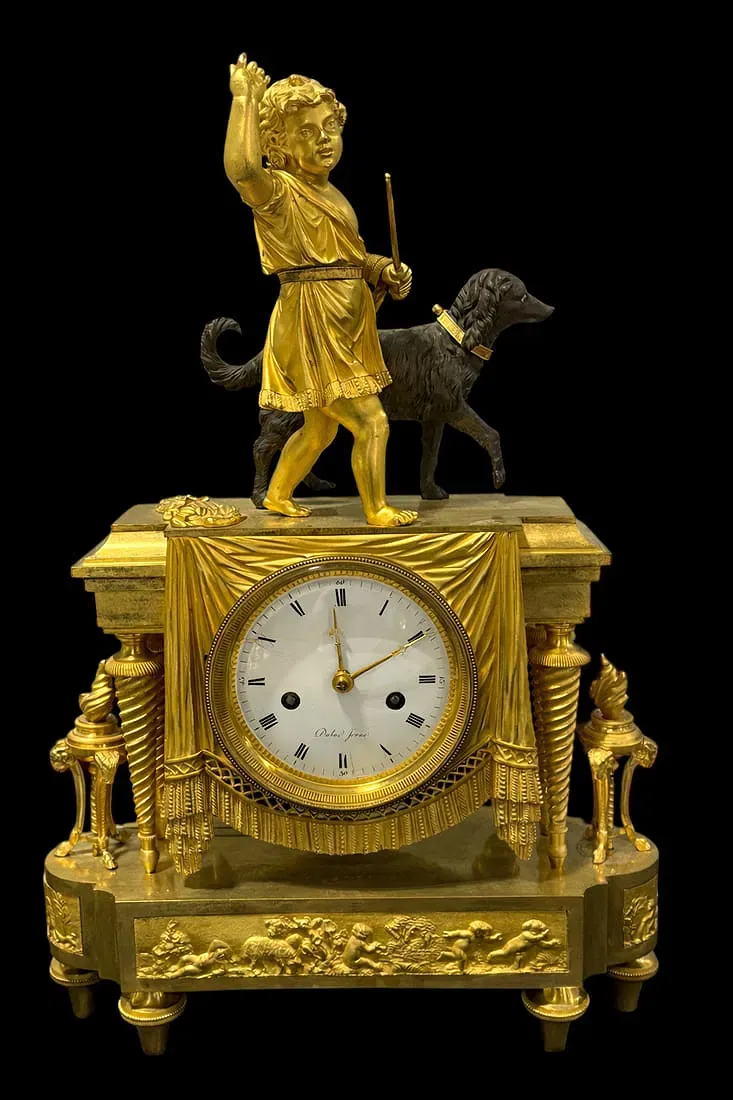
Let me introduce a quintessential object of Napoleonic taste: a French Empire period gilt bronze mantel clock, crowned by a charming putto leading a faithful dog.
This is not merely a timekeeper—it is a sculptural statement from the first decades of the 19th century, when France embraced classical symbolism as an expression of order, virtue, and imperial ambition. The child and dog motif speaks quietly of loyalty and guidance, themes beloved during the Empire.
The clock is executed in richly fire-gilt bronze, with deep, warm gilding that only mercury gilding can produce. Note the crisp chasing in the drapery, the twisted columns, and the animated frieze of frolicking putti along the base. The white enamel dial is proudly signed “Dubuc jeune,” a known Parisian clockmaker of the period.
Condition is very good for its age. There is honest wear to the gilding and minor losses—exactly what one hopes to see rather than a suspiciously pristine surface. The movement strikes on a bell and appears correct to the case.
A word about copies.. Empire clocks are among the most frequently reproduced French antiques. Fortunately, this example shows the right weight, patina, and sculptural confidence to stand apart from later imitations.
I would place its authenticity at about 70 percent, with a conservative auction estimate of $12,000 to $18,000 if confirmed period. A later reproduction would fall dramatically lower. A handsome survivor of France’s golden age of bronzes—elegant, symbolic, and quietly authoritative.
Used for this report's TTS and avatar presentation.
Item Report
French Empire Period Gilt Bronze Mantel Clock with Putto and Dog
Condition:Very Good (age-appropriate wear to gilding, minor losses, movement visible; not recently over-restored)
Value:If authentic: USD 12,000–18,000 at auction. If later reproduction: USD 1,000–2,500 at auction.
Maker's Marks / Writing:Dial signed 'Dubuc jeune'; stamped numbers visible on movement plate
Date:2026-02-05 01:19:08.109728
Description:
A finely cast and fire-gilt bronze (ormolu) French mantel clock surmounted by a classical putto holding a baton and leading a dog, symbolizing fidelity. The architectural case features draped motifs, twisted columns, paw feet, and a relief frieze of playing putti. The white enamel dial with Roman numerals is signed 'Dubuc jeune', a Parisian clockmaker active in the early 19th century. The movement strikes on a bell and is housed within a robust Empire-period case of high-quality gilding and crisp chasing.
Curator Questions
Curated by Jade
Assessment:
This is a high-quality French Empire period mantel clock displaying excellent sculptural modeling, deep mercury gilding, and a signed Paris dial. The iconography, materials, and construction are consistent with early 19th-century French production. Minor wear and small losses are commensurate with age and do not detract significantly from value. A word about copies.. Empire clocks are heavily reproduced, often with bright modern gilding and unsigned dials; this example shows convincing period patina, correct proportions, and an appropriate movement, supporting its authenticity.
Individual Images:
whole clock front view
whole clock door open
side view left
back of clock movement
side view right
upper sculptural group
detail of dog and putto base
detail of dial hairline
detail of dial signature
detail of column and foot
detail of bell and movement
detail of stamped numbers
Provenance:
No documentary provenance provided
Condition:
Very Good (age-appropriate wear to gilding, minor losses, movement visible; not recently over-restored)
Identification Score: 95%
The form, Empire iconography, signed Paris dial, and movement layout strongly support identification as a French Empire mantel clock by Dubuc jeune.
Authenticity Score: 70%
The clock shows period-correct materials, wear, patina, and a signed dial consistent with early 19th-century Paris work. While Empire clocks are widely reproduced, the quality of casting, mercury gilding tone, and movement details argue for an authentic period piece rather than a modern copy.
Image Memory Note
None
None
Keywords
French Empire mantel clock, ormolu clock, Dubuc jeune, Paris clockmaker, gilt bronze clock, early 19th century France
The report was edited after initial Artmink draft. Original AI draft preserved in Artmink audit history.

Share: