Premium upgrade: Jade delivers your appraisal as a guided podium narration with synced visuals and voiceover.
Output is a narrated, animated slideshow with video intro and outro, sandwiching the autoplay voiceover sequence in actual video.
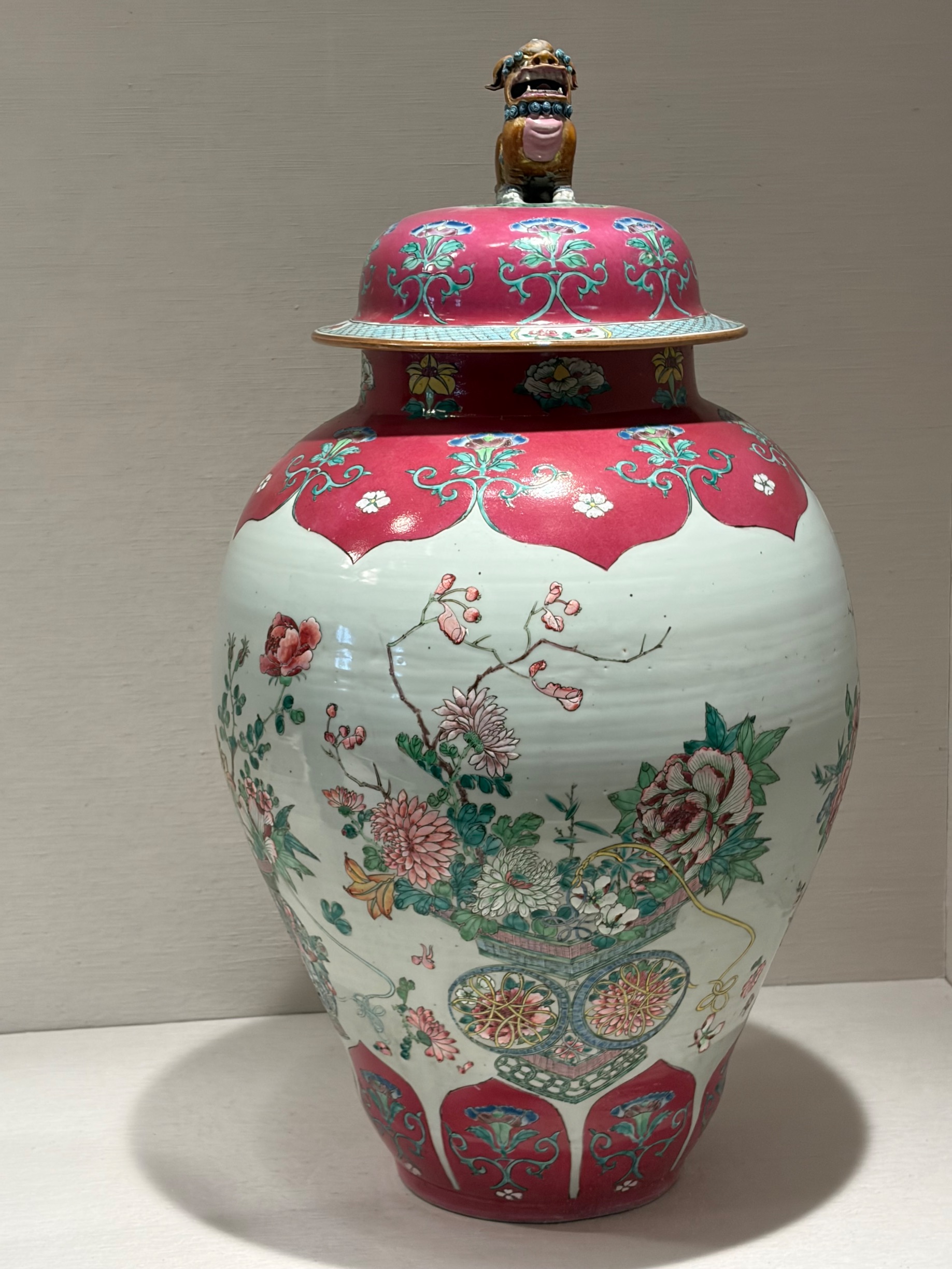
Chinese Famille Rose Style Porcelain Covered Temple Jar with Buddhist Lion Finial中国粉彩风格瓷盖罐,狮钮盖
LANGUAGE UNLOCK
Glossary Roundup
Original Presentation Script
Here we have a Chinese famille rose style porcelain covered temple jar, the sort of object designed to look grand, auspicious, and just a little theatrical. The baluster body, domed lid, and lion finial all quote the language of Qing decorative porcelain, especially export and revival wares that prized bright color and lavish floral ornament.
The decoration centers on blooming flowers and a wheeled basket arrangement, motifs associated with abundance, elegance, and cultivated prosperity. At first glance, it gestures toward 18th-century famille rose. But this is where connoisseurship earns its tea.
Look closely at the surface: the pink ground is very even, the enamels are glossy and rather uniform, and the painted flowers feel more decorative than deeply hand-modeled. The lion finial, while charming, is a little stiff in modeling. Those are important clues. Genuine Qing pieces typically show more nuanced enamel pooling, kiln softness, and a greater sense of painterly spontaneity.
Condition appears fairly solid from the visible angles, with light wear, a few minor imperfections, and some small firing specks, but no dramatic age-related damage is obvious from these photographs. We are missing the underside, which is critical for a firmer dating call.
So my reading is: a later 20th-century Chinese famille rose style decorative jar, not a Qing period one. I’d place the authenticity score around 28%. Conservatively, I’d expect an auction result around $300 to $700 as a decorative piece. If it were truly Qing period, the value gap would be immense, reaching well into the many-thousands range. In short: handsome, charming, and historically inspired—but not imperial thunder in a porcelain teacup.
Used for this report's TTS and avatar presentation.
Item Report
Chinese Famille Rose Style Porcelain Covered Temple Jar with Buddhist Lion Finial
中国粉彩风格瓷盖罐,狮钮盖
By:Unknown
Style:Chinese Export-inspired Famille Rose Style Porcelain
Origin:China
Materials:Porcelain, overglaze famille rose enamels, molded porcelain finial
Age:Likely late 20th century, circa 1975-2000
Condition:Very Good (minor surface wear and small enamel imperfections visible; underside not shown)
Value:Auction estimate: as a later decorative Chinese famille rose style jar, $300-$700; if it were an authentic 18th-century Qing famille rose covered jar of comparable size and quality, the value could be many thousands to tens of thousands of dollars, potentially $8,000-$25,000+ depending on mark, provenance, condition, and quality.
Maker's Marks / Writing:No maker's mark or writing visible in the provided images.
Date:2026-04-14 13:27:38.477333
Description:
Large baluster-form covered porcelain jar decorated in famille rose enamels with floral sprays and a wheeled flower basket on a pale ground, with deep pink bands and a molded Buddhist lion finial on the domed cover. The decoration borrows from Qing export and courtly famille rose vocabulary, but the glossy surface, even finish, and slightly mechanical painting suggest a later decorative production rather than an 18th-century period example.
大型鼓腹带盖瓷罐,器身以粉彩绘花卉折枝与花篮纹,浅色地,上下饰浓玫红色边饰,拱形盖顶塑佛狮钮。其装饰借用了清代外销瓷与宫廷粉彩的图案语言,但釉面较亮、表面处理均匀、绘画略显程式化,更像后期装饰性制品,而非十八世纪本朝器。
Curator Questions
Curated by Jade
Assessment:
This appears to be a Chinese famille rose style covered jar made as a decorative object in the later 20th century, probably drawing on Qing dynasty rose-enameled prototypes. The form is convincing at a glance, but the strong uniform pink ground, glossy enamel surface, simplified floral handling, and somewhat stiff lion finial all point away from an 18th-century imperial or export period piece. The close details show some minor wear and small firing specks, but not the nuanced age, glaze character, or hand refinement one would expect from a genuine Qing period example.
这件器物应为一件中国粉彩风格带盖大罐,属于二十世纪后期的装饰性作品,明显借鉴了清代粉彩器的样式。其整体器形初看颇具古意,但玫红地色过于统一、釉上彩过亮、花卉描绘较简化,且狮钮造型略显生硬,这些特征都不支持其为十八世纪官窑或外销时期真品。细节图可见轻微使用磨损与少量烧造黑点,但缺乏真正清代瓷器常见的釉质层次、自然老化感与精细手工气息。
Individual Images:
whole jar front
detail of floral painting
detail of lid border
detail of lion finial
Provenance:
No provenance information provided or visible in the images.
Condition:
Very Good (minor surface wear and small enamel imperfections visible; underside not shown)
Identification Score: 94%
The covered jar form, famille rose palette, domed lid, and lion finial are all clearly visible and consistent with a Chinese decorative covered temple jar or ginger-jar type vessel. Confidence is high on object type and stylistic family, though exact dating is necessarily approximate from photos alone.
从器形、粉彩设色、拱形盖以及狮钮来看,这是一件中国风格的带盖大罐或庙罐类型器物,判断较为明确。对于器物类别与风格归属,我有很高把握;但仅凭照片,具体断代仍只能作相对保守的估计。
Authenticity Score: 28%
The strongest evidence against Qing-period authenticity is the highly even glossy finish, the bright and uniform pink ground, the somewhat formulaic floral painting, and the molded lion finial, which lacks the sharper sculptural authority and kiln character expected of an 18th- or 19th-century example. Visible minor wear does not read as deep age patina. With no base mark or underside shown, a period attribution cannot be supported.
不支持清代本朝真品判断的最主要依据,是其过于均匀而发亮的表面、鲜艳且一致的玫红地色、程式化较强的花卉绘画,以及狮钮塑造缺乏十八至十九世纪器物应有的雕塑力度与窑烧气息。虽可见轻微磨损,但并未呈现深厚自然的岁月包浆。由于未见底足与款识,也无法支持本朝断代。
Image Memory Note
None
None
Keywords
Chinese porcelain jar, famille rose style, covered temple jar, lion finial, floral decoration, pink ground, decorative porcelain, China
中国瓷罐, 粉彩风格, 带盖庙罐, 狮钮, 花卉纹饰, 胭脂红地, 装饰瓷, 中国
The report was edited after initial Artmink draft. Original AI draft preserved in Artmink audit history.

Share: