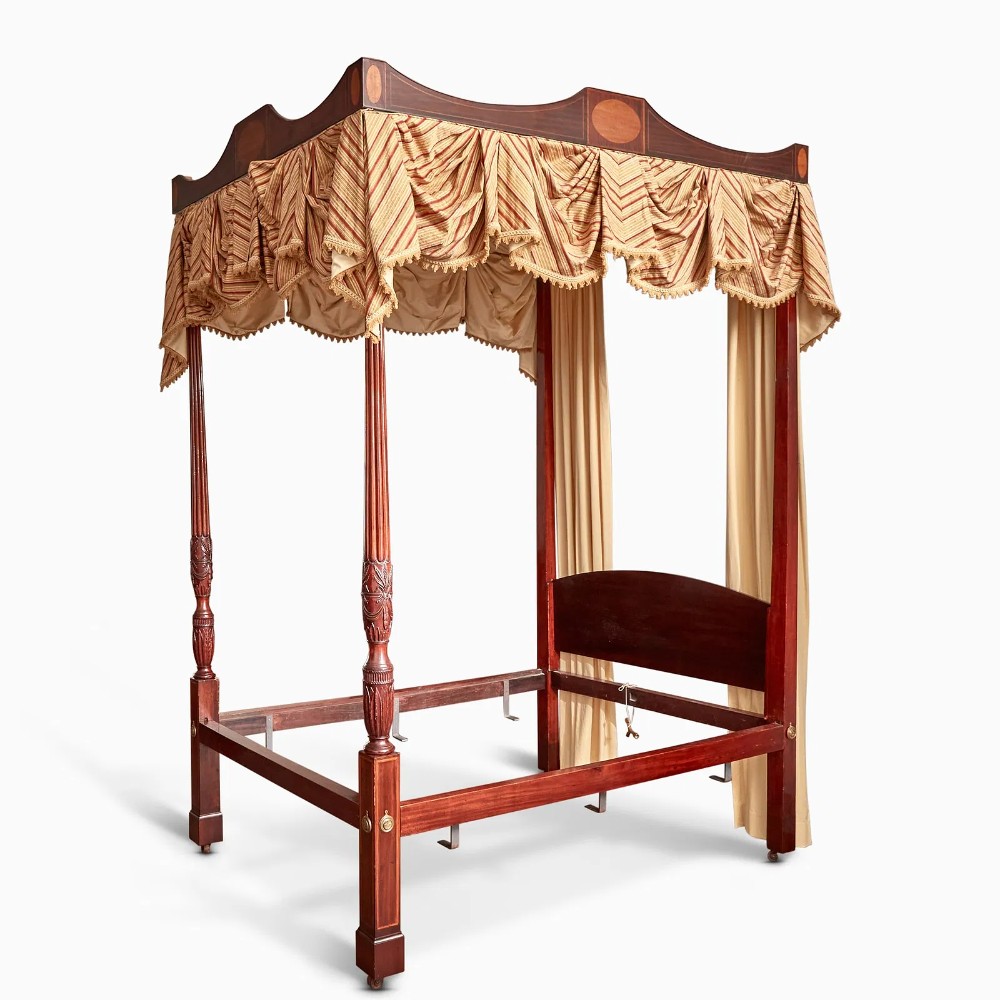
American Federal Period Mahogany Tester Canopy Bed
LANGUAGE UNLOCK
Glossary Roundup
Original Presentation Script
What we have here is a stately American Federal Period mahogany tester canopy bed — the kind of architectural furniture that transforms a bedroom into a temple of neoclassical taste. With its soaring posts and shaped tester crown, this bed was designed not merely for sleep, but for ceremony.
Dating to roughly 1800 to 1820, it reflects the young American republic’s fascination with classical antiquity. The carved swags, fluting, and stylized leaf motifs echo Greco-Roman ornament filtered through the refined lens of Federal design. This was the era of symmetry, proportion, and cultivated restraint.
The mahogany — likely imported from the Caribbean — was the luxury wood of choice. Note the depth of color and the softened edges of the carving; these details suggest hand workmanship and genuine age. The brass rosette mounts display a mellow patina consistent with early 19th-century hardware. The canopy fabric, however, is a later addition — which is common and expected.
Condition is very good, with honest surface wear and no alarming structural issues visible. These beds were often updated over generations, and that history is part of their charm.
A word about copies.. Federal-style canopy beds were widely reproduced in the late 19th and 20th centuries. However, the carving quality, proportion, and surface aging here support authenticity. I would place the authenticity confidence at around 80%.
At auction, a genuine example like this would likely achieve between $3,000 and $6,000. A later reproduction would bring under $1,500. A grand survivor from America’s early classical age — dignified, architectural, and quietly impressive.
Used for this report's TTS and avatar presentation.
Item Report
American Federal Period Mahogany Tester Canopy Bed
By:Unknown
Style:Federal Period (Neoclassical)
Origin:United States
Materials:Mahogany (primary wood), brass mounts, later fabric canopy and hangings
Age:Circa 1800–1820
Condition:Very Good (minor surface wear, later canopy fabric, structurally sound)
Maker's Marks / Writing:No visible maker's mark observed.
Date:2026-04-08 22:08:24.550234
Description:
A carved mahogany four-poster tester bed with shaped canopy, fluted and foliate-carved posts, classical swag and leaf motifs, and brass rosette mounts. The bed retains a decorative fabric tester surround and shows refined neoclassical detailing typical of the early American Federal era.
Curator Questions
Curated by Jade
Assessment:
This appears to be an early 19th-century American Federal period tester bed in mahogany, exhibiting strong neoclassical carving and appropriate brass hardware. The carved swags, fluting, and leaf motifs align with classical revival tastes of the period. Surface wear, softened carving edges, and patina on the brass mounts support age. The canopy fabric is clearly later. Overall, the bed presents as an authentic period piece rather than a modern reproduction.
Individual Images:
whole canopy bed
detail of carved swag post
detail of fluted carving
detail of brass rosette mount
detail of carved leaf motif
detail of lower post carving
Provenance:
No provenance documentation provided.
Condition:
Very Good (minor surface wear, later canopy fabric, structurally sound)
Identification Score: 95%
The form, proportions, carved neoclassical motifs, and tester canopy structure clearly identify this as a Federal period tester bed.
Authenticity Score: 80%
Hand-carved details show slight asymmetry and age-related softening. Brass rosettes exhibit appropriate patina. Finish shows wear consistent with 19th-century use. While revival beds exist, the carving quality and surface aging strongly support period authenticity.
Image Memory Note
None
None
Keywords
American Federal Period Mahogany Tester Bed, Neoclassical, four-poster bed, carved posts, brass rosettes, United States
The report was edited after initial Artmink draft. Original AI draft preserved in Artmink audit history.


Share: