American Victorian Revival Oak Lion-Paw Pedestal Dining Table
LANGUAGE UNLOCK
Glossary Roundup
Original Presentation Script
No narration for this appraisal report
Used for this report's TTS and avatar presentation.
Item Report
American Victorian Revival Oak Lion-Paw Pedestal Dining Table
By:Unknown factory production
Style:Victorian Revival / Golden Oak inspired
Origin:United States
Materials:Solid oak (likely red oak), machine-turned pedestal, carved oak legs with lion-paw terminals
Age:Circa 1970–1990 (revival of c.1895–1910 forms)
Condition:Very good (light surface wear and scuffs; finish appears later; joints look stable)
Value:USD $150–$400 at auction
Maker's Marks / Writing:No maker’s label, stamp, or writing visible in the photo.
Date:2025-10-05 22:55:41.383296
Description:
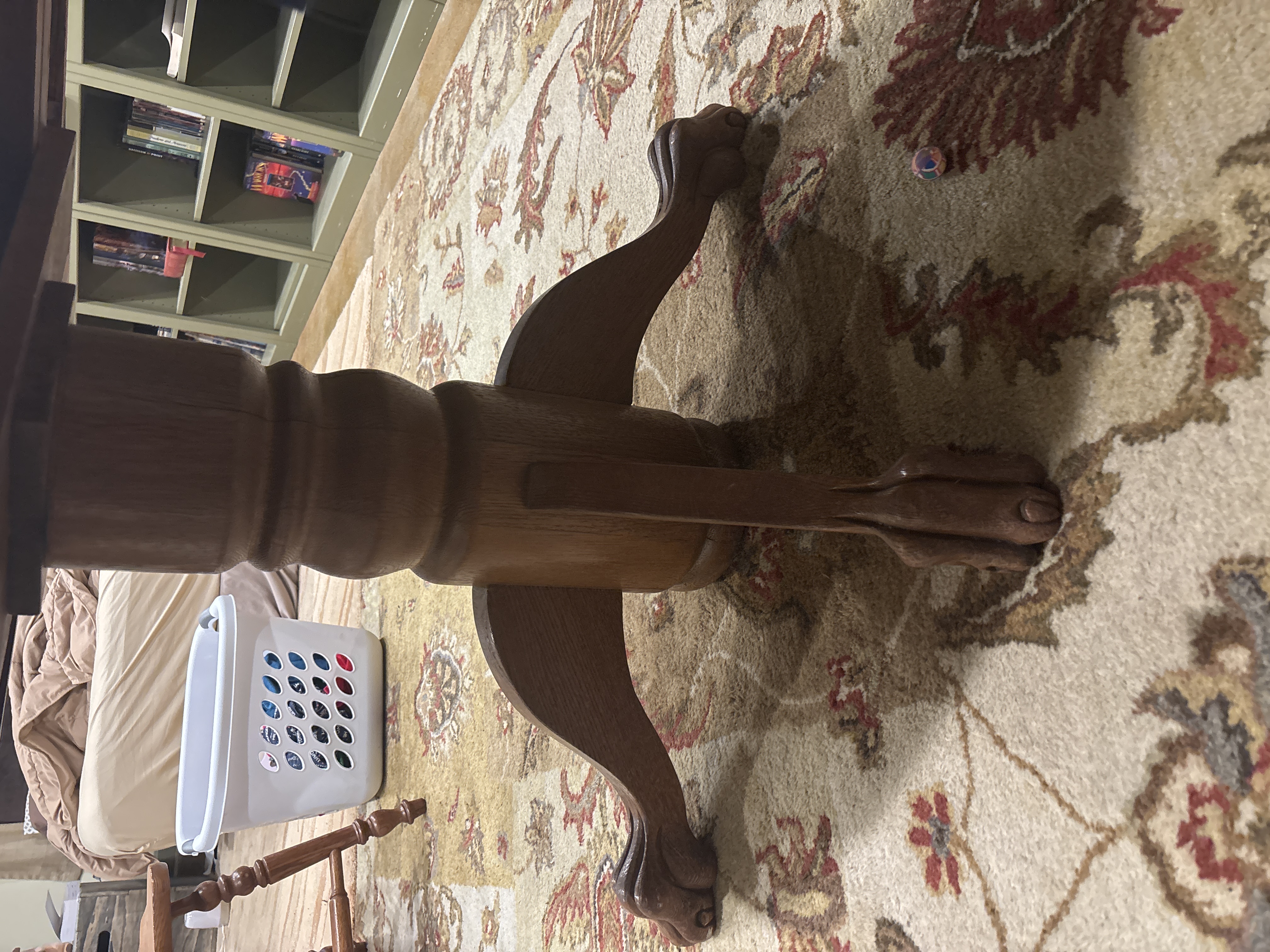
Single turned pedestal dining table of oak with four splayed legs terminating in carved lion-paw feet. The pedestal is machine-turned with ringed balusters; legs are thick, scroll-kneed, and end in stylized three-toed paws. The oak shows a medium stain and semi-gloss finish. Overall form follows late 19th–early 20th century American ‘Golden Oak’ patterns, though execution and finish suggest a later revival production.
Curator Questions
Curated by Jade
Assessment:
This appears to be a later 20th-century revival of the classic American Golden Oak claw- or lion-paw pedestal dining table, not an 1890–1910 period example. Indicators include the uniform machine turning, comparatively simplified paw carving, absence of casters often seen on period bases, and a modern-looking polyurethane-type finish. As a decorative, sturdy dining table it remains desirable for everyday use, but period collectors value original circa-1900 examples more highly. A word about fakes.. the oak-claw pedestal category is heavily reproduced; many modern pieces mimic late Victorian patterns while lacking the hand-carved crispness, deep patina, oxidation, and hardware typical of genuine circa-1900 tables.
Individual Images:
whole item
Provenance:
No provenance provided.
Condition:
Very good (light surface wear and scuffs; finish appears later; joints look stable)
Identification Score: 90%
The turned central column, four splayed legs, and lion-paw terminals clearly identify it as a Golden Oak–type pedestal dining table; the exact maker is uncertain, but the form is unmistakable.
Authenticity Score: 25%
Low likelihood of being a circa-1900 period piece: carving is simplified and consistent across legs, turning is very uniform, finish looks modern, and no casters or old hardware are visible. Without period joinery evidence or maker’s label, it is safest to treat this as a late 20th-century revival.
Image Memory Note
Photo shows the underside/base of a round (or possibly oval) dining table with a single, substantial turned oak pedestal. The pedestal has ring turnings and a visible glue seam running vertically. Four legs appear to radiate from the pedestal; two curved, scroll-kneed legs are clearly visible to left and right, each ending in a carved lion-paw foot (three rounded toes with nail details). The leg facing the camera appears more linear in profile but terminates in a similar paw; likely perspective makes it appear straighter. Wood grain indicates oak with medium brown stain and semi-gloss finish. No brass casters or metal feet are visible. No labels, stamps, or writing can be seen on the pedestal or legs. Wear: minor scuffs to toes and edges of feet; light handling wear overall; no cracks or breaks noted. Surroundings include a patterned rug, shelving, a laundry basket, and a bed; no additional parts or leaves are visible. Notable design elements: lion-paw terminals, scroll knees, ring-turned baluster pedestal, uniform machine carving, and modern-looking clear coat.
Keywords
American, Victorian Revival, Golden Oak, lion paw feet, pedestal dining table, oak table, 20th-century furniture
The report was edited after initial Artmink draft. Original AI draft preserved in Artmink audit history.

Share: