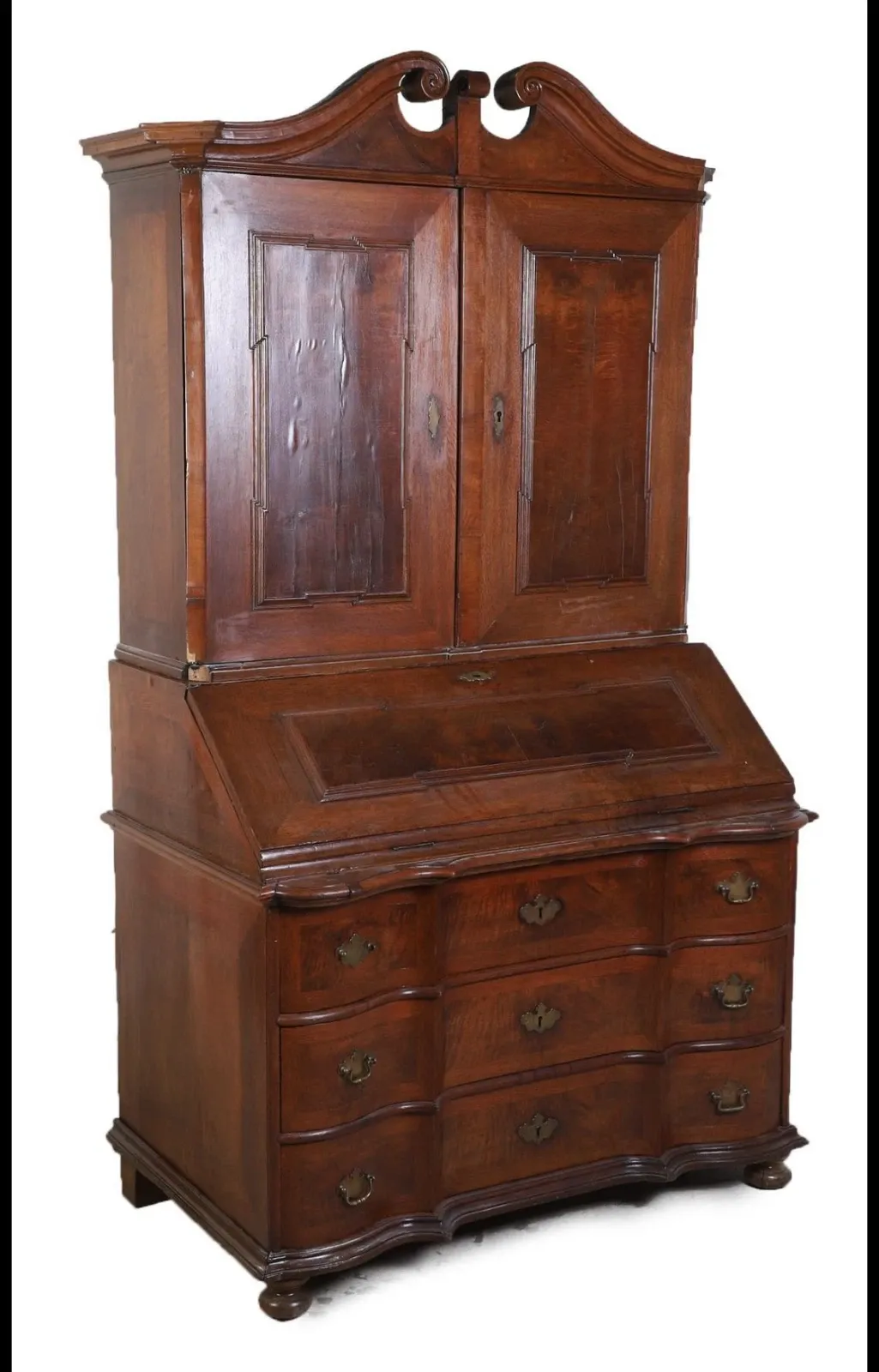
Let’s take a look at this commanding Continental Baroque Style Walnut Slant‑Front Secretary Bookcase — the kind of piece that turns a home office into a stage set.
We have a classic two-part form: a cupboard top with paneled doors and a dramatic broken-scroll pediment, over a slant-front writing desk resting on a voluptuous serpentine chest of drawers. It’s straight out of the Baroque playbook, a style that swept through Germany and the Low Countries in the late 17th and early 18th centuries.
Open it up and the interior tells a story of paperwork and power: tiers of pigeonholes, small drawers, and a generous writing surface, all in warm walnut over softwood. The workmanship is competent and attractive, but the regular dovetails, machine-sawn boards, and standardized interior drawers reveal a later hand — a 19th-century workshop paying homage to an earlier century.
Condition is honest: surface wear, shrinkage, oxidation, and a scattering of repairs and reinforcement plates around the fall-front and case corners. These don’t ruin the piece; they simply say “I’ve worked for a living.”
In authenticity terms, this is not a 1600s grandee’s original, but a Baroque Revival interpretation. I’d place authenticity as a true period Baroque at around 25%, and as a circa 1880–1910 revival at about 75%.
On today’s market, I’d expect this to fetch roughly $1,200–$2,500 at auction. In a stylish interior, however, it delivers far more than that in atmosphere — a little theatre of bureaucracy from another age.
Used for this report's TTS and avatar presentation.
Origin:Continental Europe (likely Germany or the Low Countries)
Materials:Walnut and walnut veneer over softwood (pine or fir) carcass; brass or brass-plated hardware; iron hinges and locks
Age:Circa 1880–1910 (made in 18th-century Baroque style)
Condition:Good (age-consistent wear, repairs to hinges and case edges, oxidation and finish wear but structurally serviceable)
Value:If authentic late 17th–early 18th century Baroque: US $6,000–$12,000 at auction. As a late 19th–early 20th century Baroque Revival secretary bookcase (which the evidence strongly suggests): US $1,200–$2,500 at auction, depending on venue and restoration.
Maker's Marks / Writing:No maker’s mark or inscription visible in the provided images.
Date:2025-12-08 01:27:10.086884
Description:
Tall two-part secretary bookcase with upper cabinet doors and slant-front writing surface over a serpentine three-drawer base. The broken-scroll pediment, paneled doors, boldly serpentine drawer fronts, bun feet, and interior of small drawers and pigeonholes all follow late 17th–early 18th century Continental Baroque prototypes. Casework appears in walnut and walnut veneer over a softwood carcass, with later brass handles and various repairs and reinforcements.
Curator Questions
Curated by Jade
Assessment:
Impressive Baroque-style walnut secretary bookcase with strong architectural presence and generous fitted interior. Construction details—relatively regular machine-cut dovetails, overall symmetry, standardized drawer linings, later screws and plates, and the general crispness of the serpentine drawer fronts—indicate a well-made late 19th–early 20th century revival piece rather than a true 17th/early 18th century original. The piece shows honest age, oxidation, and wear, with structural repairs to the fall-front hinges and case edges. A word about fakes.. Baroque case furniture is widely reproduced, and many pieces are sold as 1600s–1700s when they are later revivals like this one; buyers should be cautious about claims of very early dates. As a decorative, functional antique of good quality, it remains desirable to collectors of Continental furniture and offers excellent storage and display potential, though not museum-level rarity.
Individual Images:
none
Provenance:
Not provided.
Condition:
Good (age-consistent wear, repairs to hinges and case edges, oxidation and finish wear but structurally serviceable)
Identification Score: 90%
Form, construction, and ornament clearly identify this as a Continental Baroque-type secretary bookcase with serpentine base and broken-scroll pediment; small uncertainty only as to exact regional origin.
Authenticity Score: 25%
The style matches late 17th–early 18th century Baroque, but tool marks and joinery (relatively uniform dovetails, machine-sawn boards, standardized drawer construction, later screws and plates) point to a late 19th–early 20th century Baroque Revival manufacture, not a true period piece.
Image Memory Note
None
None
Keywords
Baroque style secretary bookcase, Continental European furniture, walnut slant-front desk, serpentine chest, antique revival furniture, Germany, Low Countries
The report was edited after initial Artmink draft. Original AI draft preserved in Artmink audit history.


Share: