Jade : Chinese Fine and Decorative Arts
Jade Presents

Original Presentation Script
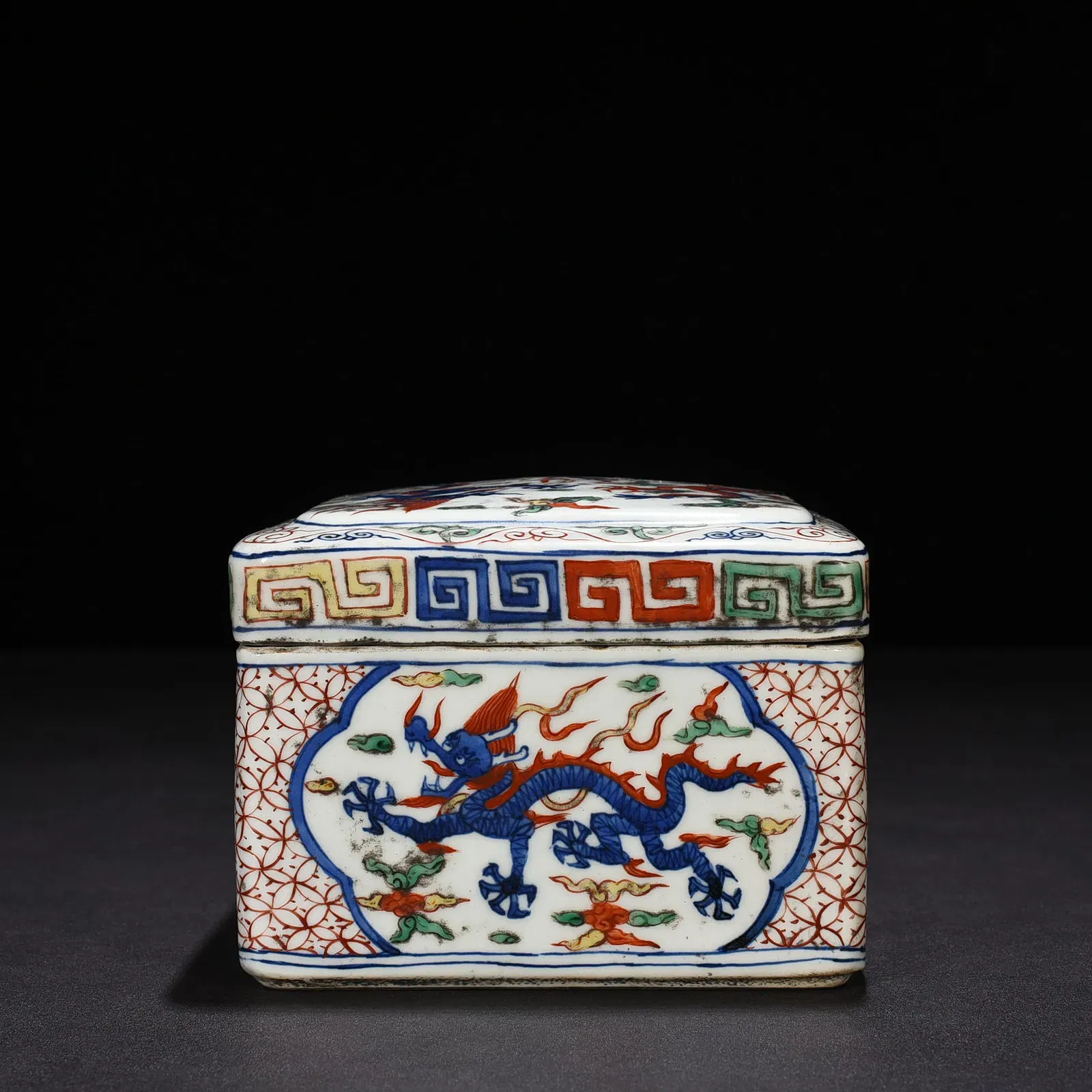
Here we have a Chinese Ming Style Wucai Porcelain Covered Box, a compact square form that borrows heavily from the visual language of early imperial wares. With its lively dragons, flame scrolls, and bold palette of cobalt blue, iron-red, green, and yellow, it certainly knows how to make an entrance. The big historical claim sits underneath: a Xuande mark, one of the most seductive names in Chinese ceramics. But that is precisely where caution begins. Genuine Xuande-marked pieces are rare, refined, and materially persuasive. This box, by contrast, feels more like an homage than a survivor. The porcelain body is neatly potted, but not with the elegance one expects from a 15th-century imperial object. The dragons are decorative rather than masterfully animated, and the surface shows suspicious darkened grime concentrated in seams, corners, and the base recesses — the sort of theatrical aging that often signals modern manufacture. Condition-wise, it shows rubbing, dirt accumulation, and some abrasions, but these do not read as naturally accumulated centuries of handling. Instead, they sit awkwardly on an otherwise relatively fresh-looking object. So, the verdict: likely a late 20th- or early 21st-century Chinese reproduction in Ming taste, with an authenticity score of 18%. Conservative auction estimate as a reproduction: $150 to $500. If it were genuinely of the Xuande period, we would be in an entirely different conversation — think $15,000 to $30,000 or more at auction. A handsome box, yes; a Ming treasure, very unlikely.
Used for this report's TTS and avatar presentation.
Item Report
Chinese Ming Style Wucai Porcelain Covered Box
中国明式五彩瓷盖盒
By: Unknown
Style: Ming Style Chinese polychrome porcelain
Origin: China
Materials: Porcelain with underglaze cobalt blue and overglaze enamel decoration
Age: Likely late 20th to early 21st century
Condition: Good (visible wear, grime, small edge abrasions; authenticity concerns)
Value: Auction estimate if authentic Ming Xuande period example: $15,000-$30,000; as a later Ming style reproduction: $150-$500
Peer-Reviewed Market Values
- Dating Range
- Pending structured dating
- Auction Liquidation
- Pending structured market values
- Fair Market Value
- Pending structured market values
- Replacement Value
- Pending structured market values
- Comparables Used
- No saved comparables yet
- Research Confidence
- Not Run
Peer review completed, but this run did not return structured market value ranges.
Maker's Marks / Writing: Blue four-character mark on base: 大明宣德 ('Da Ming Xuande' / 'Great Ming Xuande'). This appears apocryphal rather than period-correct.
Date: 2026-03-16 04:10:12.173040
Description:
Square porcelain covered box decorated in underglaze blue and overglaze iron-red, green and yellow enamels with opposing dragons amid flames and cloud scrolls. The lid and sides feature geometric borders and diaper grounds. The base bears a blue four-character Xuande mark, but the mark and the overall execution appear later and likely apocryphal. 一件方形瓷盖盒,采用釉下青花与釉上矾红、绿色及黄色彩绘装饰,盒身与盒盖绘有相对行龙、火焰纹与云气纹。盒沿与四壁饰几何回纹及锦地纹。底部有青花“大明宣德”四字款,但款识与整体工艺看起来较晚,极可能为后加寄托款。
Curator Questions
Curated by Jade
Assessment:
This appears to be a Chinese porcelain covered box made in the Ming taste, borrowing from wucai and doucai decorative vocabulary associated with dragon subjects and Xuande-era prestige. However, the object raises several concerns. The dragons are somewhat stiff and formulaic, the enamel palette looks fresh, and the artificially darkened seams, interior rim, and base show the kind of contrived 'buried dirt' effect often used to simulate age. The base carries a four-character mark reading 'Da Ming Xuande' (大明宣德, 'Great Ming Xuande'), but the calligraphy and presentation do not convincingly support a 15th-century dating. The body also lacks the refined potting, glaze character, and spontaneous painterly authority expected of a genuine imperial or even strong period piece. A word about copies.. Chinese marked porcelain is one of the most reproduction-heavy categories in the market, and Xuande references are especially favored by modern workshops because they lend instant prestige. My view is that this is most likely a modern decorative reproduction rather than a period Ming object. And that's etched in Jade..! 这件器物看起来是一件仿明代风格的中国瓷盖盒,借用了与龙纹题材及宣德时期声望相关的五彩 / 斗彩装饰语言。不过,此器存在多项疑点。龙纹造型较为僵硬程式化,彩料显得偏新,盒盖接缝、口沿内侧与底部可见的深色污迹也很像人为做旧中常见的“积垢”效果。底部青花四字款为“大明宣德”,但书法与呈现方式并不足以令人信服地支持其为十五世纪作品。器形胎釉与绘画气韵,也缺乏真正明代官窑或优质时期器应有的精致修胎、釉面质感与自然生动的笔意。A word about copies.. 在中国带款瓷器这一门类中,复制品与仿品极其常见,而“宣德”题款尤其常被现代作坊使用,以迅速赋予器物所谓皇家气息。综合判断,我认为这更可能是一件现代装饰性仿制品,而非真正的明代时期器。And that's etched in Jade..!
Individual Images:
- front porcelain box
- whole box three-quarter view
- reverse porcelain box
- side view porcelain box
- overhead porcelain box
- porcelain box open
- base with Xuande mark
Provenance:
No provenance documentation shown.
Condition:
Good (visible wear, grime, small edge abrasions; authenticity concerns)
Identification Score: 94%
The form, decoration, and mark clearly indicate a Chinese porcelain covered box in Ming revival taste; confidence is high on object type and decorative intent, though not on period authenticity. 根据器形、纹饰与款识判断,这是一件中国瓷质盖盒,明显带有仿明风格特征;对于器物类别与装饰意图的判断把握很高,但对其时代真实性并无同等把握。
Authenticity Score: 18%
Low score due to spurious Xuande mark, over-neat yet uneven modern-looking decoration, suspiciously artificial surface grime in recesses and seams, and lack of convincing Ming-period potting, glaze wear, and painterly sophistication. In keeping with strict fakery checks, I would treat this as a modern reproduction unless proven otherwise. 真实性评分较低,原因包括:宣德款极可能为寄托伪款;纹饰虽刻意追古但显出现代感;缝隙与凹处的污色颇似人为做旧;整体修胎、釉面磨损与绘画水平也不符合可靠明代器的特征。按照严格的辨伪标准,在没有进一步证据前,我会将其视为现代仿制品。
Image Memory Note
None None
Keywords
Chinese porcelain box, Ming style, wucai, covered box, dragon decoration, Xuande mark, apocryphal mark, reproduction, China 中国瓷盒, 明式, 五彩, 盖盒, 龙纹, 宣德款, 寄托款, 仿制品, 中国
Peer Review Summary
Peer Review
Key Visible Evidence
Images 1-5 show a square covered box decorated in a wucai-style palette with dragons, flames, clouds, and geometric borders. The enamel colors (iron-red, green, yellow) appear bright and somewhat uniform, lacking the subtle variations and depth often associated with genuine Ming-period enamels. The underglaze blue is also a consistent, bright cobalt. The drawing of the dragons appears stylized and somewhat stiff. Image 6, showing the open box, reveals significant, uneven dark discoloration and grime on the interior rim of both the lid and the box itself, which appears intentionally applied to simulate age rather than naturally accumulated. The potting of the box appears relatively thick. Image 7, depicting the base, shows an unglazed area heavily discolored with a dark, gritty substance, consistent with artificial aging. The central glazed circle contains a four-character underglaze blue mark, "大明宣德" (Da Ming Xuande). The calligraphy of this mark is relatively neat but lacks the characteristic fluidity, slight blurring, and "heaping and piling" effect often seen in genuine Xuande imperial marks. The blue pigment is uniform and bright.
Market and Source Support
The prevalence of apocryphal Xuande marks on later Chinese porcelain is extensively documented in scholarly literature and auction house catalogs. Genuine Xuande marks are known for specific calligraphic styles and the distinctive "heaping and piling" effect of imported cobalt blue, which is absent in the visible mark (Image 7). Techniques for artificial aging, such as applying grime or staining to unglazed areas and recesses, are commonly employed in modern reproductions of Chinese ceramics to simulate age. The stylistic characteristics of the dragons and the enamel palette, while borrowing from Ming prototypes, align with later revival styles or modern interpretations rather than authentic 15th-century imperial production.
Needs Verification
While the visual evidence strongly suggests a modern reproduction, definitive dating would require scientific analysis such as Thermoluminescence (TL) testing of the porcelain body. Closer macro photography of the enamel application, particularly at the edges of the colors, could provide further insight into the manufacturing techniques and confirm the 'fresh' appearance noted in the report. Detailed images of the glaze surface under magnification could reveal micro-crazing or wear patterns that would either support or contradict natural aging versus artificial treatment.
Audit Conclusion
The report's assessment of the object as a "Chinese Ming Style Wucai Porcelain Covered Box" from the "late 20th to early 21st century" with an "apocryphal" Xuande mark is strongly supported by the visible evidence. The artificial grime observed in the seams, interior rim (Image 6), and unglazed base (Image 7), combined with the characteristics of the underglaze blue mark and the overall decorative execution, are consistent with a modern reproduction attempting to simulate age and prestige. The report's low authenticity score and detailed explanation are well-grounded in the visual facts.
Comparables (Similar Items)
No archived comparables matched this report yet.
Share: