Sienna : African and Oceanic Art
Sienna Presents

Original Presentation Script
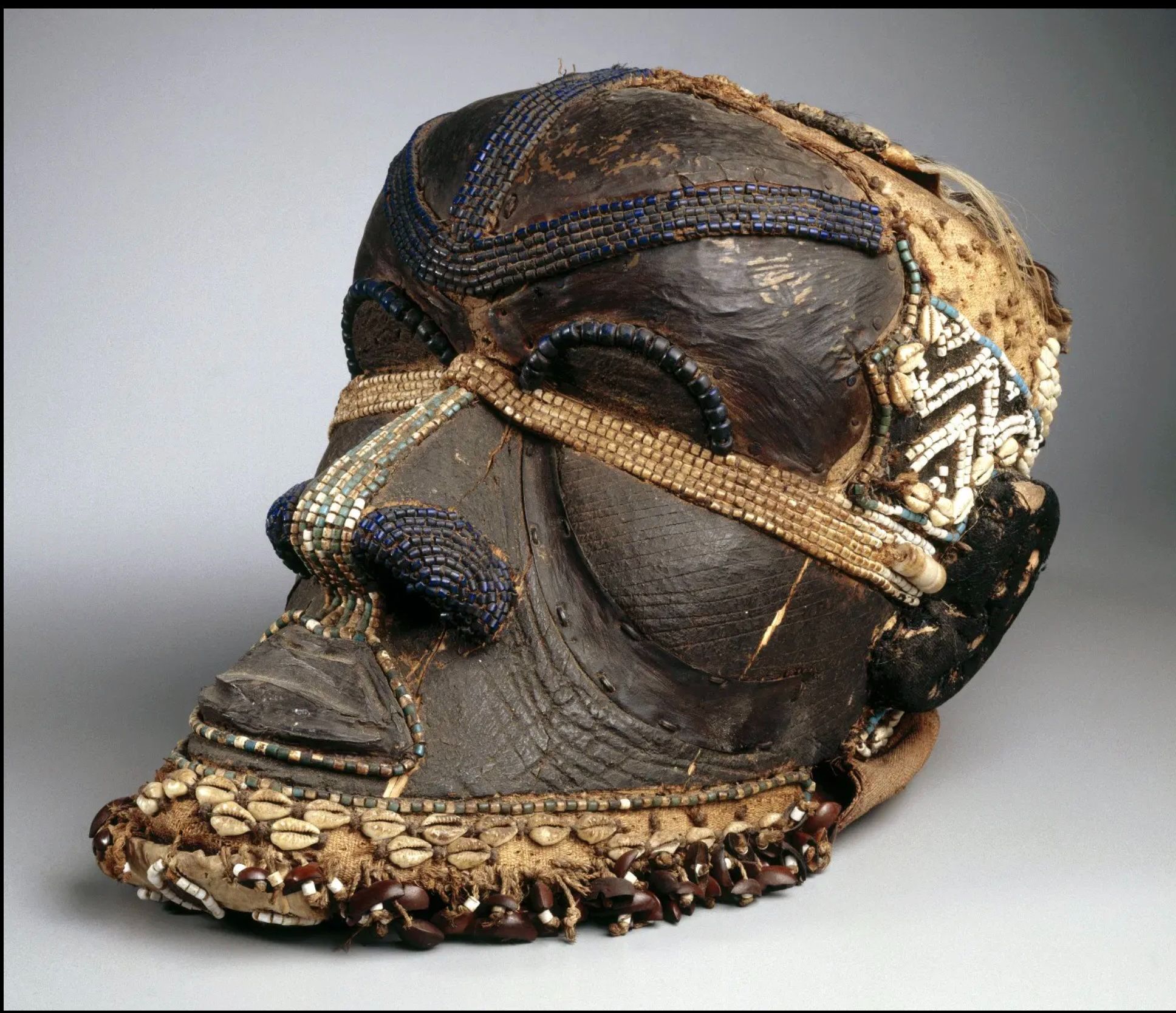
Here we have a striking Chokwe or closely related Lwena Mwana Pwo mask, one of Central Africa’s most graceful sculptural forms. These masks represent an idealized female ancestor and were danced by men in masquerade, combining beauty, social memory, and performance. What makes this example compelling is its combination of sculptural restraint and richly layered ornament. The dark carved wood face, with its lowered eyes and calm mouth, is framed by applied beadwork, cowries, cloth, and fiber that together simulate coiffure, scarification, and prestige adornment. That mixture of carving and attachment is very much part of the tradition. The craftsmanship appears hand-worked rather than machine-finished. There are shrinkage cracks, abrasions, losses to the beadwork and cloth, and a patina that suggests actual age and handling. Those flaws are not a problem here—they are part of the evidence. In fact, the slight asymmetries and worn joins help distance it from the slick tourist-market copies that flood the field. A word about copies.. African masks are among the most reproduced ethnographic objects on the market, and Chokwe-related types are no exception. So caution is essential. Based on the visible age, integrated attachments, and convincing surface history, I would place the authenticity score at about 72%. At auction, a genuinely period example like this might bring roughly $4,000 to $12,000, depending heavily on provenance and size. If later, more like $300 to $1,200. In other words: a beautiful face, and—quite possibly—a truthful one.
Used for this report's TTS and avatar presentation.
Item Report
Chokwe/Lwena Period Wood and Bead Mwana Pwo Mask
By: Unknown Chokwe/Lwena artist
Style: Central African Chokwe/Lwena ceremonial mask, period tribal art
Origin: Angola / Zambia / Democratic Republic of the Congo region
Materials: carved wood, glass trade beads, cowrie shells, fiber, textile, leather/hide, cord, possible pigment
Age: Probably late 19th to early 20th century, circa 1890-1930
Condition: Good (age-related wear, bead and textile losses, cracks and abrasions consistent with use; not professionally conserved in images)
Value: Conservative auction estimate: if authentically period and with strong provenance, approximately $4,000-$12,000; if later decorative reproduction, approximately $300-$1,200.
Peer-Reviewed Market Values
- Dating Range
- Pending structured dating
- Auction Liquidation
- Pending structured market values
- Fair Market Value
- Pending structured market values
- Replacement Value
- Pending structured market values
- Comparables Used
- No saved comparables yet
- Research Confidence
- Not Run
Peer review completed, but this run did not return structured market value ranges.
Maker's Marks / Writing: No visible maker's mark or inscription in the provided images.
Date: 2026-03-21 14:25:14.589713
Description:
A carved wooden female initiation or masquerade mask, likely from the Chokwe/Lwena cultural sphere of Angola or neighboring Zambia/DRC, with an elegant coiffure, downcast almond eyes, scarification motifs, and extensive bead, cowrie shell, textile, and fiber ornament. The form and refined facial modeling are characteristic of Mwana Pwo-type masks representing an idealized female ancestor.
Curator Questions
Curated by Jade
Assessment:
This appears to be a serious and likely period Central African mask rather than a tourist copy. The asymmetry, accumulated wear, old beadwork losses, surface abrasions, shrinkage cracks, and aged fiber attachments all support age and ceremonial use. The coiffure patterning, facial scarification, and restrained, idealized expression align well with Chokwe/Lwena Mwana Pwo traditions. Without underside, interior, and provenance images, attribution must remain somewhat cautious, but the object reads as substantially more convincing than most late 20th-century reproductions. A word about copies.. African masks are heavily reproduced for the decorative market, especially Chokwe, Pende, and Fang types, so one must default to caution; in this case, however, the patina, construction, and old applied ornament suggest a genuinely older work.
Individual Images:
- whole mask three-quarter view
- whole mask front three-quarter view
Provenance:
No provenance documentation shown in the provided images.
Condition:
Good (age-related wear, bead and textile losses, cracks and abrasions consistent with use; not professionally conserved in images)
Identification Score: 88%
The female face type, arched brows, scarification patterning, coiffure, and beaded additions strongly suggest a Mwana Pwo-related Chokwe/Lwena mask, though exact ethnic attribution is limited by the absence of interior and full frontal detail.
Authenticity Score: 72%
The fakery check is reasonably favorable: the wood surface shows believable age, handling wear, crack formation, abrasion, and bead loss; the attachments appear old and integrated rather than freshly assembled. Still, because African masks are frequently reproduced and because we lack views of the interior, tool marks, and provenance, the score should remain moderate rather than high.
Image Memory Note
None None
Keywords
Chokwe mask, Lwena mask, Mwana Pwo, Central African art, Angola, wood mask, beaded mask, cowrie shells, ceremonial mask, tribal art, period African carving
Peer Review Summary
Peer Review
Key Visible Evidence
The subject mask (Image 1, Image 2) is carved from dark wood with an elaborate coiffure and facial features adorned with blue, white, and light brown glass trade beads, cowrie shells, and woven fiber/textile elements. Distinctive downcast, almond-shaped eyes, a small mouth, and scarification patterns on the forehead and cheeks are visible, consistent with Mwana Pwo iconography. The wood surface exhibits a dark, somewhat lustrous patina, along with visible wear, abrasions, and several shrinkage cracks (e.g., on the right cheek in Image 1). The applied beadwork and fiber elements show signs of age, including losses, fraying, and a general integration with the mask's surface, suggesting they are not recent additions. No visible maker's marks, inscriptions, or labels are present in the provided images.
Market and Source Support
The report's identification of the object as a Chokwe/Lwena Mwana Pwo mask is strongly supported by multiple grounded comparables from reputable auction houses (Sotheby's, Christie's, Bonhams) and museum collections (The Metropolitan Museum of Art). These sources consistently feature stylistically similar masks, often dating them to the late 19th to early 20th century, which corroborates the report's proposed age range. The materials (carved wood, glass trade beads, cowrie shells, fiber, textile) are also consistent with documented Mwana Pwo masks. Auction results for comparable 'period' examples (ranging from approximately $10,000 to $13,000) provide a robust basis for the higher end of the report's value estimate ($4,000-$12,000) for an authentically period piece.
Needs Verification
While visible wear and integrated materials suggest age consistent with the late 19th to early 20th century, definitive dating without scientific analysis (e.g., carbon dating of wood/fiber) or robust provenance remains an expert opinion. Microscopic analysis of tool marks, wood species identification, and detailed examination of bead types could provide further evidence. The report's 'authenticity score' of 72% is subjective; while visible evidence supports an older piece over a modern reproduction, the absence of interior views, specific tool marks, and provenance prevents a higher confidence level. Interior views are needed to examine the mask's thickness, carving technique, and potential signs of wear from use. The precise ethnic attribution (Chokwe vs. Lwena) could benefit from more detailed stylistic analysis or provenance, though the report's combined 'Chokwe/Lwena' is appropriate. A UV/blacklight examination would be beneficial to detect any repairs, restorations, or overpainting not apparent under normal light, which would refine the condition assessment.
Audit Conclusion
The report accurately identifies the subject as a Chokwe/Lwena Mwana Pwo mask, a conclusion strongly supported by visible evidence and corroborated by numerous grounded comparables. The visible patina, integrated wear, and material degradation are consistent with the proposed late 19th to early 20th-century dating. The value estimate for an authentically period piece is well-grounded by comparable auction results. However, the absence of provenance and interior views limits the ability to definitively confirm the exact age and authenticity with 100% certainty. Further investigation into the interior carving, tool marks, and material analysis would strengthen the authenticity assessment. The report's cautious approach and acknowledgment of the challenges in authenticating African masks are appropriate.
Comparables (Similar Items)
No archived comparables matched this report yet.
Share: