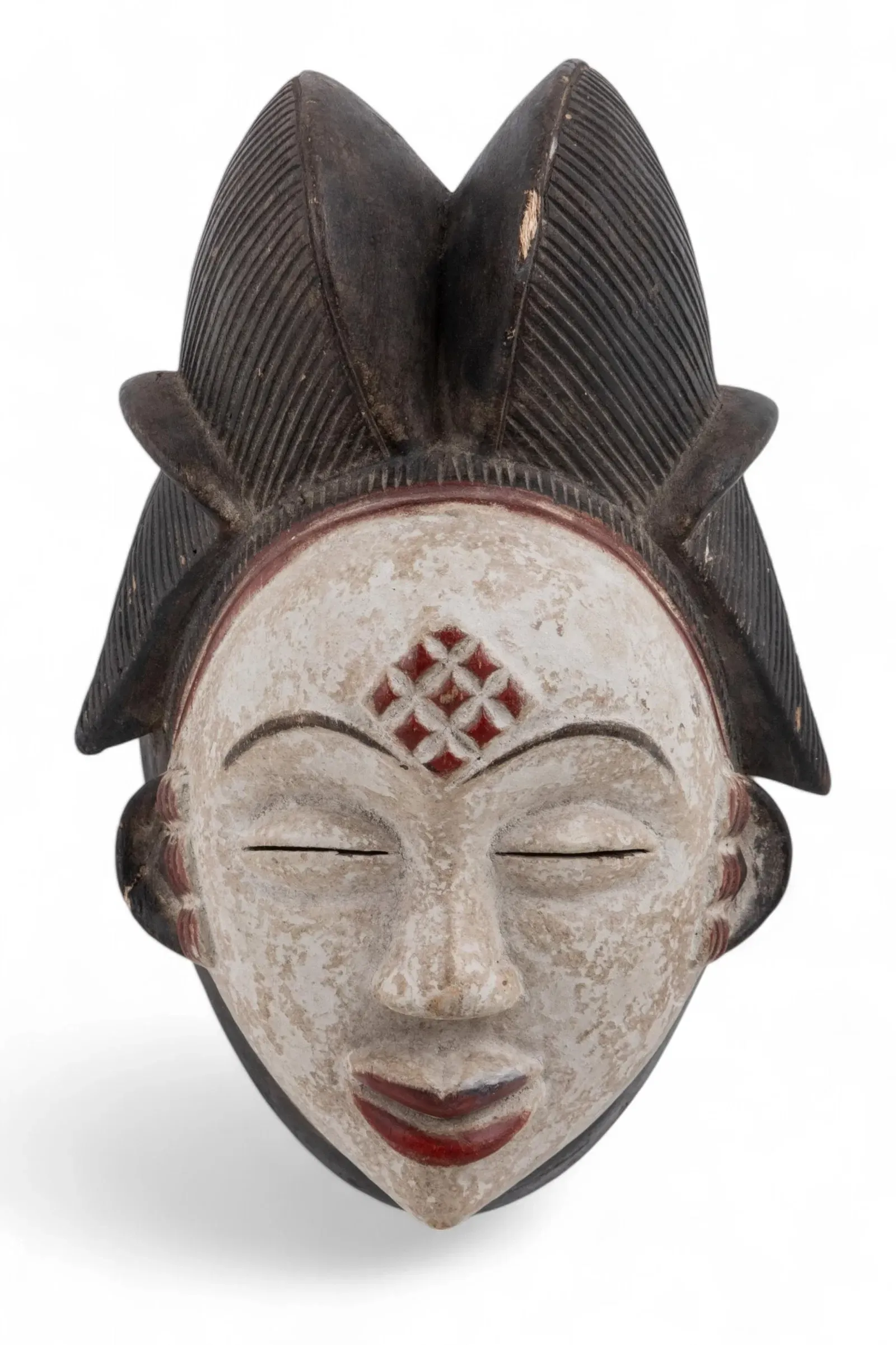
Enter the enigmatic world of the Gabon Punu Tribe, where the masterful art of mask-making yields cultural treasures like this exquisite polychrome wooden mask. With its serene almond-shaped eyes and high coiffure, this mask beckons you into a realm of ceremonial dance and ancestral homage.
Hailing from the early to mid-20th century, this mask captures the essence of Punu craftsmanship. Its design is steeped in tradition, serving as a symbol in funerary contexts, where artistry and spiritual significance converge in a single, powerful visage.
Crafted by an unknown artisan, this piece features an interplay of materials: carved wood, kaolin pigments lending it its ghostly white pallor, and accented natural hues of red and black. Each groove and pigment stain is a testament to the meticulous hand-carving techniques revered among the Punu.
Despite its delicate beauty, the mask bears the marks of its journey through time. Subtle abrasions and paint loss witness its authenticity and ceremonial past, with a modern green cord quietly whispering the adjustments of contemporary display. Such signs of age and wear only enhance its narrative richness.
Our expert appraisal confers a strong authenticity score of 80%, supporting a value estimate between $2,000 and $6,000, provided its origins align with ceremonial use. Whether a seasoned collector or a newcomer to tribal arts, this piece offers a tangible connection to the Punu's vibrant cultural tapestry. We thank you for exploring its mystique with us.
Used for this report's TTS and avatar presentation.
Condition:Very Good (minor paint and surface wear, some abrasions, modern string added, patina appropriate for age)
Value:$2,000–$6,000 (auction estimate, if authentic and of ritual use origin)
Maker's Marks / Writing:No visible maker's mark or writing (typical for traditional tribal masks).
Date:2025-07-18 22:48:25.194863
Description:
This is a carved wooden mask from the Punu people of Gabon, Central Africa. The mask features characteristic white kaolin-covered facial surfaces, narrow eyes, pursed red-painted lips, traditional scarification patterns on the forehead and temples, and a high coiffure with finely carved striations. Such masks, known as 'mukudj' or 'ikenga', are often used in ceremonial dances, particularly in funerary contexts. The mask exhibits expected age wear with minor paint loss and surface abrasions. The inside of the mask shows patination and evidence of ritual use.
Curator Questions
Curated by Jade
Assessment:
A fine, classic example of a Punu mask, displaying desirable features and apparent signs of age and use. The carving style, patina on the reverse, and surface wear are consistent with authentic masks formerly used in ceremony. The white kaolin slip and red accents are typical. The presence of modern green cord on the interior is not original and may have been added for display. A word about fakes: African masks are heavily reproduced; careful attention must be paid to surface patina, interior wear, and quality of carving. This example shows credible aging, but further provenance or expert examination would be ideal for a complete certainty.
Individual Images:
Detail images show: 1) Finely striated coiffure
with wear/losses suggesting age; 2) Deep
naturalistic scarification and red pigment insets; 3) Patinated
soiled inner surface with abrasions consistent with ceremonial wear; 4) Green string is a recent addition for hanging
not original. 5) Close-ups of facial features and edges support authenticity due to nuanced carving and pigment weathering.
Provenance:
No direct provenance documentation shown in images.
Condition:
Very Good (minor paint and surface wear, some abrasions, modern string added, patina appropriate for age)
Identification Score: 98%
The form, coiffure, markings, pigments, and carving technique are highly characteristic of authentic Punu masks from Gabon, allowing confident identification. The mask’s features match published and museum examples.
Authenticity Score: 80%
The mask displays convincing surface wear, interior patina, and quality consistent with early- to mid-20th-century Punu tribal works. The edges and inner surface exhibit natural abrasion, and pigment loss is appropriately distributed. The presence of modern green string is a minor detractor but not an automatic sign of reproduction. However, due to the prevalence of high-quality reproductions in this field, certainty cannot be absolute without further in-person examination or provenance documentation.
Image Memory Note
The object is an oval, polychrome carved wooden African mask, representing a serene female face with almond-shaped, slit eyes, a closed mouth with red-accented lips, black eyebrows, and a high, striated double-crest coiffure. The dominant surface is white (kaolin slip) with areas of red pigment (forehead lattice/scarification, lips, ears). There are three parallel rectangular scarification marks in red on each cheek/temple. The surface exhibits oxidization wear, especially around the facial plane and on the coiffure high-points. The underside/back of the mask is deeply patinated, showing a rich brown coloration and abraded, soiled surface indicative of age and possible use. There is a green plastic cord threaded through holes on the reverse rim (for modern hanging). No inscriptions, numbers, or maker's marks are present. No significant cracks, but the mask bears chipping and wear at contact points, notably at the coiffure's high edge and rim. Overall, the mask reflects typical Gabon Punu characteristics in facial form and surface coloration.
Keywords
Punu mask, African tribal art, Gabon, polychrome, kaolin, wood, scarification, mukudj, funeral mask, Central Africa
The report was edited after initial Artmink draft. Original AI draft preserved in Artmink audit history.

Share: