
Monique : French Fine and Decorative Arts
Monique Presents

Original Presentation Script
Here we have a charming French Empire Period ormolu and patinated bronze figural mantel clock — a wonderfully theatrical object that is part sculpture, part timekeeper, and entirely Parisian in ambition. The case is crowned by a classical child with a dog, a subject that blends sentiment, antiquity, and domestic luxury in exactly the way early 19th-century French decorative arts so often do. This clock reads as circa 1805 to 1820, when Empire design favored strong architectural forms, rich gilding, and references to the ancient world. The draped front, twisted columns, and symmetrical structure all fit that moment beautifully. The signed enamel dial, 'Delhu jeune,' is likely the name of the clockmaker or retailer rather than the case bronzier. The materials are telling: fire-gilt bronze for the luminous gold surfaces, darker patinated bronze for the dog, and a proper white enamel dial with Roman numerals. The visible bell-striking movement also looks consistent with period French production rather than a recent decorative copy. Condition is respectable for age. There is visible rubbing and an apparent missing or removed element on the top platform, plus the usual light surface wear one hopes to see on a genuinely old clock. Those imperfections are not disqualifying; in fact, they often help separate honest age from glossy reproduction. My authenticity score is 78%. A word about copies.. Empire clocks are heavily reproduced, but this one has the right gravitas. Conservative auction estimate: $2,500 to $5,500 if authentic; perhaps $300 to $900 if later. In short: a handsome survivor with real period promise.
Used for this report's TTS and avatar presentation.
Item Report
French Empire Period Ormolu and Patinated Bronze Figural Mantel Clock
By: Dial signed 'Delhu jeune'; case maker unknown
Style: French Empire Period
Origin: France
Materials: ormolu (gilt bronze), patinated bronze, white enamel dial, steel bell and movement components
Age: circa 1805-1820
Condition: Good (visible wear, probable minor alteration/loss to top, movement untested from photos)
Value: Auction estimate, if authentic: USD 2,500-5,500. If later reproduction: USD 300-900.
Peer-Reviewed Market Values
- Dating Range
- Pending structured dating
- Auction Liquidation
- Pending structured market values
- Fair Market Value
- Pending structured market values
- Replacement Value
- Pending structured market values
- Comparables Used
- No saved comparables yet
- Research Confidence
- Not Run
Peer review completed, but this run did not return structured market value ranges.
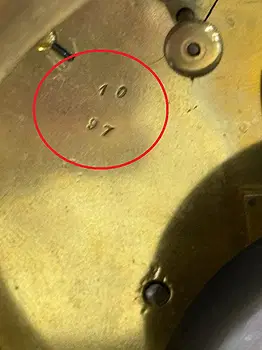
Maker's Marks / Writing: Dial signed 'Delhu jeune'; movement interior stamped or punched with numbers '10' and '87' visible in one detail image.
Date: 2026-03-24 01:48:33.301122
Description:
A gilt-bronze and patinated bronze mantel clock in the French Empire taste, surmounted by a classical standing child figure with a dog above a circular enamel dial. The case features draped ormolu ornament, twisted columns, figural supports, and a relief frieze to the base. The dial is signed 'Delhu jeune.'
Curator Questions
Curated by Jade
Assessment:
This appears to be a genuine early 19th-century French Empire mantel clock rather than a modern reproduction. The model, fire-gilt bronze surfaces, patinated bronze dog, enamel dial format, and visible bell-striking movement are all consistent with period Paris production. The signature 'Delhu jeune' likely refers to the retailer or clockmaker on the dial rather than the bronzier. Visible age, surface rubbing, and a now-empty hole or removed element on the top platform suggest honest wear and possible alteration rather than fakery. The case quality is strong, with refined neoclassical drapery and a well-modeled figure. A word about copies.. French Empire clocks have been widely reproduced in the late 19th century and again in the 20th century, so caution is essential; however, this example shows enough period construction, wear, and sculptural quality to support an authentic Empire-period attribution.
Individual Images:
- detail of movement numbers
- whole clock front
- front with bezel open
- detail of dial signature
- side view clock
- front three-quarter with bezel open
- reverse side view
- upper half figure and dog
- whole clock front view
- upper half from opposite angle
- detail of right support
- interior movement and bell
- detail of top surface alteration
Provenance:
No documentary provenance shown in the images.
Condition:
Good (visible wear, probable minor alteration/loss to top, movement untested from photos)
Identification Score: 95%
The object is clearly identifiable as a French figural mantel clock of Empire type based on the enamel dial, bell-striking round movement, ormolu architectural case, and classical bronze group.
Authenticity Score: 78%
I believe it is likely period and not a recent copy because of the crisp but not over-sharp casting, convincing age to the gilding and patinated bronze, proper enamel dial layout, old movement construction, and the sort of minor losses/alterations seen on authentic clocks. The top surface shows a vacant hole and rubbing where an attachment may have been removed, which actually supports age. Still, without seeing the backplate, suspension, pendulum, and movement in full, I stop short of a higher score.
Image Memory Note
None None
Keywords
French Empire mantel clock, ormolu, gilt bronze, patinated bronze, figural clock, Delhu jeune, Paris clock, neoclassical, France, antique clock
Peer Review Summary
Peer Review
Key Visible Evidence
The subject clock is a figural mantel clock featuring a gilt-bronze child figure and a patinated bronze dog atop an architectural case. The case exhibits draped ormolu ornament, twisted columns, and a relief frieze on the base, consistent with neoclassical design elements (Image 2, 5, 6, 7, 8). The dial is white enamel with Roman numerals and is clearly signed 'Delhu jeune' in script (Image 3, 4). The interior of the movement shows stamped numbers '10' and '97' (Image 1). The overall condition displays visible surface rubbing and wear, which is generally consistent with the reported age. However, a distinct 'vacant hole or removed element on the top platform', as described in the report, is not unequivocally discernible as a clear hole in the provided general images of the top platform (Image 2, 5, 6, 7, 8).
Market and Source Support
The general style, materials (ormolu, patinated bronze, enamel dial), and architectural form of the clock are consistent with French Empire period mantel clocks, typically dated to the early 19th century (circa 1800-1820). The dial signature 'Delhu jeune' is visually present. While the report identifies this, research indicates a prominent Parisian horologist of the Consulate and Empire periods named Jean-Baptiste-Gabriel Dubuc, who signed 'Dubuc le jeune'. The visible script in Image 4, however, distinctly reads 'Delhu jeune', suggesting this is the correct reading of the visible inscription, rather than a misreading of 'Dubuc jeune'. 'Delhu jeune' does not appear to be a widely documented clockmaker in the same manner as 'Dubuc le jeune' or other prominent Empire period makers. Comparables confirm the market for French Empire figural mantel clocks with animal motifs, with prices ranging from several thousands to tens of thousands of USD/GBP, depending on maker, condition, and specific figural composition.
Needs Verification
A notable discrepancy exists between the report's stated movement numbers '10' and '87' and the visible stamped numbers '10' and '97' in Image 1. This requires clarification and re-examination of the physical object or a higher-resolution image of the movement numbers. The claim of a 'now-empty hole or removed element on the top platform' is mentioned multiple times in the report, but a distinct 'hole' or clear evidence of a removed element is not unequivocally visible in the provided images. A dedicated, high-resolution close-up image of this specific area would be required for definitive confirmation. Furthermore, as noted by the report, a comprehensive mechanical and authenticity evaluation would necessitate a full, hands-on inspection of the movement, including the backplate, suspension, and pendulum, which are not fully visible in the provided photographs.
Audit Conclusion
The subject clock exhibits stylistic and material characteristics largely consistent with a French Empire period figural mantel clock, likely dating to the early 19th century. The use of gilt and patinated bronze, neoclassical motifs, and an enamel dial aligns with period production. The dial signature 'Delhu jeune' is clearly visible, though further documentation of this specific maker would strengthen the attribution. The discrepancy in the reported movement numbers versus visible evidence (Image 1) and the lack of clear photographic evidence for the alleged alteration on the top platform are points requiring further investigation. While the overall appearance supports an Empire-period attribution, a definitive authenticity and value assessment would benefit from a full, hands-on inspection of the movement and clearer photographic evidence of the alleged alteration.
Comparables (Similar Items)
No archived comparables matched this report yet.
Share: