Premium upgrade: Sienna delivers your appraisal as a guided podium narration with synced visuals and voiceover.
Output is a narrated, animated slideshow with video intro and outro, sandwiching the autoplay voiceover sequence in actual video.
Helmet mask (Egungun)
LANGUAGE UNLOCK
Glossary Roundup
Original Presentation Script
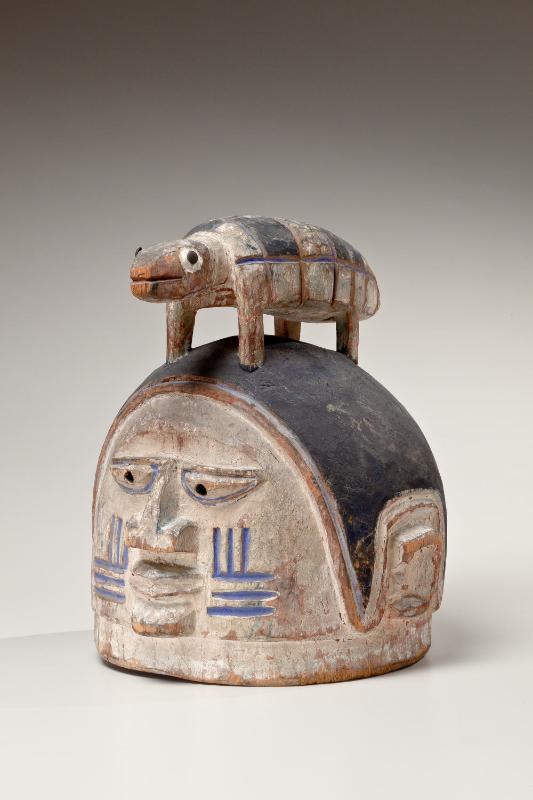
This striking helmet mask, known as Egungun, hails from the Yoruba culture of Nigeria and dates back to the late 19th century. Crafted from wood and adorned with pigment, it stands at 10 3/4 inches tall and has a diameter of 8 inches. The Egungun masks are traditionally used in ceremonies to honor ancestors, reflecting the rich cultural heritage of the Yoruba people.
Used for this report's TTS and avatar presentation.
Fair Market Value
Pending structured market values
Replacement Value
Pending structured market values
Archived Matches
No archive matches yet
Research Confidence
Insufficient Data
Peer Review
Key Visible Evidence
The images present a carved wooden helmet mask featuring a human face with prominent Yoruba-style scarification marks (three vertical and three horizontal lines on the cheeks) painted in blue. A carved turtle superstructure rests on the dark-painted crown. The wood surface, pigment application, and overall wear—including edge abrasions and patina—are consistent with substantial age and traditional use.
Market and Source Support
Historical records confirm that the Newark Museum acquired a significant collection of Yoruba art in 1924 from Walter Dormitzer, a businessman active in West Africa during the late 19th century. The mask's iconography, including the specific scarification patterns and the turtle motif, aligns with documented Yoruba masking traditions (such as Egungun or Gelede) from this period.
Needs Verification
['While the institutional provenance strongly supports the late 19th-century dating, physical inspection of the interior cavity for wear patterns and traditional tool marks would further corroborate its ceremonial use prior to collection.', "The specific attribution to the Egungun society (as opposed to Gelede, which also heavily features animal superstructures) relies on the museum's cataloging and cannot be definitively proven from the images alone."]
Audit Conclusion
The report is supported. The visible stylistic features, material aging, and highly specific, verifiable institutional provenance strongly align with the attribution of a late 19th-century Yoruba helmet mask.

Share: