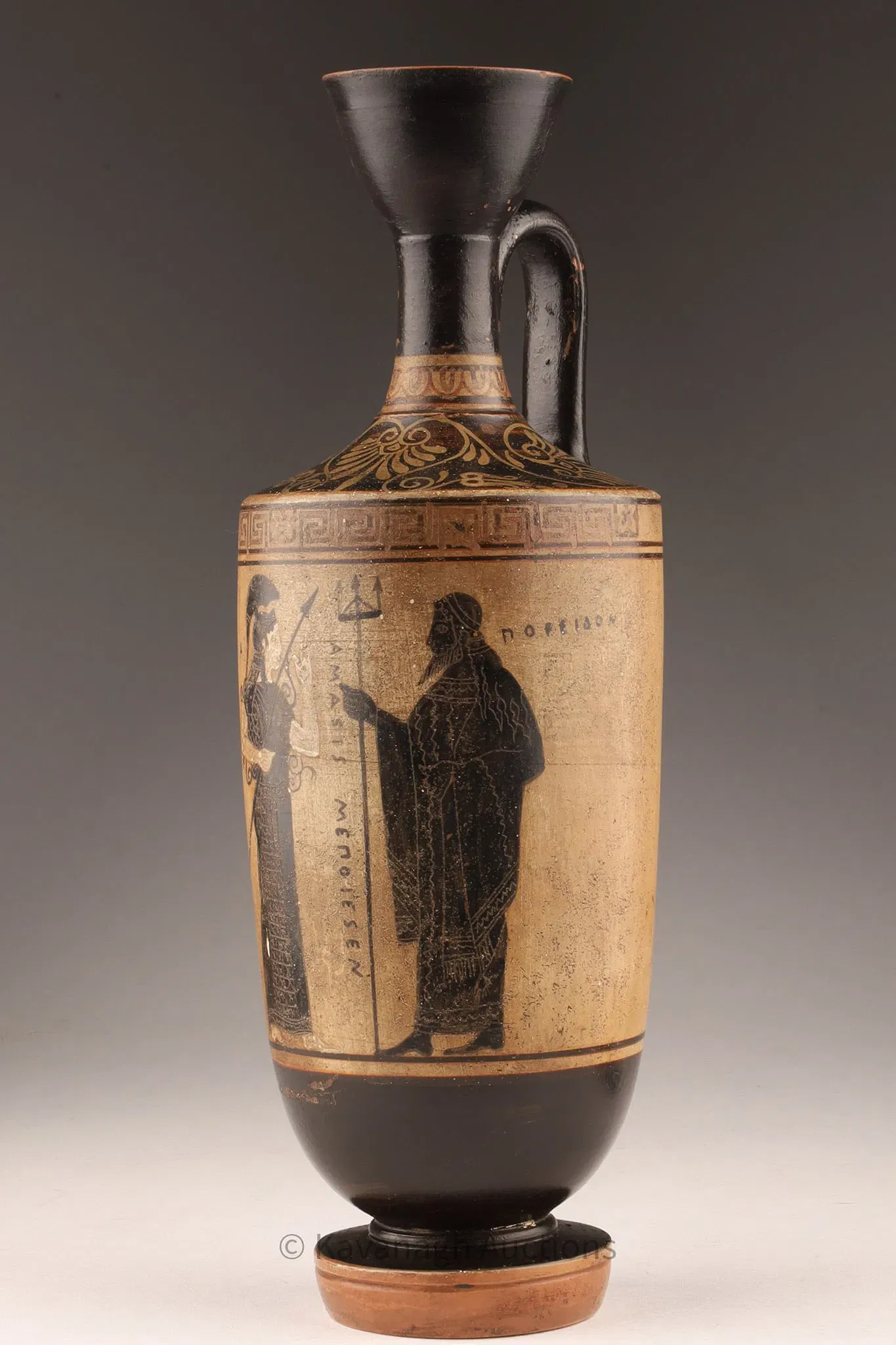
Attic Black-Figure Lekythos with Athena and Poseidon
LANGUAGE UNLOCK
Glossary Roundup
Original Presentation Script
Introducing the Attic Black-Figure Lekythos — a captivating relic of ancient Greece attributed to the renowned Amasis Painter, depicting an eternal struggle between gods Athena and Poseidon, arrested in mythological discourse upon its terracotta surface. With a narrow body and a gracefully singular handle, the lekythos stands as a vessel that once cradled sacred oils, now holding whispers of antiquity for modern scholars to decipher.
Traversing back to circa 550–510 BCE, this remarkable artifact shines a light on the archaic aesthetic and religious narratives preserved in distinct Attic style. The inscriptions — bold and pronounced — reveal not only its mythical protagonists but proclaim the artistry of 'Amasis,' weaving history through its meticulously incised clay.
Crafted from terracotta, the vessel's beauty extends from the luscious black glaze that contrasts sharply with its reserved clay ground, articulating figures with an ancient hand's precision. The dexterity of incised lines and motifs — meanders, lotus flowers, and palmettes — enhance its visual sophistication, affirming human creativity through the epochs.
Yet, time's embrace is visible upon its surface. The lekythos bears scars familiar to antiquity: glaze losses, rim chipping, and surface abrasions, indicators of its genuine age against a backdrop of contemporary deceit. Despite these, the absence of obvious reconstruction maintains its purity, resting just shy of perfection.
In the realm of authenticity, the vessel clinches a commendable score of 75%, its artistry and historical resonance only slightly shadowed by the specter of modern forgeries — a thorough scientific examination awaits to seal its truth. As for its value in the ever-curious auction market, estimates elegantly balance between $10,000–$20,000, underscoring a piece of past elegance gracing present conversations. A toast to the immortal dialogues of gods encased in time-clad clay, where history artfully converses with the collector's discerning eye.
Used for this report's TTS and avatar presentation.
Item Report
Attic Black-Figure Lekythos with Athena and Poseidon
By:Attributed to the Amasis Painter (identified by inscription 'AMASIS MEPOIESEN')
Style:Ancient Greek Black-Figure Pottery
Origin:Greece
Materials:Terracotta with black-glaze painting
Age:Circa 550–510 BCE
Condition:Good (surface wear, rim and base chipping, glaze losses, typical for antiquity)
Maker's Marks / Writing:Greek inscriptions: 'AMASIS MEPOIESEN' (Amasis made it — signature of the potter/painter); 'ATHENA'; 'POSEIDON' — naming the depicted deities.
Date:2025-07-09 00:59:26.238704
Description:
A fine ancient Greek black-figure lekythos (oil flask) attributed to the Amasis Painter, depicting the deities Athena and Poseidon in a mythological encounter. The vessel displays the distinctive black-figure technique, with luscious black glaze, incised details, and reserved clay ground. The main panel portrays Athena wearing a crested helmet and holding a spear, facing Poseidon, who wields a trident. The figures are inscribed in ancient Greek, clearly naming ‘AMASIS MEPOIESEN’, indicating the maker/painter, and the deities ‘ATHENA’ and ‘POSEIDON’. The vessel is further embellished with a band of meanders, lotus and palmette motifs around the shoulder. The lekythos form, with high neck, single handle, and narrow body, was used for storing oils or perfumes. Signs of age include scattered areas of surface wear, some loss to the glaze, and chipping around the rim and base.
Curator Questions
Curated by Jade
Assessment:
This is an outstanding example of Attic black-figure pottery, highly desirable due to its mythological iconography, clear inscriptions, and attribution to a celebrated ancient painter (Amasis Painter). The figures and fine details suggest a vessel of significant historical and artistic value. However, a word about fakes: the market for Greek vases is rife with high-quality modern forgeries. This piece shows positive indicators including correct aging, inscription style matching ancient conventions, and appropriate glaze/patina, but only an in-person scientific examination (including thermoluminescence dating) can conclusively confirm authenticity.
Individual Images:
Additional detail images reveal surface wear and glaze loss around the neck and shoulder
characteristic of age rather than recent damage. The view of the underside shows further chipping and weathering
but also reveals modern pencil inscription — possibly an old collection or inventory number
not ancient. Handle junctions and painted motifs display minor abrasions and scattered pigment loss
entirely expected for an object over 2
500 years old. No sign of obvious modern reconstruction or repainting is visible in provided images.
Provenance:
No explicit documentary provenance visible in photos; presence of inventory marks on base may indicate prior inclusion in a collection.
Condition:
Good (surface wear, rim and base chipping, glaze losses, typical for antiquity)
Identification Score: 98%
The vessel form, black-figure iconography, Greek inscriptions, and stylistic features collectively leave little doubt that this is a black-figure lekythos of Archaic Athens. The presence of both Athena, Poseidon, and an 'Amasis' signature fits well within known masterpieces. Only minute chance of misattribution.
Authenticity Score: 75%
The vessel demonstrates well-executed black-figure technique, detailed incised lines, and wear patterns consistent with antiquity. The inscriptions are convincing, both in form and content, and the style fits the oeuvre of the Amasis Painter. There is visible aging, patina, glaze chipping, and wear to high points, particularly around rim and base. However, due to the high prevalence and sophistication of modern Greek vase forgeries, only laboratory analysis can offer absolute certainty. Authenticity is likely but cannot be guaranteed from photographs alone.
Image Memory Note
The primary object is a tall, narrow-necked black-figure Attic lekythos with a single handle and footed base. Its primary frieze shows two black-figure mythological figures: a bearded male (Poseidon, labeled 'ΠΟΣΕΙΔΩΝ') with a trident, and a female warrior with helmet and spear (Athena, labeled 'ΑΘΕΝΑ'), both in profile. Between them: the inscription 'AMASIS MEPOIESEN' (“Amasis made [me]”). Geometric meander borders and palmette/floral motifs decorate the neck and shoulder. Condition: mild to moderate glaze losses, extensive ancient-style wear, significant chipping at rim (especially visible at handle junction) and foot, scattered abrasions, and a small area of glaze loss on Athena’s dress. The base displays modern pencil marks/inscriptions, not ancient. No obvious evidence of composite repair. The pottery clay body is fine and orange-red, consistent with Attic origin. Vector shapes, incised outlines, and reserved highlights are in keeping with authentic 6th-century BCE technique.


Share: