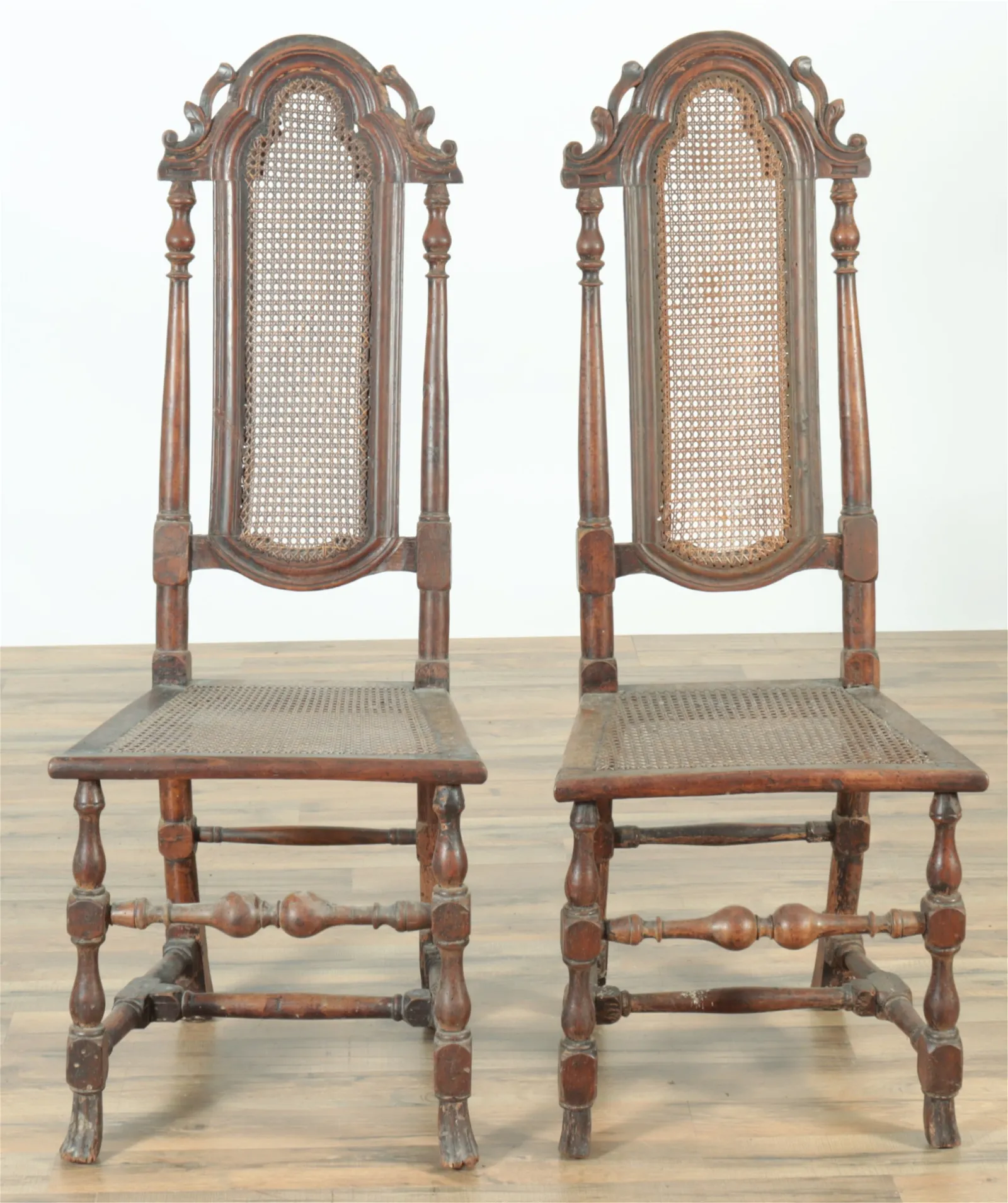
Pair of Late 17th–Early 18th Century English William & Mary / Early Queen Anne Period Walnut Caned Side Chairs
LANGUAGE UNLOCK
Glossary Roundup
Original Presentation Script
Here we have a rather regal duo: a Pair of English William & Mary / Early Queen Anne Period Walnut Caned Side Chairs. Tall, narrow, and faintly theatrical, they’re the sort of chairs you might imagine flanking a paneled fireplace in a late 17th-century town house.
These forms emerge in England around 1690, when caned seating became the height of fashion—lighter, airier, and more cosmopolitan than the old solid oak. The arched, scrolled crest rails and attenuated backs speak fluent Baroque, while the block-and-turned legs anchor everything with sturdy practicality.
The timber appears to be walnut (or a close stand‑in), oxidized to a deep, mellow brown. The turnings show honest irregularities, and the surface bears the bumps, abrasions, and shrinkage you expect from centuries of service. The cane, by contrast, is clearly not all original—broken and likely re-woven in parts, which is perfectly normal for chairs of this age.
There are hints that some stretchers or elements may have been reinforced or even replaced in the 19th century, a common fate for hardworking seating. That doesn’t negate their age; it simply means they’ve been kept useful rather than relegated to the attic.
On balance, I’d place authenticity at about 55%—plausibly period with probable later work. At auction, a period pair might bring $1,500–3,000; if judged largely revival or composite, more in the $300–600 range.
… Charles here, signing off: Let the Mink have a Think!
Used for this report's TTS and avatar presentation.
Item Report
Pair of Late 17th–Early 18th Century English William & Mary / Early Queen Anne Period Walnut Caned Side Chairs
By:Unknown English maker
Style:William & Mary / Early Queen Anne English Baroque Period
Condition:Fair to good (considerable wear, surface losses, distortions to stretchers, and damaged/replaced cane but structurally mostly intact)
Value:If authentic period pair: US $1,500–3,000 at auction; if largely 19th–20th century revival/reworked: US $300–600 for the pair
Maker's Marks / Writing:No maker’s mark or inscriptions visible from the provided image.
Date:2025-12-13 01:11:09.843012
Description:
A matched pair of high-back side chairs with arched and scrolled crest rails, turned front legs and stretchers, and woven cane backs and seats. The tall, narrow backs with shaped caned panels and baluster side uprights, together with block-and-turned legs united by a robust front stretcher, are characteristic of late William & Mary to early Queen Anne seating. The warm, oxidized walnut shows wear, small losses, and surface irregularities consistent with age. Cane appears partly replaced and broken in areas.
Curator Questions
Curated by Jade
Assessment:
A strongly stylistic pair of English high-back caned side chairs, closely following late 17th–early 18th century William & Mary / early Queen Anne forms. Turnings, cresting, and overall proportions are convincing, and the surface shows genuine age with accumulated wear, abrasions, and shrinkage. The cane work is at least partly replaced, as is expected in chairs of this age. Some elements—such as the comparative regularity of the turnings and possible later stretchers or repairs—raise the possibility of 19th-century reworking or composite construction using earlier components. A word about fakes.. caned baroque and early Queen Anne chairs are heavily copied, often in the 19th century, so caution is warranted and hands-on inspection of joints, tool marks, and under-structure would be essential before declaring them fully period. Nonetheless, they present well as decorator or collector pieces with substantial age.
Individual Images:
none
Provenance:
Not provided.
Condition:
Fair to good (considerable wear, surface losses, distortions to stretchers, and damaged/replaced cane but structurally mostly intact)
Identification Score: 88%
The combination of tall arched caned backs, scrolled cresting, baluster uprights, and block-and-turned legs clearly places the design in the English William & Mary / early Queen Anne caned side chair tradition; while some construction details may be later, the typology is secure.
Authenticity Score: 55%
The surface patina, wear, and irregularities suggest genuine 18th-century or earlier components, but the relative regularity of turnings, possible later stretchers, and lack of close-up joinery views leave open the likelihood of 19th-century reworking or partial replacement; therefore I assume authenticity only cautiously, just above even odds.
Image Memory Note
None
None
Keywords
pair of chairs, William & Mary, Queen Anne, English Baroque, walnut caned chair, antique side chairs, England
The report was edited after initial Artmink draft. Original AI draft preserved in Artmink audit history.

Share: