Premium upgrade: George delivers your appraisal as a guided podium narration with synced visuals and voiceover.
Output is a narrated, animated slideshow with video intro and outro, sandwiching the autoplay voiceover sequence in actual video.
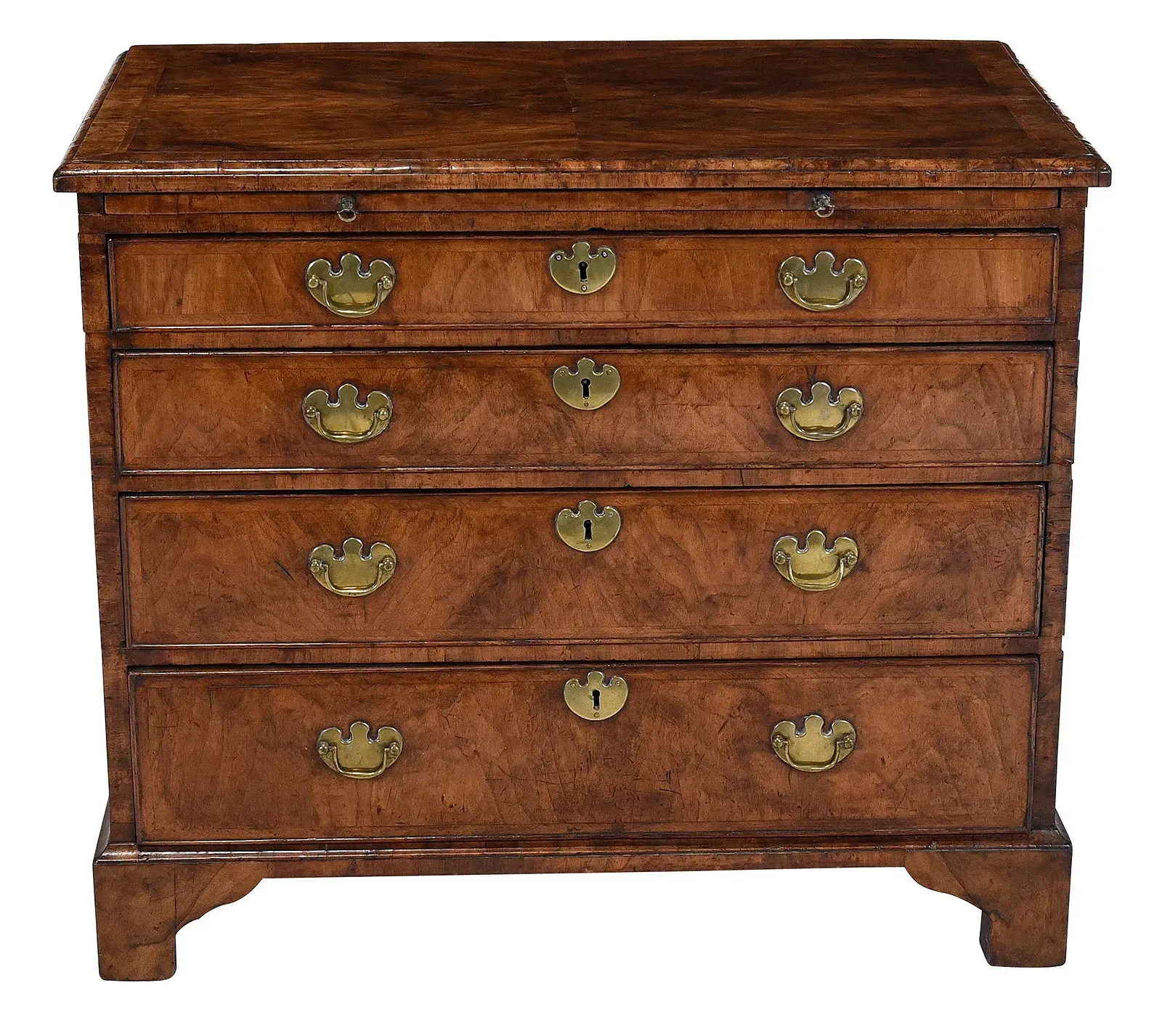
Early Georgian Figured and Bookmatched Walnut Bachelor's Chest
LANGUAGE UNLOCK
Glossary Roundup
Original Presentation Script
Ah — a splendid English George I Period Walnut Bachelor's Chest of Drawers, a compact, multi-purpose piece of furniture tailored for the smaller living quarters of a single gentleman. This classic form is distinguished by a pull-out "brushing slide" that converts the small dresser into a surface for writing or grooming. Dating to the early decades of the 18th century, this is when English furniture is moving from the heavier William and Mary forms into the more refined, architectural elegance of the Queen Anne taste.
This piece dates from the Age of Walnut, which predates the Age of Mahogany, a transition which took place in the 1730s and 40s.
Notice the beautifully book-matched walnut veneers across the top — almost symmetrical, like butterfly wings. The feather-banding around the drawer fronts is crisp and confident, a hallmark of early Georgian craftsmanship. The rounded batwing pulls are period correct and appear to be original, although inspection of the interior drawer mounts would be helpful here. The bracket feet are integral and properly proportioned, although again, close inspection of the underside of the piece would help confirm whether the feet are original, which they do appear to be.
The oak secondary wood, slightly irregular brasses, hand-cut dovetails, and subtle shrinkage cracks in the veneers all point toward genuine early 18th-century workmanship.
Condition is reassuring: surface wear consistent with three centuries of life, minor veneer stress, and honest patina. Nothing here feels artificially distressed or suspiciously pristine.
A word about copies.. George I walnut chests have been reproduced extensively in the 19th and 20th centuries. Many are convincing at first glance. But true period examples reveal themselves in the quiet details — the drawer linings, the oxidation, the proportions.
With an authenticity confidence of about 85%, I would place this at auction between four thousand and seven thousand dollars A later reproduction would struggle to reach one thousand dollars.
Overall, this is a fine and proud 300 year old survivor of early Georgian England…
Used for this report's TTS and avatar presentation.
Item Report
Early Georgian Figured and Bookmatched Walnut Bachelor's Chest
By:Unknown English cabinetmaker
Style:George I Period (Queen Anne taste)
Origin:England
Materials:Walnut veneers over oak secondary wood, brass hardware
Age:Circa 1715–1730
Condition:Very Good (age-appropriate veneer cracks, likely replaced brasses, structurally sound)
Value:Auction estimate (if authentic): $4,000–$7,000 USD; If later reproduction: $800–$1,500 USD
Peer-Reviewed Market Values
Dating Range
Pending structured dating
Auction Liquidation
Pending structured market values
Fair Market Value
Pending structured market values
Replacement Value
Pending structured market values
Comparables Used
No saved comparables yet
Research Confidence
Not Run
Peer review completed, but this run did not return structured market value ranges.
Maker's Marks / Writing:Chalk marking '2643' visible on back panel.
Date:2026-03-12 08:54:49.021724
Description:
A four-drawer walnut chest with featherbanded drawer fronts, crossbanded top, original-style brass batwing handles, and bracket feet. The top features bookmatched walnut veneers, and the carcass shows oak secondary wood typical of early 18th-century English construction.
Curator Questions
Curated by Jade
Assessment:
This appears to be a genuine early 18th-century English walnut chest of drawers from the George I period. The featherbanding, bookmatched veneers, bracket feet, and overall proportions are consistent with documented examples. The secondary woods and visible drawer dovetailing suggest early hand construction. Surface wear, oxidation, and minor veneer stress cracks are appropriate to age. Hardware appears replaced but period-appropriate in style, which is common and does not detract significantly from value.
Individual Images:
front chest of drawers
whole chest three-quarter view
overhead of chest
whole chest opposite three-quarter view
slide extended
side of chest
back of chest
detail of side veneer wear
detail of drawer dovetails
detail of brass batwing handles
detail of bracket foot
detail of bracket foot alternate view
Provenance:
No documentation provided.
Condition:
Very Good (age-appropriate veneer cracks, likely replaced brasses, structurally sound)
Identification Score: 95%
The form, proportions, veneer work, and bracket feet clearly align with early 18th-century English walnut chests of the George I era.
Authenticity Score: 85%
Strong indicators of period construction include hand-cut dovetails, oak secondary wood, natural veneer cracking, and appropriate patina. Hardware appears later but sympathetically replaced. Overall wear is consistent with early 18th-century age.
Image Memory Note
None
None
Keywords
English furniture, George I Period, walnut chest of drawers, Queen Anne, bracket feet, featherbanding, 18th century, England
The report was edited after initial Artmink draft. Original AI draft preserved in Artmink audit history.
Fair Market Value
Pending structured market values
Replacement Value
Pending structured market values
Archived Matches
No archive matches yet
Research Confidence
Narrative peer review only
Peer Review
Key Visible Evidence
1) Supported by Visible Evidence: The images clearly show hand-cut, irregular dovetails (image 9), supporting the claim of early hand construction. Walnut veneers are evident across the front and top, with oak secondary wood visible in the drawer construction (image 9) and likely the backboards (image 7). The overall form, proportions, presence of a brushing slide (image 5), four drawers, and bracket feet (images 11, 12) are consistent with an Early Georgian/Queen Anne taste bachelor's chest. Surface wear, minor veneer stress cracks (e.g., image 8), and general patina are visible and consistent with the stated age. The chalk marking '2643' is visible on the back panel (image 7).2) Supported by Grounded Sources: The comparables from Christie's, Sotheby's, Bonhams, and the V&A Museum (all explicitly dated George I / 1715-1730) strongly support the dating of 'Circa 1715–1730' and 'George I Period (Queen Anne taste)'. The form, veneer work (featherbanding, bookmatching), and bracket feet are consistent with these documented examples. The claim of 'Unknown English cabinetmaker' is standard for this period unless specific provenance or marks are present, which is supported by the general lack of specific maker attribution on similar pieces from this era in auction records. The auction comparables (Christie's: ~ $8,400 USD, Sotheby's: ~ $8,000 USD, Bonhams: ~ $4,500 USD) provide a strong basis for the estimated auction range of $4,000–$7,000 USD, especially considering the condition and potential for replaced hardware. The dealer asking price (~$9,800 USD) also supports the higher end of the authentic value.3) Uncertain / Needs Dealer Verification: The report states 'Hardware appears replaced but period-appropriate' in the overall assessment, but the narration says 'rounded batwing pulls are period correct and appear to be original'. Image 10 shows relatively clean brasses and escutcheons, which could suggest replacement or thorough cleaning. A closer inspection of the reverse of the drawer fronts for original holes/shadows from earlier hardware would be needed to definitively confirm if they are original or period-appropriate replacements. The narration states 'bracket feet are integral and properly proportioned, although again, close inspection of the underside of the piece would help confirm whether the feet are original, which they do appear to be.' While the images (11, 12) show good integration, a definitive confirmation of originality would require a physical inspection of the joinery at the base.4) Auditor Take (Dealer as Final Judge): The report's assessment of this as a genuine Early Georgian English walnut bachelor's chest (circa 1715-1730) is strongly supported by both visible evidence in the images (hand-cut dovetails, oak secondary wood, period form, age-appropriate wear) and by the grounded comparables. The stylistic elements like featherbanding, bookmatched veneers, and bracket feet align well with documented examples from major auction houses and museum collections. The estimated value range is well-supported by recent auction results for similar pieces. The primary areas for further verification by the dealer are the definitive originality of the brass hardware and the bracket feet, as the visual evidence is somewhat ambiguous on these specific points, and the report itself offers slightly conflicting statements or calls for further inspection. However, even if replaced, the hardware is noted as period-appropriate, which is a common occurrence and does not fundamentally undermine the authenticity or value of the piece as an early 18th-century item. The authenticity and identification scores appear reasonable given the evidence.


Share: