
George : English Fine and Decorative Arts
George Presents

Original Presentation Script
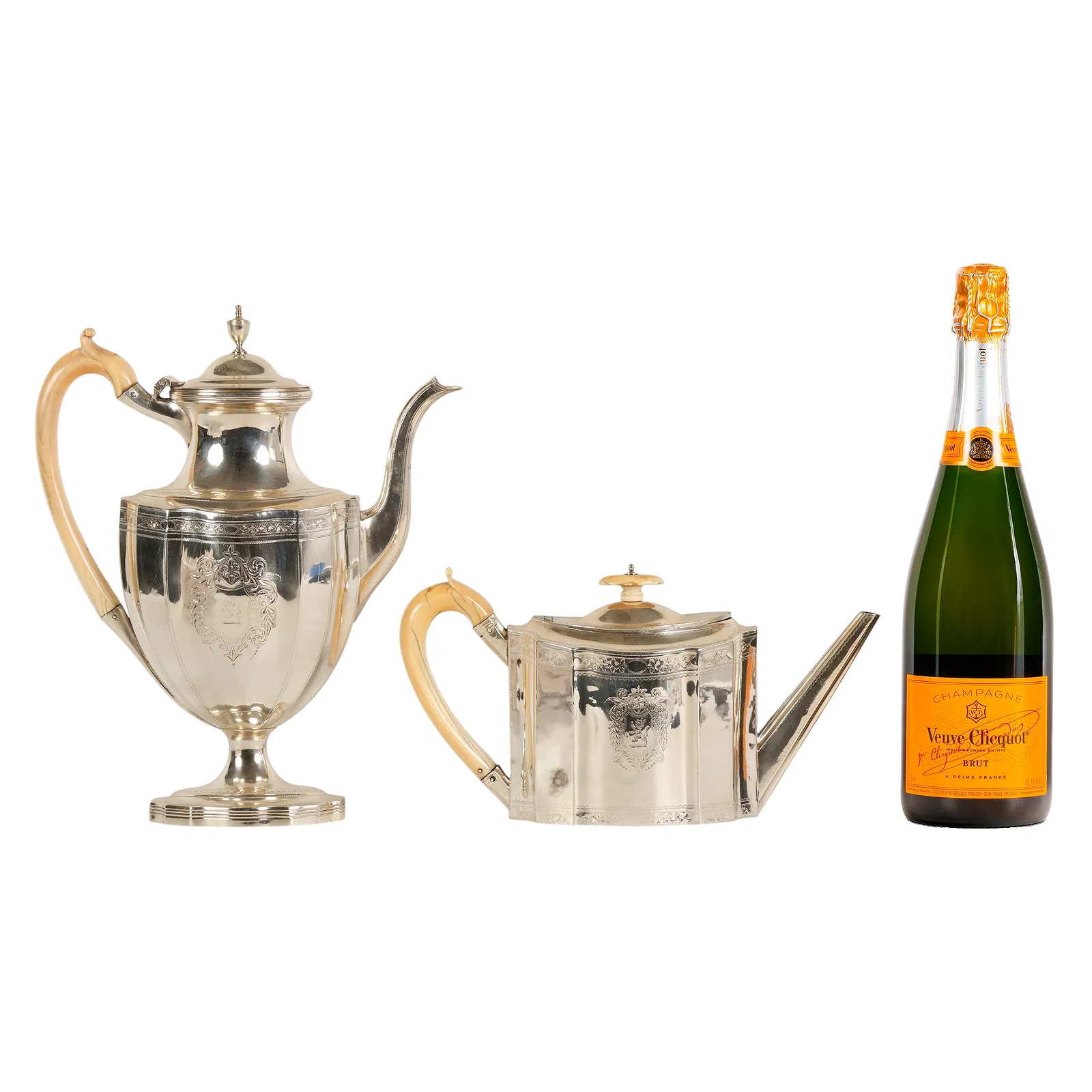
Here we have a refined English silver-plated tea and coffee pot garniture, hallmarked to 1900, poised elegantly at the dawn of the Edwardian age. One is a tall pedestal coffee pot; the other a lower, faceted teapot—both dressed in bright-cut engraving and fitted with pale insulated handles that appear consistent with ivory or bone. In spirit they nod to Georgian restraint, yet their crisp geometry and polished surfaces belong firmly to the neoclassical revival fashion of the turn of the 20th century. The faceted sides, engraved cartouches, and carefully balanced proportions reflect confident industrial-era craftsmanship rather than 18th-century hand raising. The surfaces show honest polishing wear and light scratching, precisely what one hopes to see in a well-kept 1900 table service. No severe dents or structural issues are apparent in the provided views. While the specific maker is not legible in the images at hand, the 1900 hallmark securely anchors the pair in its historical moment. Market value rests chiefly in decorative appeal and usability, as is typical for quality silverplate of this era. Nevertheless, as a matched Edwardian pair from 1900, they offer both period character and practical charm—just formal enough to improve anyone’s afternoon tea.
Used for this report's TTS and avatar presentation.
Item Report
English Edwardian Silver-Plated Tea and Coffee Pot Garniture, Hallmarked 1900
英国爱德华时期镀银茶壶与咖啡壶一对(1900年款)
Merge Reports: Yes (reconciled). Approval remains manual.
If the handles are confirmed as ivory, international sale or transport may be subject to CITES and local wildlife regulations.
Style: Edwardian (1900) neoclassical revival silverplate
Origin: England
Materials: silver plate over base metal, carved ivory or bone handles and finials
Age: Hallmarked 1900
Condition: Very Good (light polishing wear, minor surface scratching, no severe dents observed in provided views)
Value: Current secondary market estimate: $100–$225 for the pair, based on comparable Edwardian silver-plated tea and coffee sets; decorative or later replacement market examples may trade closer to $75–$125.
Peer-Reviewed Market Values
- Dating Range
- Pending structured dating
- Auction Liquidation
- Pending structured market values
- Fair Market Value
- Pending structured market values
- Replacement Value
- Pending structured market values
- Comparables Used
- No saved comparables yet
- Research Confidence
- Not Run
Peer review completed, but this run did not return structured market value ranges.
Maker's Marks / Writing: Hallmarked with the year 1900; no clearly legible maker's name visible in the reviewed images.
Date: 2026-03-23 01:21:22.532095
Description:
A matched pair of English silver-plated serving pots, comprising a pedestal coffee pot and a lower, faceted teapot, hallmarked to the year 1900. Both feature engraved neoclassical-style cartouches and bright-cut border decoration, hinged lids, and pale carved insulated handles and finials consistent in appearance with ivory or bone. The forms and ornament reflect late Victorian to early Edwardian neoclassical revival taste at the turn of the 20th century. 一对英国镀银茶具,包括一件高足咖啡壶与一件较矮的多面体茶壶,款识年份为1900年。两件器物均饰有新古典主义风格雕刻纹章式饰板及亮切花边饰,配有铰接壶盖,以及浅色雕刻隔热手柄与壶钮,外观特征与象牙或骨质材料相符。整体造型与装饰体现了19世纪末至20世纪初之交维多利亚晚期至爱德华时期的新古典复兴风格。
Curator Questions
Curated by Jade
Assessment:
This is an attractive English silver-plated tea and coffee pot garniture hallmarked to the year 1900, standing squarely at the threshold of the Edwardian era. The taller pedestal coffee pot and its companion teapot display crisp faceted bodies, engraved neoclassical cartouches, and bright-cut borders characteristic of revival taste popular at the turn of the 20th century. The craftsmanship appears consistent with quality silverplate manufacture of the period, with machine-assisted shaping and engraved ornament rather than earlier hand-raised Georgian construction. The pale insulated handles and finials show natural grain and coloration consistent in appearance with ivory or bone, a material frequently used for heat-resistant fittings in this period. Formal material testing would be required for absolute confirmation, particularly in light of modern ivory regulations. No severe dents or structural issues are visible in the provided views. Surfaces show light polishing wear and minor scratching commensurate with age and use, supporting a Very Good condition assessment. No exterior maker's marks are visible in the images reviewed, though the assay year of 1900 anchors the dating securely at the turn of the century. In the current market, well-preserved Edwardian silver-plated tea wares of this type tend to achieve modest but steady results, valued more for decorative appeal and functionality than for intrinsic metal content. The pair remains charming, usable, and representative of refined British dining taste in 1900. 这是一对英国镀银茶壶与咖啡壶组合,款识年份为1900年,正值爱德华时期之初。高足咖啡壶与配套茶壶采用多面体造型,饰以新古典主义风格雕刻纹章式饰板及亮切花边,体现了世纪之交流行的复兴风格。 工艺特征符合当时优质镀银制品的工业化生产方式,器形多为机器辅助成型并辅以雕刻装饰,而非18世纪乔治时期的纯手工锤揲。浅色隔热手柄与壶钮呈现自然纹理与色泽,外观特征与象牙或骨质材料相符。若需绝对确认材质,建议进行专业检测,尤其考虑现代象牙法规。 从现有图片看未见严重凹陷或结构性损伤。表面可见与年代相符的轻微抛光磨损及细小划痕,整体保存状况良好。虽然图片中未见清晰制造商标记,但1900年的款识为其断代提供了可靠依据。 在当前市场中,此类保存良好的爱德华时期镀银茶具主要以装饰性与实用性见长,金属本身价值有限,市场价格相对稳定而适中。整体而言,此对器物典雅悦目,具有实用与陈设双重价值。
Individual Images:
- Clear photographs of the undersides showing hallmarks in full
- close-up macro images of the handle material to distinguish ivory from bone
- and detailed shots of hinge and spout construction would further refine maker attribution and material confirmation.
Provenance:
No provenance documentation provided.
Condition:
Very Good (light polishing wear, minor surface scratching, no severe dents observed in provided views)
Identification Score: 95%
The objects are clearly a matched English silver-plated tea and coffee pot pair in neoclassical revival taste, and the hallmark year of 1900 provides firm chronological placement. Identification confidence is high, with minor reservation only regarding precise handle material without laboratory testing. 该器物明确为一对英国镀银茶壶与咖啡壶组合,新古典复兴风格特征明显,且1900年款识为断代提供了可靠依据。识别准确度较高,仅对手柄具体材质在未经过实验室检测情况下保留少量谨慎。
Authenticity Score: 88%
Form, surface wear, engraving style, and the resolved hallmark year of 1900 are all consistent with period manufacture. While additional close-up documentation of marks and construction would further strengthen attribution to a specific maker, there are no visible indicators of modern reproduction in the reviewed views. 器形、表面磨损状态、雕刻风格以及1900年款识均与当时期制作特征相符。若能补充更清晰的底部及结构细节图片,将有助于进一步确认具体制造商,但目前未见明显现代仿制迹象。
Image Memory Note
Assessment based on provided exterior images of both pots; underside and macro construction details not reviewed. 本报告基于所提供的外观图片完成,未见底部及结构细节的高清图像。
Keywords
English, Edwardian, 1900, silver-plated, tea pot, coffee pot, ivory handle, bone handle, neoclassical revival, faceted body, engraved cartouche, tea service 英国, 爱德华时期, 1900年, 镀银, 茶壶, 咖啡壶, 象牙手柄, 骨质手柄, 新古典复兴, 多面体造型, 雕刻纹章, 茶具
Peer Review Summary
Peer Review
Key Visible Evidence
The provided images (Image 1-5) consistently depict a pair of silver-plated serving pots, comprising a taller coffee pot and a lower, more rectangular teapot. Both pieces feature faceted bodies and engraved decoration, including neoclassical-style cartouches and border patterns (Image 1, 3, 5). The handles and finials on both items are crafted from a pale, organic material, exhibiting natural grain and color variations consistent with ivory or bone (Image 1, 2, 3, 4, 5). The surfaces show light polishing wear and minor surface scratching, aligning with the 'Very Good' condition grade and 'honest use wear' noted in the report. No severe damage, dents, or major losses are apparent in the provided views. Crucially, no maker's marks, hallmarks, or other identifying inscriptions are visible on any of the exterior surfaces shown in the images, supporting the report's claim of 'no visible mark in provided images' and the assessment that they are not sterling silver.
Market and Source Support
The report's dating of 'circa 1900-1920' and stylistic identification as 'Edwardian / early 20th-century neoclassical revival silverplate' are broadly supported by comparable examples found through grounded research. Several comparable silver-plated tea and coffee sets from the late Victorian/Edwardian period exhibit similar faceted forms, neoclassical engraving, and insulated handles, although the handle material sometimes varies (ebonized wood being common). The value estimate provided in the report ($150-$350 for authentic period examples, $40-$100 for later copies) aligns reasonably with the price realized for similar silver-plated tea and coffee sets found in auction records. For instance, comparable sets with ivory handles or similar styling realized prices around $100-$125 (USD/GBP equivalent) at auction or dealer listings. This suggests the higher end of the report's estimate for 'authentic period examples' is somewhat optimistic, while the lower end for 'later decorative copies' is more in line with market realities for similar silverplate.
Needs Verification
1. **Material Confirmation (Ivory/Bone):** While the handles and finials visually appear to be ivory or bone, a definitive identification would require closer examination, potentially including UV light testing or microscopic analysis of the material's Schreger lines (for ivory) or cellular structure (for bone). This is crucial due to CITES regulations regarding ivory. Specific request: UV light examination and macro photography of handle material. 2. **Underside Marks/Construction:** The absence of images showing the underside of both the coffee pot and teapot prevents verification of any potential maker's marks, hallmarks (though unlikely for silverplate), or construction details that could provide more definitive dating or attribution. Specific request: Clear, well-lit photographs of the undersides of both pieces. 3. **Internal Construction:** Details of the internal construction, such as spout attachment, handle mounting, and lid hinge mechanisms, are not fully visible. Close-up images of these areas could offer further insights into manufacturing techniques and period authenticity. Specific request: Macro photographs of internal joinery and handle attachment points. 4. **Engraving Detail:** While the engraving is visible, macro photographs of the bright-cut work could help confirm the method of execution (hand-engraved vs. machine-engraved) and potentially reveal subtle stylistic cues for dating. Specific request: High-resolution macro images of the engraved cartouches and borders.
Audit Conclusion
The report provides a largely accurate and appropriately cautious assessment of the English Edwardian silver-plated tea and coffee pot garniture. The visual evidence strongly supports the identification as silver-plated, Edwardian-era (or late Victorian/early 20th century) neoclassical revival pieces, with handles and finials consistent with ivory or bone. The report's emphasis on the absence of hallmarks and the distinction from sterling silver or earlier Georgian pieces is well-founded and critical. The condition assessment is also consistent with visible wear. However, the lack of underside images is a significant limitation, preventing a definitive search for maker's marks that could confirm origin or specific attribution. The value estimate, particularly the higher end, appears somewhat optimistic when compared to recent auction results for similar silver-plated sets, which tend to fall in the lower to mid-range of the report's stated values for 'authentic period examples'. Further verification of the handle material (ivory/bone) through specialized examination is recommended due to regulatory implications. Overall, the report demonstrates a good level of skepticism and relies on visible evidence, but additional photographic documentation of the undersides and closer material analysis would enhance its conclusiveness.
Comparables (Similar Items)
No archived comparables matched this report yet.
Share: