Jade : Chinese Fine and Decorative Arts
Jade Presents

Original Presentation Script
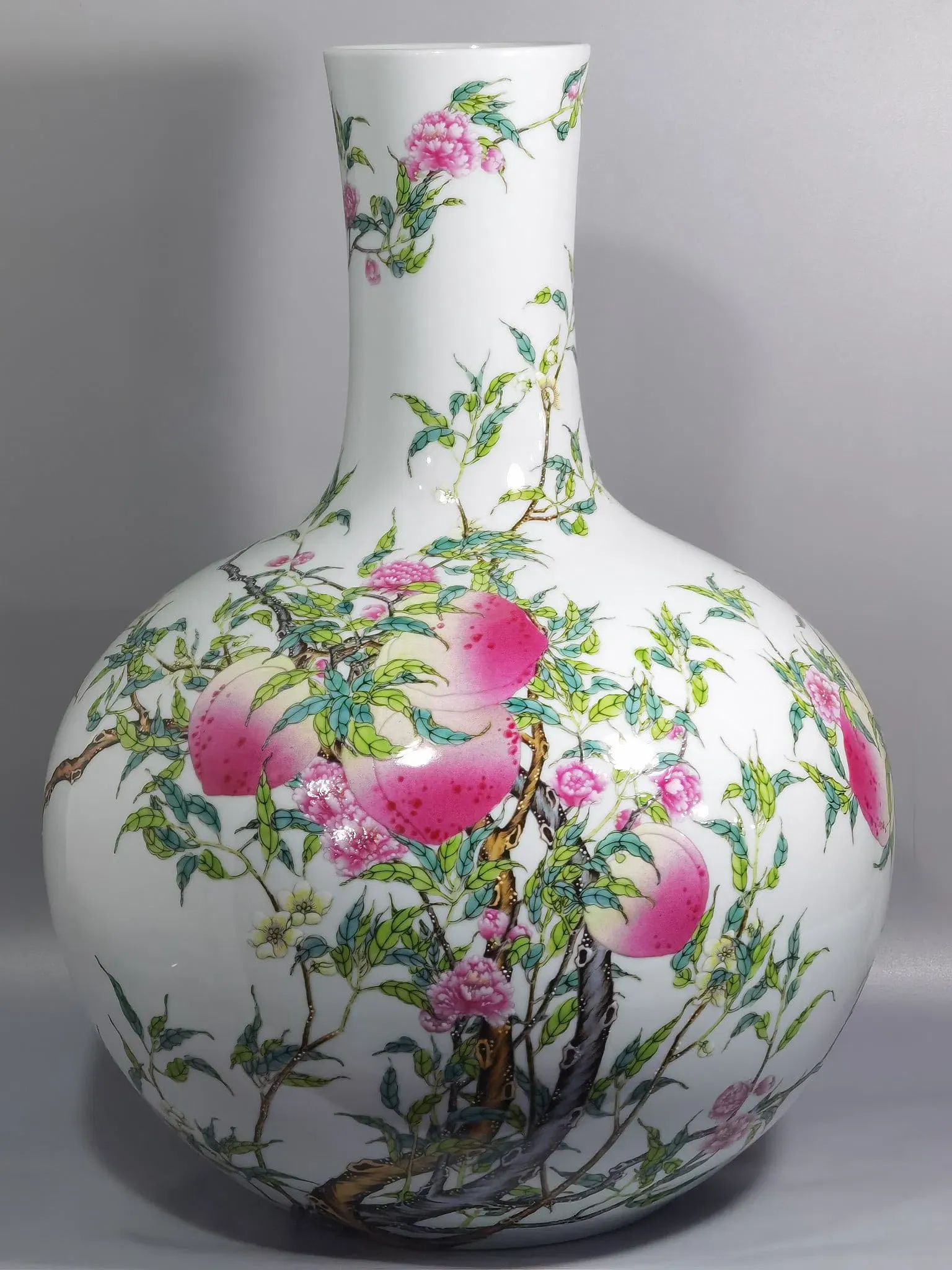
Here we have a Chinese famille rose style porcelain peach bottle vase, a shape long associated with elegant display pieces and auspicious symbolism. The peaches, blossoms, and bats are not random decoration—they form a classic visual wish for longevity, happiness, and blessing. That all sounds wonderfully Qing, and the base obligingly adds a Qianlong-style seal mark. But this is where connoisseurship must keep its footing. The painting is pleasant and carefully arranged, yet the surface is conspicuously fresh, the white ground unusually even, and the foot ring looks tidily finished in a way that feels modern rather than 18th century. The enamels are bright and decorative, with a polished, showroom gloss. Up close, the peach shading and outlines read more like later decorative porcelain than imperial or period workshop painting. The mark is best understood as honorific or imitative, not documentary. Condition appears excellent from the images, with no obvious chips or cracks visible. That helps display value, but paradoxically it also raises caution in a category where supposed centuries-old objects often show at least some honest wear. A word about copies.. Chinese porcelain is one of the great minefields of the antiques market, and Qianlong-marked wares are reproduced endlessly. My authenticity score here is 18%. As a modern decorative reproduction, I would place the conservative auction estimate around $300 to $800. If this were genuinely of Qianlong period quality, we would be in an entirely different financial universe. A handsome vase, yes—but not, I think, an emperor's contemporary.
Used for this report's TTS and avatar presentation.
Item Report
Chinese Famille Rose Style Porcelain Peach Bottle Vase
中国粉彩风格瓷寿桃纹长颈瓶
By: Unknown maker; bearing an apocryphal Qianlong-style seal mark
Style: Chinese famille rose longevity-decoration porcelain, Qianlong style
Origin: China
Materials: Porcelain, famille rose enamels, underglaze blue mark
Age: Late 20th to early 21st century
Condition: Excellent (no obvious chips or cracks visible; likely modern piece, condition based only on photos)
Value: Auction estimate: as a reproduction/decorative modern example $300-$800; if authentic 18th-century Qianlong period imperial-quality example, the value would likely be many tens of thousands to well over $100,000 depending on provenance, quality, and condition.
Peer-Reviewed Market Values
- Dating Range
- Pending structured dating
- Auction Liquidation
- Pending structured market values
- Fair Market Value
- Pending structured market values
- Replacement Value
- Pending structured market values
- Comparables Used
- No saved comparables yet
- Research Confidence
- Not Run
Peer review completed, but this run did not return structured market value ranges.
Maker's Marks / Writing: Underglaze blue four-character seal mark appears to read 乾隆年製 / 大清乾隆年製 style, meaning 'Made in the Qianlong period of the Great Qing,' but it is almost certainly apocryphal on this vase.
Date: 2026-04-09 02:48:35.455350
Description:
A large white-ground porcelain bottle vase with tall cylindrical neck and rounded body, finely painted with peaches, blossoming branches, foliage, and bats in the traditional longevity motif. The decoration is executed in famille rose enamels with a polished modern surface and an apocryphal underglaze-blue seal mark on the base. 一件大型白地瓷瓶,长直颈、圆鼓腹,通体以寿桃、花枝、叶片与蝙蝠等传统祝寿题材装饰。纹饰采用粉彩绘制,表面光洁偏新,底部见青花仿古篆书款。
Curator Questions
Curated by Jade
Assessment:
This appears to be a modern decorative Chinese porcelain vase made in the style of Qing dynasty famille rose wares rather than an authentic Qianlong-period object. The painting is attractive and competent, but the pristine glossy surface, highly even white ground, mechanically neat foot, and conspicuously fresh enamels strongly suggest recent manufacture. The underbase mark is almost certainly apocryphal. A word about copies.. Chinese porcelain is one of the most heavily reproduced categories in the antiques trade, and Qianlong-style seal marks are especially common on late 20th-century and contemporary decorative wares. Fakery check: the mark does not, by itself, support age; the object lacks the nuanced wear, kiln character, and period surface one expects from an 18th-century vase. This should be valued conservatively as a modern decorative reproduction. 此瓶更像是一件现代制作的中国装饰瓷,采用清代粉彩器的风格,而非真正的乾隆时期实物。绘工颇为悦目且较为熟练,但其表面过于光亮洁新、白釉过分均匀、圈足修整过于规整,彩料也显得十分新鲜,这些都强烈指向近现代烧造。底款几乎可以肯定是寄托款。A word about copies.. 中国瓷器是古玩市场中仿制最泛滥的门类之一,尤其是乾隆风格篆书款,常见于二十世纪晚期至当代的装饰瓷。仿伪核查:底款本身并不能证明年代;器物缺乏十八世纪瓷器应有的自然磨损、窑火气息与旧器包浆感。因此应将其保守估值为现代装饰性仿古瓷。
Individual Images:
- whole vase front
- whole vase side view
- whole vase reverse
- upper half of vase
- front vase detail
- detail of peach painting
- detail of peach branch
- detail of bat motif
- base of vase
- detail of seal mark
Provenance:
No provenance documentation shown.
Condition:
Excellent (no obvious chips or cracks visible; likely modern piece, condition based only on photos)
Identification Score: 94%
The form, palette, peach-and-bat longevity theme, and seal-marked base clearly identify it as a Chinese famille rose style bottle vase, although exact dating and workshop attribution cannot be confirmed from photos alone. 其器形、设色、寿桃与蝙蝠的祝寿题材,以及带篆书款的底部,都清楚表明这是一件中国粉彩风格的长颈瓶;但仅凭照片仍无法精确确认具体年代与窑口作坊。
Authenticity Score: 18%
The vase shows multiple modern indicators: very fresh enamels, uniformly bright white body, glossy unworn finish, cleanly machined-looking foot rim, and a likely spurious Qianlong-style seal mark. Because Qianlong-marked wares are widely copied, and no convincing period wear or kiln evidence is visible, I regard this as a modern reproduction with low probability of Qing-period authenticity. 此瓶呈现多项现代制品特征:彩料新鲜、胎釉白度过于均匀明亮、表面光泽过强且缺乏自然磨耗、圈足修整带有机械化整洁感,底部乾隆风格篆书款大概率为伪托。由于带乾隆款瓷器被大量仿制,而照片中也未见足够可信的时代磨损或窑烧老化痕迹,因此我认为它是现代仿制品,属清代真品的可能性很低。
Image Memory Note
None None
Keywords
Chinese porcelain vase, famille rose, peach vase, longevity motif, bats, Qianlong style, seal mark, reproduction, China 中国瓷瓶, 粉彩, 寿桃纹, 祝寿题材, 蝙蝠纹, 乾隆风格, 篆书款, 仿制品, 中国
Peer Review Summary
Peer Review
Key Visible Evidence
The subject vase (Images 1-3) presents a classic bottle form with a globular body and a tall, cylindrical neck. The decoration (Images 4-7) features the traditional 'nine peach' motif with bats, executed in famille rose enamels on a bright white ground. The enamels are vibrant, appear thickly applied, and exhibit a high gloss with a pristine, unworn surface. Close-up views (Images 5-7) show crisp outlines and a somewhat uniform application of color, lacking the subtle variations and depth often associated with 18th-century imperial porcelain. The foot rim (Image 8) is notably clean, sharp, and evenly finished, with a very white, smooth biscuit area that shows no signs of age-related discoloration, grit, or typical kiln imperfections expected from an antique piece. The inner foot rim is also remarkably clean. The underglaze blue seal mark on the base (Image 8) is precisely rendered and appears to read 乾隆年製 (Qianlong Nian Zhi) in seal script. The blue color is consistent and lacks the 'heaping and piling' effect or varied tones often seen in genuine period underglaze blue.
Market and Source Support
The report's identification of the mark as 乾隆年製 (Qianlong Nian Zhi) is confirmed by visual comparison with established Qianlong seal marks in reference materials (RAG_REF_3, RAG_REF_4, RAG_REF_5). The characters 乾 (Qian), 隆 (Long), 年 (Nian), and 製 (Zhi) are clearly legible in seal script. Grounded sources and market knowledge widely confirm that Qianlong reign marks are among the most frequently copied on later Chinese porcelain, particularly on decorative wares produced from the late 20th century onwards. The presence of such a mark, especially when combined with modern manufacturing characteristics, is generally considered apocryphal rather than indicative of period production. The report's dating of 'Late 20th to early 21st century' for this piece is well-supported by the visible evidence of modern production techniques and surface quality, aligning with common market understanding of such reproductions.
Needs Verification
While the visual evidence strongly points to modern manufacture, a more definitive assessment could benefit from a UV light examination to rule out any subtle repairs or overpainting that might be masked by the pristine surface. Macro photography of the enamel surface and glaze could potentially reveal microscopic characteristics (e.g., air bubbles, enamel composition, glaze texture) that further differentiate modern production from 18th-century techniques. Specific gravity testing could provide additional data on the porcelain body composition, though this is typically beyond photographic assessment.
Audit Conclusion
The report's assessment that this is a modern decorative Chinese porcelain vase, dating to the late 20th to early 21st century, is thoroughly supported by the visible evidence. The pristine, glossy surface, the uniform white ground, the mechanically neat foot rim, and the bright, unworn enamels are all consistent with recent manufacture. The underglaze blue seal mark, correctly identified by the report as 乾隆年製 (Qianlong Nian Zhi), is clearly apocryphal, a common feature on later reproductions. The report's conservative valuation as a modern decorative item is appropriate and aligns with comparable market results for similar pieces. The audit finds the report's claims to be well-grounded and appropriately skeptical regarding authenticity and dating.
Comparables (Similar Items)
No archived comparables matched this report yet.
Share: