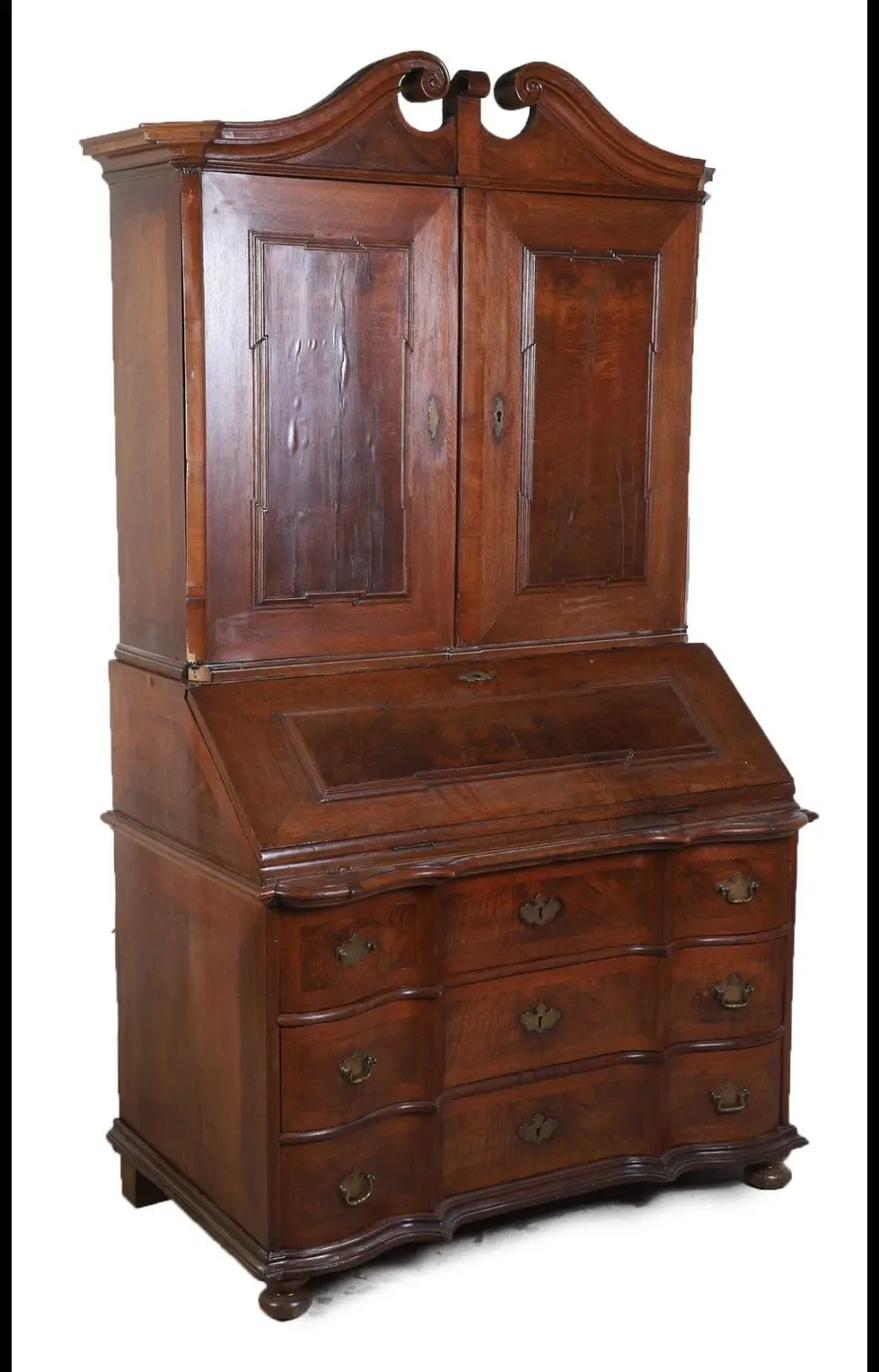
Let’s open the conversation with what we’re really looking at: a Continental Baroque Style walnut bureau bookcase, a grand hybrid of book storage and writing desk that once proclaimed wealth and literacy in equal measure.
At first glance—the broken-scroll pediment, the serpentine lower drawers, the tall, commanding silhouette—you might think early 18th century, perhaps Dutch or German. That is exactly the language this piece is speaking. It quotes the Baroque vocabulary fluently, but with a slightly more modern accent.
Look closer at the drawers and underside and the story shifts. The dovetails are neat and regular, the secondary woods evenly sawn, the brass hardware standardized rather than hand-forged. Add to that some later strap reinforcements and you’re in the realm of a well-made late 19th–early 20th century revival piece, not a survivor from 1720.
The walnut has developed a pleasing, warm patina, and the interior still feels wonderfully architectural, with its stepped drawers and pigeonholes—very much a working scholar’s stage set. Condition is honest: wear on the edges, repairs to stress points, but no catastrophic losses.
In terms of authenticity, I’d place this around 25% on the “true period” scale: stylistically faithful, but not of the Baroque period itself. Value follows that conclusion—perhaps $1,500 to $3,000 at auction as a handsome Baroque Style secretary, whereas a fully documented early-18th-century original of this scale could bring several times that. Still, as a dramatic focal point in a room, it absolutely earns its keep.
Used for this report's TTS and avatar presentation.
Item Report
Continental Baroque Style Walnut Bureau Bookcase
By:Unknown cabinetmaker
Style:Baroque / Early 18th-century revival, Continental (probably Dutch or German influence)
Origin:Continental Europe (likely Netherlands or Germany)
Materials:Walnut (and/or stained hardwood with walnut veneers), secondary softwoods, brass escutcheons and pulls, iron hinges and reinforcing brackets
Age:Circa 1880–1930 (late 19th to early 20th century, in Baroque style)
Condition:Good (structurally sound but with visible repairs, edge wear, some losses and reinforcements to writing flap and sides)
Value:If authentic early-18th-century Baroque period: US $8,000–15,000 at auction. As a late 19th–early 20th century Baroque Style reproduction (most likely): US $1,500–3,000 at auction.
Maker's Marks / Writing:No visible maker’s marks or inscriptions in the provided images.
Date:2025-12-08 01:16:29.133512
Description:
Tall two-part bureau bookcase in stained walnut, with a broken-scroll pediment over paneled double doors, above a fall-front writing slope and serpentine-front chest of drawers on bun feet. The interior fitted with small drawers, pigeonholes, and shelves. Overall proportions, molded panels, and lively serpentine lower case evoke late Baroque / early 18th-century models, but details of construction and hardware suggest a later reproduction made in traditional manner.
Curator Questions
Curated by Jade
Assessment:
Large and impressive Baroque-inspired bureau bookcase, very decorative and practical for storage. The broken-scroll pediment, serpentine drawer fronts, and fitted interior all follow early 18th-century Dutch/German precedents. However, the joinery and surfaces point to a later, probably late-19th/early-20th-century workshop piece: relatively regular machine-cut dovetails, uniform boards, and hardware that lacks the hand-wrought irregularity of true Baroque cabinetry. Wear, shrinkage, and later repairs (metal strap hinges, replaced or reinforced elements) show honest use but not 300 years of age. Collectible as a good quality revival case piece rather than a museum-level period secretary.
Individual Images:
none
Provenance:
Not provided.
Condition:
Good (structurally sound but with visible repairs, edge wear, some losses and reinforcements to writing flap and sides)
Identification Score: 90%
Form, layout, and decorative vocabulary clearly match a Continental Baroque bureau bookcase; images of interior and construction provide enough detail to be confident about the general type, although exact regional attribution remains somewhat open.
Authenticity Score: 25%
Construction details—regular machine-cut dovetails, relatively uniform machining on drawer sides, and standardized brass hardware—indicate a later Baroque Style reproduction rather than an early 18th-century period piece. Surface patina and wear appear consistent with perhaps 100–140 years of age, not 300+. A word about fakes.. Baroque case furniture is heavily copied, and many pieces claim 18th-century origins; without clearly hand-wrought hardware, cruder early dovetails, and deeper age patina, one should assume a later reproduction, which is the safer reading here.
Image Memory Note
None
None
Keywords
Baroque Style bureau bookcase, walnut secretary, serpentine chest, Continental European furniture, Dutch German revival, antique desk, Netherlands, Germany
The report was edited after initial Artmink draft. Original AI draft preserved in Artmink audit history.

Share: