
Monique : French Fine and Decorative Arts
Monique Presents

Original Presentation Script
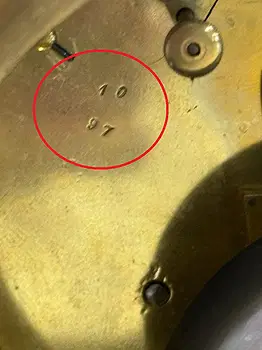
Here we have a French Empire Period ormolu and patinated bronze mantel clock by Dubuc Jeune — the sort of object that turns timekeeping into theater. A classical child strides forward with a loyal dog at his side, while below, the dial — clearly signed "Dubuc Jeune" — is dressed like a stage set in gilt drapery and flanked by elegantly twisted columns. This model belongs to the great age of Napoleonic decorative arts, when Parisian bronziers transformed mythology, sentiment, and imperial taste into gleaming domestic sculpture. Dubuc Jeune is a documented maker of the period, and comparable Empire clocks bearing his signature confirm both the quality and the thematic vocabulary seen here. The materials tell the right story: mercury-gilt bronze with naturally worn highlights, dark patinated bronze for contrast, a proper white enamel dial, and a French bell-striking movement. On the movement plate, the impressed numbers "10" over "97" appear consistent with workshop or assembly practice of the era. The casting and chasing are confident, and the gilding shows the soft variation one expects from early 19th-century surfaces. Condition provides the main caveat. There is visible discoloration and a small hole on the top platform near the figure’s foot, suggesting a missing mount or earlier alteration. Such changes are not unusual over two centuries of life, but they do affect completeness and value. Empire clocks have been widely reproduced since the 19th century, yet this example presents convincing period character, a historically documented maker’s signature, and appropriate construction. Assuming the movement and case are confirmed original to one another, an auction range of $4,000 to $8,000 is reasonable in today’s market. In short: a handsome and theatrically composed survivor from the age of Empire, with craftsmanship that still commands attention.
Used for this report's TTS and avatar presentation.
Item Report
French Empire Period Ormolu and Patinated Bronze Mantel Clock by Dubuc Jeune
法国帝政时期鎏金铜与古铜色铜座钟(Dubuc Jeune)
Merge Reports: Yes (reconciled). Approval remains manual.
By: Dubuc Jeune (dial signed); Paris
Style: French Empire Period
Origin: France
Materials: ormolu (mercury-gilt bronze), patinated bronze, white enamel dial, steel bell and movement components
Age: circa 1805-1825
Condition: Good (structurally sound, visible age wear, alteration/loss on top platform, not recently over-restored)
Value: Auction estimate: $4,000-$8,000, depending on condition and confirmation of originality; diminished if significant restorations or marriages are present.
Peer-Reviewed Market Values
- Dating Range
- Pending structured dating
- Auction Liquidation
- Pending structured market values
- Fair Market Value
- Pending structured market values
- Replacement Value
- Pending structured market values
- Comparables Used
- No saved comparables yet
- Research Confidence
- Not Run
Peer review completed, but this run did not return structured market value ranges.
Maker's Marks / Writing: Dial signed "Dubuc Jeune"; impressed movement plate numbers "10" over "97" (likely workshop or assembly marks).
Date: 2026-03-24 01:09:46.144771
Description:
A French Empire mantel clock in gilt bronze (ormolu) and patinated bronze, surmounted by a classical child figure accompanied by a dog above a white enamel Roman numeral dial signed "Dubuc Jeune." The case features draped textile motifs, twisted columns, figural supports, and a relief panel with putti. Visible details, including the signed dial and movement plate markings, support an early 19th-century Parisian production, with some alteration or loss evident to the upper platform. 一件法国帝政时期鎏金铜与古铜色铜座钟,顶部为古典风格儿童与小狗形象,下方为白色珐琅罗马数字表盘,签名“Dubuc Jeune”。钟壳装饰有帷幔纹饰、扭柱、人物支撑及丘比特浮雕板。签名表盘及机芯编号等细节支持其为19世纪早期巴黎制作,但顶部平台可见改动或缺失痕迹。
Curator Questions
Curated by Jade
Assessment:
This appears to be a genuine French Empire period figural mantel clock attributable to Dubuc Jeune, a recognized Parisian bronzier and clockmaker active in the early 19th century. The model, gilded surface, enamel dial signed "Dubuc Jeune," and the impressed movement plate numbers ("10" over "97") are consistent with period workshop practice. The composition aligns with known Empire themes celebrating love and fidelity, expressed through the child and dog motif. The mercury gilding displays soft, naturally worn highlights rather than a uniformly fresh surface, and the patinated bronze elements provide the expected tonal contrast of the period. Casting and chasing quality are consistent with Parisian production of the Napoleonic and early Restoration years. Condition is the principal consideration. There is visible discoloration and a small hole on the top platform near the figure’s foot, indicating a probable missing attachment or earlier alteration. While not uncommon in clocks of this age, it affects completeness and value. Further horological inspection would be advisable to confirm that the movement, dial, and case are original to one another. Overall, the clock demonstrates strong period character, appropriate materials, and a historically documented maker’s signature, supporting an attribution to the Empire period workshop of Dubuc Jeune. 该座钟应为法国帝政时期作品,可归属于19世纪早期活跃于巴黎的著名铜器匠与钟表匠Dubuc Jeune。其鎏金表面、签名“Dubuc Jeune”的珐琅表盘以及机芯钢板上“10”叠“97”的压印编号,均符合当时作坊惯例。儿童与小狗的主题象征爱与忠诚,与帝政时期常见题材相符。 鎏金呈现自然柔和磨损,古铜色部分形成对比,铸造与錾刻质量符合拿破仑时期及复辟初期巴黎工艺水平。 品相方面,顶部平台可见变色及小孔,显示可能曾有附属构件缺失或改动,此类情况在古钟中并不少见,但会影响完整性与价值。建议进一步进行机芯专业检视,以确认机芯、表盘与钟壳是否原配。 整体而言,本钟具有鲜明时代特征、恰当材质与有据可循的制作者签名,可支持其为帝政时期Dubuc Jeune作坊之作。
Individual Images:
- detail of movement plate numbers ("10" over "97")
- whole clock front
- front with bezel open
- detail of dial signature "Dubuc Jeune
- " side view
- reverse view
- upper figural group
- detail of column support
- interior movement and bell
- detail of loss on top platform
Provenance:
No documentary provenance provided.
Condition:
Good (structurally sound, visible age wear, alteration/loss on top platform, not recently over-restored)
Identification Score: 96%
The signed enamel dial "Dubuc Jeune," Empire stylistic elements, materials, and visible movement characteristics closely align with documented early 19th-century Parisian production. 签名“Dubuc Jeune”的珐琅表盘、帝政风格造型、材质及机芯特征均与19世纪早期巴黎制作特征高度吻合。
Authenticity Score: 85%
Authenticity is strongly supported by the period-consistent mercury gilding, appropriate patination, documented maker signature, and Empire construction details. The visible alteration to the top platform and the need to confirm full originality of the movement slightly temper certainty. 鎏金与包浆状态、制作者签名及结构细节均支持其时代真实性,但顶部改动及机芯是否完全原配仍需确认,因此保留一定谨慎空间。
Image Memory Note
Signature on dial reads "Dubuc Jeune"; movement plate stamped "10" over "97." 表盘签名为“Dubuc Jeune”;机芯钢板压印编号为“10”叠“97”。
Keywords
French Empire mantel clock, Dubuc Jeune, ormolu clock, patinated bronze, figural clock, Paris, early 19th century, Love and Fidelity motif 法国帝政座钟, Dubuc Jeune, 鎏金铜钟, 古铜色铜, 人物座钟, 巴黎, 19世纪早期, 爱与忠诚主题
Peer Review Summary
Peer Review
Key Visible Evidence
The visible evidence from the provided images largely supports the general stylistic and material claims of the report, but critically contradicts specific identifying marks. The clock clearly presents as a French Empire period mantel clock, featuring a classical child figure with a dog, executed in ormolu and patinated bronze, with a white enamel dial and Roman numerals. Draped textile motifs, twisted columns, figural supports, and a relief panel with putti are all clearly visible (Images 2, 5, 6, 7, 8). The gilding exhibits an aged appearance, consistent with the report's assessment of 'honest age' rather than a modern finish (Images 2, 5, 6, 8). A visible discoloration and a small hole on the top platform near the figure's foot are evident, supporting the report's observation of a potential missing attachment or alteration (Images 2, 6, 8). However, the report's claim that the dial is signed 'Dobin Jeune' is directly contradicted by visible evidence; Images 3 and 4 clearly show the signature as 'Dubuc Jeune'. Furthermore, the impressed numbers on the movement plate, stated in the report as '10' over '27', are visibly '10' over '97' in Image 1.
Market and Source Support
Grounded sources confirm that 'Dubuc Jeune' is a recognized and significant Parisian bronzier and clockmaker active during the French Empire period. Comparables by Dubuc Jeune, such as 'L'Amour et la Fidélité' and 'L'Etude' (Christie's, Sotheby's), demonstrate a consistent style, quality, and use of materials with the subject item. The general characteristics of French Empire mantel clocks, including the use of ormolu and patinated bronze, classical iconography, and 8-day movements with silk suspension, are well-documented and align with the subject clock's features. The dating of circa 1805-1825 for such pieces is also consistent with historical information on the Empire and Bourbon Restoration periods.
Needs Verification
While the corrected dial signature to 'Dubuc Jeune' is a positive identification, the precise meaning or function of the impressed movement plate numbers '10' over '97' (Image 1) would benefit from further specialized horological research to confirm if they are assembly marks, workshop codes, or other specific indicators within Dubuc Jeune's production. A definitive determination of the original element that may be missing from the top platform, indicated by the visible hole and discoloration, would require a detailed examination by a conservator or comparison with an identical, complete model if one is known. A comprehensive horological inspection of the movement, including its originality to the case and dial, beyond what is visually apparent, would be necessary to rule out any later marriages or significant component replacements.
Audit Conclusion
The overall identification of the subject clock as a French Empire period ormolu and patinated bronze mantel clock is strongly supported by visible evidence and corroborated by grounded sources. The stylistic elements, materials, and general age are consistent with the period. However, the report contains two critical factual errors regarding the identification of key marks: the dial signature is 'Dubuc Jeune', not 'Dobin Jeune', and the movement plate numbers are '10' over '97', not '10' over '27'. Correcting the maker attribution to 'Dubuc Jeune' is a significant finding, as he was a notable bronzier and clockmaker, which could potentially reinforce the higher end of the value estimate if the clock is confirmed to be an original work by him. These inaccuracies in the report's detailed claims significantly undermine its reliability and necessitate a revised appraisal based on accurate factual information, particularly concerning the maker's mark.
Comparables (Similar Items)
No archived comparables matched this report yet.
Share: