Japanese Edo Period Iron and Lacquer Samurai Armor (Tosei Gusoku)日本江户时代铁与漆武士铠甲(当世具足)
LANGUAGE UNLOCK
Glossary Roundup
Original Presentation Script
This commanding figure is a Japanese Edo Period Iron and Lacquer Samurai Armor — the kind of presence that can dominate a room even without drawing a sword.
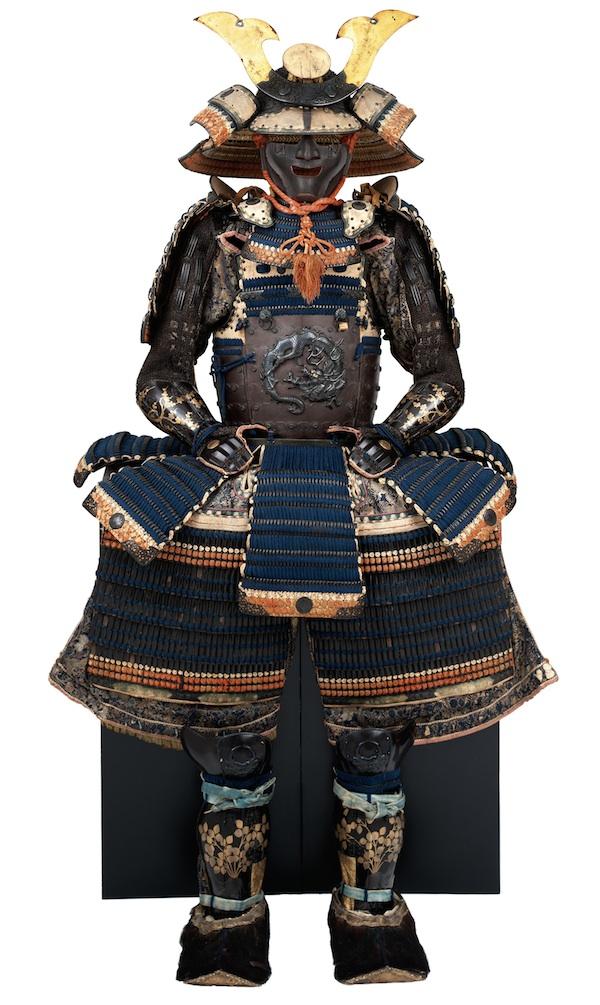
We’re looking at a full tosei gusoku ensemble: flaring kabuto helmet with bold gilt horns, a grim menpo mask, and a cuirass featuring a proud dragon in relief. The deep indigo lacing and textile trims place it squarely in late-Edo taste, when armor was as much about status and ceremony as about battlefield survival.
The materials tell the story of serious craftsmanship: laminated iron plates sealed in lacquer, painstaking silk lacing, and leather, all arranged to flex with the body. Nothing here feels mass-produced; this is workshop work from a world where armorers were engineers, artists, and tailors in one.
Condition appears good, with honest wear to the lacquer and fraying to the cords — exactly what we hope to see. At the same time, the samurai market is flooded with composite and restored suits, so some elements here may well be later replacements.
Taking that into account, I’d place authenticity around 55% pending hands-on examination. At auction, I’d expect roughly $40,000–80,000 if confirmed as largely Edo and coherent, and about $8,000–20,000 if determined to be a more modern composite.
Either way, it’s an arresting survivor of Japan’s warrior culture — an entire social system distilled into iron, silk, and a very unambiguous stare.
Used for this report's TTS and avatar presentation.
Item Report
Japanese Edo Period Iron and Lacquer Samurai Armor (Tosei Gusoku)
日本江户时代铁与漆武士铠甲(当世具足)
By:Unknown Japanese armor workshop (kacchū-shi)
Style:Edo Period Japanese Samurai Armor
Origin:Japan
Materials:Lacquered iron and steel plates, silk and cotton lacing, leather, textile, horsehair, wood display stand
Age:Circa 18th–early 19th century (late Edo period), with possible later restorations
Condition:Good to very good (visible wear, fraying, and age-consistent losses; appears complete but likely with restorations)
Value:If largely authentic Edo-period assembly: US$40,000–80,000 at auction; if a composite with significant modern replacement or reproduction elements: US$8,000–20,000
Maker's Marks / Writing:None visible in provided image; many armors bear small interior labels or clan crests not visible here.
Date:2025-12-10 15:06:01.911557
Description:
Full suit of Japanese samurai armor comprising kabuto helmet with large gilt kuwagata crests, russet-iron menpo mask with horsehair moustache, lamellar cuirass with embossed dragon medallion, sode shoulder guards, kote arm defenses, haidate thigh guards, and suneate shin guards. The plates are lacquered and laced in dark blue silk with contrasting lighter cords and decorative textile trim, typical of late-Edo aesthetics. Displayed on a black stand in complete, matching configuration.
一整套日本武士铠甲,包括带大型鎏金锹形前立的兜盔、带髭毛的褐铁面颊(面颊)、浮雕龙纹胸甲、袖形肩甲、小手臂甲、佩楯和臑当等部件。铠甲板片以黑褐色漆涂饰,并以深蓝色丝绳联结,配以浅色系串结和锦织边饰,呈现出江户晚期武家审美。整套铠甲配置完整统一,置于黑色陈列座上。
Curator Questions
Curated by Jade
Assessment:
Impressive and visually coherent suit of Japanese tosei gusoku armor in late-Edo style. The combination of lacquered iron, dense blue lacing, and decorative dragon motif suggests a mid- to upper-ranking samurai commission rather than battlefield mass issue. From the photo, the armor shows convincing age in the lacquer, textile fraying, and surface wear, though high-end modern workshop suits can mimic this appearance. Without close-up inspection of rivets, interiors, and lacing, it is safest to treat the set as an Edo-period core with possible later-composed or restored components. Still, as a decorative and historical object, it would be highly appealing to collectors and institutions.
这是一套气势恢宏、风格统一的日本当世具足铠甲,呈江户后期样式。黑漆铁甲配以密集的蓝色系威绳及胸前龙纹装饰,说明其应为中高阶武士的委制铠,而非普通战场制式。从照片来看,漆面、金属及织物部分均呈现出可信的旧化与磨损,但现代高仿铠也能在一定程度上模拟这种效果。由于缺乏铆钉、甲内结构和威绳细节的近照,较稳妥的判断是:整体应含江户时代原件,但可能为后期组合或局部修复。无论如何,作为陈设与历史研究对象,对收藏家和机构仍具相当吸引力。
Individual Images:
none
Provenance:
Not provided; provenance, if documented to a specific clan or collection, could significantly affect value.
Condition:
Good to very good (visible wear, fraying, and age-consistent losses; appears complete but likely with restorations)
Identification Score: 90%
Form, components, and construction are clearly those of a Japanese tosei gusoku samurai armor with Edo-period stylistic features; only minor uncertainty about precise dating and whether all elements are original to each other.
其结构、部件组合与做法明显为日本当世具足武士铠,且细节呈现典型江户时代风格;主要不确定点在于确切年代及各部件是否完全出自同一时期和同一套装。
Authenticity Score: 55%
Based on visible patina, textile wear, and traditional construction, the armor likely incorporates genuine Edo-period elements; however, given the prevalence of expertly aged modern reproductions and assembled suits, and without close physical inspection, a cautious mid-level authenticity score is appropriate. A word about fakes.. samurai armor is heavily reproduced today, with many composite suits made from mixed old and new parts, so one must assume reproduction or assembly until detailed examination proves otherwise.
从可见的包浆、织物磨损和传统结构判断,此铠很可能包含江户时代真品部件;但考虑到现代高仿与拼装铠极为普遍,在缺乏实物近距检查的情况下,只能给出偏中性的真实性评分以示谨慎。关于赝品需要强调的是:武士铠是当今被大量仿制的门类,许多整套铠由新旧零件拼合而成,因此在未做详尽检验前,应默认其为后配或部分复制品。
Image Memory Note
None
None
Keywords
Japanese samurai armor, Edo Period armor, tosei gusoku, kabuto, menpo, lacquered iron, Japan, warrior art, militaria
日本武士铠, 江户时代铠甲, 当世具足, 兜盔, 面颊, 漆甲, 日本, 武家艺术, 军事收藏
The report was edited after initial Artmink draft. Original AI draft preserved in Artmink audit history.

Share: