Jade : Chinese Fine and Decorative Arts
Jade Presents

Original Presentation Script
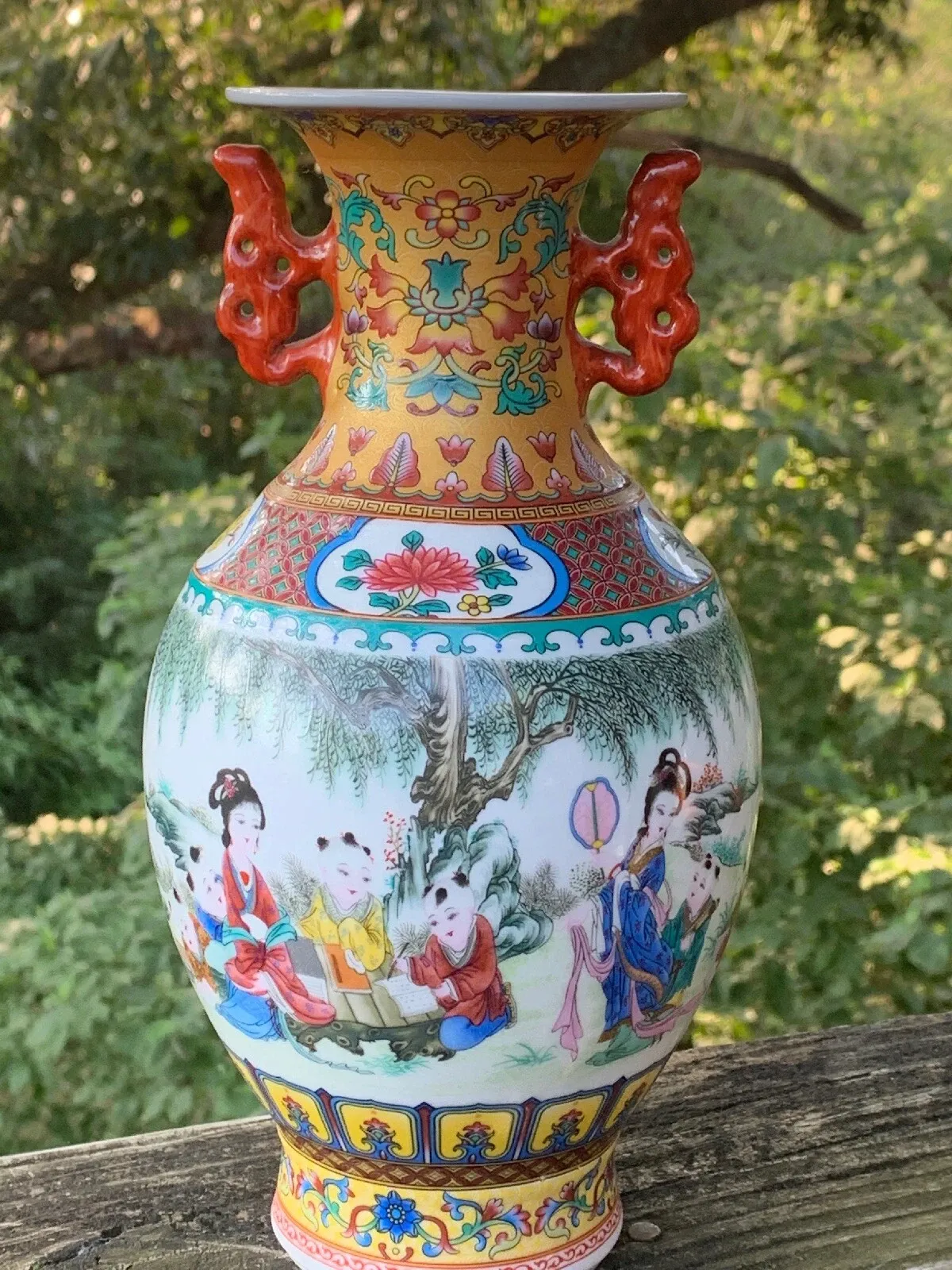
Here we have a Chinese famille rose style porcelain twin-handled vase, a form designed to look elegant, auspicious, and just a little theatrical. With its flared neck, coral-form handles, and lively palette, it borrows from Qing decorative taste—especially the world of court beauties, attendants, and children at play in garden settings. The subject matter is traditional: refined women, children, and a poetic inscription rendered in flowing calligraphy. On the base appears an iron-red square seal mark in a Qianlong style. Its indistinct execution and format, however, align with decorative apocryphal marks commonly used on later production rather than authentic imperial reign marks. The visual clues are consistent. The enamels are bright and evenly applied, the outlines crisp, and both the painted surfaces and molded handles carry a glossy, uniform finish. The foot rim shows only minimal wear. While charming and competently executed, the painting lacks the layered subtlety and natural aging associated with genuine Qing-period examples. Comparable 20th-century famille rose vases with ladies and children motifs have realized between approximately $100 and $250 at auction, placing this example comfortably within that decorative market range. The overall conclusion is that this is a modern Chinese decorative vase in famille rose style, most likely dating to the late 20th or early 21st century. It is best appreciated for its color, craftsmanship, and decorative presence rather than as an 18th-century antique.
Used for this report's TTS and avatar presentation.
Item Report
Chinese Famille Rose Style Porcelain Twin-Handled Baluster Vase
中国粉彩风格瓷双耳瓶
Merge Reports: Yes (reconciled). Approval remains manual.
By: unknown modern workshop
Style: Chinese Famille Rose Style Export/Decorative Porcelain
Origin: China
Materials: porcelain, overglaze famille rose enamels, iron-red seal mark
Age: late 20th to early 21st century, circa 1980–2020
Condition: Very Good (light base wear visible; no obvious major chips or cracks in provided photos, not professionally examined)
Value: Auction estimate: $100–$250, consistent with comparable 20th-century famille rose decorative vases featuring ladies and children motifs.
Peer-Reviewed Market Values
- Dating Range
- Pending structured dating
- Auction Liquidation
- Pending structured market values
- Fair Market Value
- Pending structured market values
- Replacement Value
- Pending structured market values
- Comparables Used
- 2 comparables
- Research Confidence
- Insufficient Data
Peer review completed, but this run did not return structured market value ranges.
Maker's Marks / Writing: One side bears a poetic inscription in Chinese calligraphy, decorative in character. The base carries an iron-red square seal mark in a Qianlong style; the mark is indistinct and does not conform to standard Qing imperial reign mark formats, and is considered apocryphal.
Date: 2026-05-15 02:39:31.122369
Description:
A Chinese-style porcelain vase of baluster form with a flared mouth and molded faux-coral handles, decorated in bright famille rose enamels with courtly female figures and children in a garden setting. The scene is framed by dense floral and geometric borders. One side features a poetic inscription in Chinese calligraphy. The base bears an iron-red square seal mark in the Qianlong style, decorative and apocryphal in character. The painting style, enamel application, and mark together indicate a modern decorative piece rather than a Qing period vase. 这是一件中国风格的瓷质双耳瓶,器形为撇口鼓腹,配仿珊瑚式贴塑双耳,通体以明艳粉彩装饰,绘有庭园仕女人物与童子题材,并饰繁密花卉及几何纹边饰。一侧题写诗文,底部施矾红方形篆书“乾隆”式印章款,具有装饰性质而非时代真款。结合绘画风格、彩料状态与款识特征来看,此器更可能为现代装饰性作品,而非清代时期真品。
Curator Questions
Curated by Jade
Assessment:
This vase presents as a modern Chinese decorative porcelain work in famille rose style, likely produced for the home décor or export market in the late 20th to early 21st century. The enamels are bright and uniformly applied, outlines are crisp, and both the painted surfaces and molded faux-coral handles have a glossy, consistent finish. The foot rim shows only minimal wear. The calligraphy appears decorative in nature, and the iron-red square seal mark on the base, rendered in a Qianlong style, does not correspond to standard Qing imperial reign marks and is best understood as apocryphal. The subject of ladies and children in a garden references traditional themes, but the execution lacks the painterly nuance and age characteristics associated with genuine Qing-period examples. 此瓶应为现代中国粉彩风格装饰瓷器,可能制作于20世纪晚期至21世纪初,主要面向陈设或外销市场。其彩料鲜艳且施彩均匀,线条清晰,绘画与仿珊瑚双耳釉面光亮一致,足缘磨损轻微。题字偏装饰性,底部矾红方形“乾隆”式印章款不符合清代官窑标准款识特征,应属仿款。仕女童子题材源于传统题材,但整体笔意与自然陈化痕迹不足以支持其为清代真品。
Individual Images:
- whole vase front
- whole vase front closer
- upper half of vase
- detail of figural painting
- detail of figural painting
- detail of figural painting
- lower half of vase
- detail of calligraphy
- base of vase seal mark (iron-red square Qianlong-style mark
- indistinct)
Provenance:
No provenance information provided.
Condition:
Very Good (light base wear visible; no obvious major chips or cracks in provided photos, not professionally examined)
Identification Score: 95%
The baluster form, famille rose palette, figural decoration of ladies and children, poem panel, and iron-red Qianlong-style seal mark clearly identify this as a Chinese-style porcelain decorative vase. While the specific workshop cannot be determined, the object type and decorative intent are clear and consistent with late 20th-century production. 器形、粉彩设色、仕女童子人物纹饰、题诗留白以及矾红“乾隆”式印章款,都清楚表明这是一件中国风格的装饰性瓷瓶。虽无法确定具体作坊,但器物类别与装饰取向明确,且符合20世纪晚期制品特征。
Authenticity Score: 25%
As an object of late 20th- to early 21st-century decorative manufacture, authenticity is strong within that context. However, if considered as a purported Qing-period imperial or period piece, the likelihood is low. The fresh enamels, glossy and uniformly modeled handles, minimal foot wear, decorative calligraphy, and indistinct iron-red Qianlong-style seal mark all support classification as a modern apocryphal-marked example rather than an 18th-century work. 若将其视为20世纪晚期至21世纪初的装饰性制品,其真实性较高;但若按清代官窑或清代时期器物认定,则可能性较低。彩料新亮、双耳造型与釉面均匀、足部磨损轻微、题字偏装饰性,以及底部矾红“乾隆”式印章款较为模糊且不符官窑标准,均支持其为现代仿款作品。
Image Memory Note
Base shows an indistinct iron-red square Qianlong-style seal mark; enamels bright and glossy overall. 底部可见较为模糊的矾红方形“乾隆”式印章款;整体彩料鲜艳且釉面光亮。
Keywords
Chinese vase, famille rose style, porcelain vase, twin handles, ladies and children motif, Qianlong style seal mark, apocryphal mark, modern decorative porcelain, late 20th century 中国瓷瓶, 粉彩风格, 瓷器, 双耳瓶, 仕女童子图, 乾隆式印章款, 仿款, 现代装饰瓷, 二十世纪晚期
Peer Review Summary
Peer Review
Key Visible Evidence
The vase exhibits characteristics consistent with modern decorative porcelain, including bright, uniformly applied enamels, crisp outlines, and a glossy finish on both the painted surfaces and the molded faux-coral handles (Images 1-6). The foot rim shows minimal wear (Image 7). The calligraphy appears decorative, and the iron-red square seal mark on the base (Image 8) is indistinct and does not resemble standard Qing imperial reign marks, supporting its classification as apocryphal.
Market and Source Support
Market comparables for similar Chinese Famille Rose style vases, featuring ladies and children motifs and dating to the 20th century, consistently realize prices in the $100-$250 range at auction. These comparables reinforce the assessment of the subject item as a modern decorative piece rather than an antique Qing-period object.
Needs Verification
A clearer, high-resolution image of the base mark (Image 8) would be beneficial to attempt a more precise transcription, although its apocryphal nature is strongly suggested by current visual evidence and context.
Audit Conclusion
The report's assessment of the vase as a modern Chinese decorative piece, likely late 20th to early 21st century, with an apocryphal mark, is well-supported by both visible evidence and grounded market comparables. The proposed valuation range is consistent with the market for similar contemporary decorative items.
Comparables (Similar Items)
No archived comparables matched this report yet.
Share: