Jade : Chinese Fine and Decorative Arts
Jade Presents

Original Presentation Script
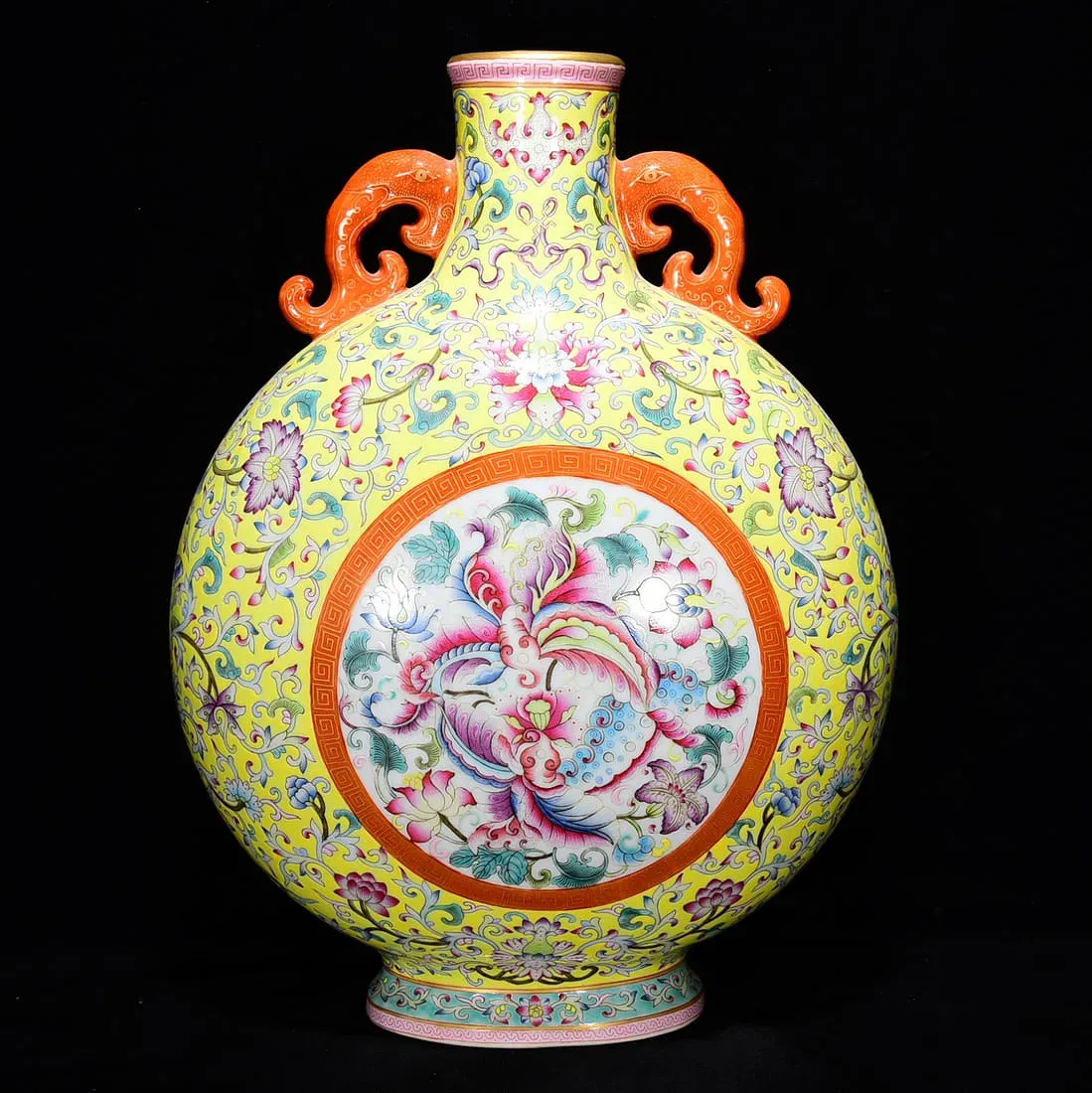
Here we have a Chinese Qianlong Style Famille Rose Yellow-Ground Porcelain Moon Flask — a form beloved for its flattened circular body and theatrical side handles, here modeled as elephant heads. It is a piece designed to impress, and it certainly does. The design draws directly from Qing court porcelain: yellow ground, scrolling lotus-like arabesques, and famille rose floral medallions framed in formal borders. The base bears a Qianlong seal mark, which, in theory, would suggest one of the most valuable categories in Chinese ceramics. In practice, that is exactly why one must be careful. The craftsmanship is competent and decorative, but the surfaces tell the real story. The enamels are very bright, very even, and conspicuously glossy. The painted ornament feels highly controlled, almost workshop-standardized, rather than possessing the subtle variation and patina one expects from an 18th-century imperial vessel. The base, too, is suspiciously clean, with only slight discoloration around the footrim. A word about copies.. Qianlong-marked Chinese porcelains are reproduced in enormous numbers, and yellow-ground wares are especially prone to deliberate overstatement. This example reads as a later decorative reproduction, likely late 20th century or newer, rather than a true Qing imperial piece. I’d assign an authenticity score of 18%. As a reproduction, the conservative auction estimate is about $300 to $800. If it were genuinely of the Qianlong period, the value would leap dramatically — roughly $80,000 to $180,000 or more. A handsome object, yes — but one that whispers empire rather than proves it.
Used for this report's TTS and avatar presentation.
Item Report
Chinese Qianlong Style Famille Rose Yellow-Ground Porcelain Moon Flask
中国乾隆风格粉彩黄地瓷抱月瓶
By: Unknown workshop
Style: Chinese Qing Revival / Qianlong Style porcelain
Origin: China
Materials: Porcelain, famille rose enamels, underglaze blue mark
Age: Likely late 20th to early 21st century, circa 1980-2020
Condition: Excellent (appears very clean and glossy; likely later production, minor footrim soil only)
Value: If authentic period: USD 80,000-180,000 at auction; as a later decorative reproduction: USD 300-800 at auction
Peer-Reviewed Market Values
- Dating Range
- Pending structured dating
- Auction Liquidation
- Pending structured market values
- Fair Market Value
- Pending structured market values
- Replacement Value
- Pending structured market values
- Comparables Used
- No saved comparables yet
- Research Confidence
- Not Run
Peer review completed, but this run did not return structured market value ranges.
Maker's Marks / Writing: Underglaze blue four-character seal mark reading 'Qianlong Nian Zhi' (Made in the Qianlong period), but likely apocryphal / later honorific mark. Chinese: '乾隆年制'.
Date: 2026-03-21 07:13:21.372800
Description:
A highly decorative Chinese porcelain moon flask with flattened globular body, cylindrical neck, and molded elephant-head ring handles. It is painted in famille rose enamels on a bright yellow ground with dense scrolling floral arabesques and large circular floral medallions. The underside bears an apocryphal underglaze-blue seal mark of Qianlong. 一件装饰性很强的中国瓷抱月瓶,器形为扁圆腹、直筒颈,并饰模印象首耳。通体施粉彩于明艳黄地之上,绘缠枝花卉卷草纹,并配大幅圆形花卉开光。底部书青花矾红式乾隆篆书款,但应属寄托款。
Curator Questions
Curated by Jade
Assessment:
This appears to be a modern Chinese decorative porcelain moon flask made in the Qianlong style rather than an 18th-century imperial-period object. The colors are unusually bright and uniform, the enameling is very crisp and glossy, and the overall condition is conspicuously clean for a supposedly Qianlong-era piece. The elephant-head handles and yellow-ground floral design are based on Qing court taste, but the finish and mark strongly suggest a later workshop product. A word about copies.. Chinese imperial-style porcelains are among the most heavily reproduced categories in the antiques market, especially yellow-ground and Qianlong-marked wares, so caution is essential. 此件应为现代中国装饰瓷抱月瓶,采用乾隆风格制作,而非十八世纪乾隆朝御窑真品。其设色过于鲜艳均一,彩料表面光泽强、线条过于利落,而且整体品相对于一件若真为乾隆时期的器物而言显得过分洁净。象首耳与黄地缠枝花卉纹确实借鉴了清代宫廷审美,但其釉彩质感与底款都更像后期作坊制品。A word about copies.. 中国宫廷风格瓷器,尤其是黄地器与乾隆款识器,在古玩市场中复制品极多,因此必须格外谨慎。
Individual Images:
- whole moon flask front
- upper half moon flask
- detail of floral medallion
- detail of yellow-ground decoration
- base of moon flask
- detail of apocryphal mark
Provenance:
No provenance documentation shown in the images.
Condition:
Excellent (appears very clean and glossy; likely later production, minor footrim soil only)
Identification Score: 94%
The form, decoration, and base mark clearly identify this as a Chinese porcelain moon flask in the Qing imperial revival taste. Confidence is high on object type because the flattened body, ring handles, famille rose palette, and yellow-ground court-style ornament are all legible in the images. 从器形、纹饰与底款判断,这是一件中国瓷抱月瓶,属于清代宫廷审美的仿古风格。对器物类别的判断把握较高,因为其扁圆腹、耳饰、粉彩设色以及黄地宫廷式装饰特征都十分清晰。
Authenticity Score: 18%
The Qianlong seal mark is almost certainly spurious. Fakery check: the enamels appear too fresh and glossy, the yellow ground too even, and the painted ornament too mechanically consistent for an 18th-century imperial object. There is very little visible wear, no meaningful age-related abrasions, and the base is unusually clean except for light artificial-looking grime at the footrim. FAKER FLAG #6 applies here: a Qianlong mark combined with surfaces and decoration that do not meet 18th-century standards points to a modern reproduction, likely made for the decorative export or collector market. 这件器物上的乾隆篆书款几乎可以肯定是伪托款。作伪核查:粉彩釉面显得过于新亮,黄地发色过于均匀,纹饰绘制也过于机械整齐,不符合十八世纪御窑器常见的自然笔意与岁月痕迹。表面几乎看不到真实的长期磨损,也缺少与年代相符的擦痕与旧气,底足除了轻微、略显刻意的污色之外过于洁净。这里符合 FAKER FLAG #6:带乾隆款,但器表、彩饰与工艺标准不符十八世纪特征,应视为现代仿制品,可能为装饰市场或收藏市场所制。
Image Memory Note
None None
Keywords
Chinese porcelain moon flask, Qianlong style, famille rose, yellow ground, elephant handles, apocryphal Qianlong mark, Qing revival, China 中国瓷抱月瓶,乾隆风格,粉彩,黄地,象首耳,乾隆寄托款,清式仿古,中国
Peer Review Summary
Peer Review
Key Visible Evidence
The object is a moon flask with a flattened globular body, cylindrical neck, and molded elephant-head ring handles, decorated with famille rose enamels on a bright yellow ground (Image 1, 2). The decoration consists of dense scrolling floral arabesques and large circular floral medallions (Image 3, 4). The enamels appear exceptionally bright, uniform, and glossy, with a very clean and reflective glaze surface (Image 1, 2, 3, 4). The base (Image 5) is largely clean, showing only minimal discoloration around the footrim. The underside bears an underglaze blue four-character seal mark (Image 5, 6). The characters are clearly legible as 乾隆年製 (Qianlong Nian Zhi), meaning 'Made in the Qianlong period.'
Market and Source Support
The report's identification of the object as a Chinese porcelain moon flask in the Qianlong style, decorated with famille rose enamels on a yellow ground, is consistent with visible evidence. The Famille Rose palette, characterized by opaque pink/carmine enamels, emerged around 1720 and was prominent during the Qianlong reign (1736-1795), making the style chronologically plausible for a Qianlong-era or Qianlong-style piece. The underglaze blue four-character seal mark 乾隆年製 (Qianlong Nian Zhi) in seal script (Image 5, 6) accurately matches documented examples of Qianlong reign marks in seal script [cite: RAG_REF_3, RAG_REF_4, RAG_REF_5]. The report's assessment that the mark is apocryphal and the object is a later decorative reproduction (late 20th to early 21st century) is strongly supported by the visual characteristics of the enamels, glaze, and overall condition. The 'unusually bright and uniform' colors, 'very crisp and glossy' enameling, and 'conspicuously clean' condition, as noted in the report, are typical features of modern reproductions rather than authentic 18th-century imperial porcelain. Comparables for modern yellow-ground famille rose moon flasks with apocryphal Qianlong marks have realized prices in the low hundreds of dollars at auction, consistent with the report's estimate for a reproduction. In contrast, genuine Qianlong period imperial moon flasks of similar style command prices in the hundreds of thousands to millions of dollars, underscoring the significant value distinction between authentic and reproduction pieces.
Needs Verification
The report notes 'minor footrim soil only' on the base (Image 5). While some discoloration is visible, it is difficult to definitively ascertain from the provided images whether this is natural age-related patina or artificially applied grime without closer macro views or examination under UV/blacklight. Such additional evidence would help to distinguish between genuine wear and simulated aging.
Audit Conclusion
The report provides a well-reasoned and evidence-based audit of the subject item. The object is correctly identified as a Chinese porcelain moon flask in the Qianlong style, featuring famille rose enamels on a yellow ground. The underglaze blue four-character seal mark is accurately transcribed as 'Qianlong Nian Zhi.' Crucially, the report's conclusion that this mark is apocryphal and the object is a later decorative reproduction (likely late 20th to early 21st century) is strongly supported by the visual evidence of the enamels' freshness, the glaze's uniformity, and the overall lack of age-appropriate wear. The report appropriately highlights the vast difference in market value between an authentic Qianlong imperial piece and a modern reproduction, a distinction corroborated by market comparables. The authenticity score of 18% is a reasonable reflection of the object's likely status as a modern decorative item.
Comparables (Similar Items)
No archived comparables matched this report yet.
Share: