Premium upgrade: George delivers your appraisal as a guided podium narration with synced visuals and voiceover.
Output is a narrated, animated slideshow with video intro and outro, sandwiching the autoplay voiceover sequence in actual video.
Pair of George III Style Mahogany Demilune Console Tables
LANGUAGE UNLOCK
Glossary Roundup
Original Presentation Script
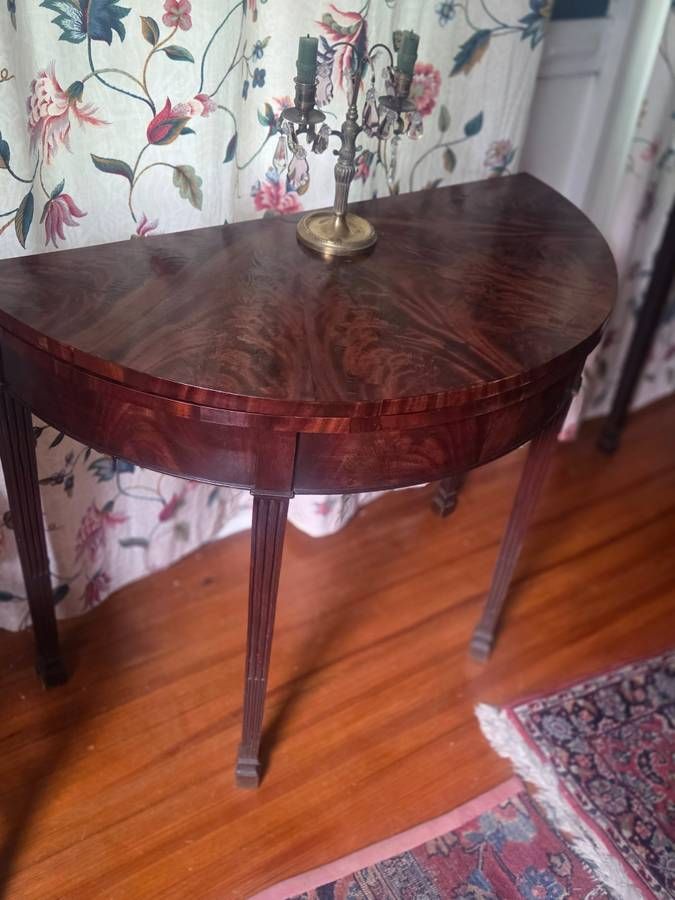
Take a look at this elegant pair of George III style mahogany demilune console tables. The classic half-moon shape is a hallmark of late 18th-century English design, but these beauties are likely later revival pieces from the late 19th or early 20th century.
What really catches the eye is the stunning pie-matched mahogany veneer on the tops. The cabinetmaker carefully selected and arranged the highly figured wood to create that striking radiating pattern. The tables rest on square tapering legs with reeded details, finishing in classic spade feet—all quintessential George III design elements.
Now, here's the clever part: according to the provided notes, this is actually a pair of tables. While they look great individually against a wall, their straight back edges allow them to be pushed together to form a single, impressive circular center table.
While we'd need to inspect the underside and joinery to confirm their exact age, the overall pristine finish and uniformity suggest they are high-quality later reproductions rather than period 18th-century antiques. Still, they are beautifully crafted and highly decorative. For the pair, I'd estimate their auction value between $800 and $1,200. A versatile and stylish addition to any traditional interior!
Used for this report's TTS and avatar presentation.
Item Report
Pair of George III Style Mahogany Demilune Console Tables
Condition:Very Good (minor surface wear consistent with age and use)
Value:800 - 1200 (for the pair)
Peer-Reviewed Market Values
Dating Range
Pending structured dating
Auction Liquidation
Pending structured market values
Fair Market Value
Pending structured market values
Replacement Value
Pending structured market values
Comparables Used
No saved comparables yet
Research Confidence
Insufficient Data
Peer review completed, but this run did not return structured market value ranges.
Maker's Marks / Writing:None visible
Date:2026-11-08 01:19:13.465581
Description:
A pair of George III style mahogany demilune console tables, each featuring a highly figured, pie-matched mahogany veneered top over a plain frieze, raised on square tapering legs with reeded decoration, terminating in spade feet. The tables are designed to be placed together to form a single circular center table, as evidenced by the straight back edges and the matching veneer patterns. The dealer notes indicate that these are two distinct tables, despite not being photographed together.
Curator Questions
Curated by Jade
Assessment:
These tables are attractive examples of George III style furniture, likely dating to the late 19th or early 20th century. The use of highly figured mahogany veneer and the classic demilune form with reeded legs are characteristic of the period's revival styles. The ability to combine them into a circular table adds versatility. While not period 18th-century pieces, they are well-made and decorative.
Individual Images:
whole table front view
top of table
two tables pushed together
top of table
whole table front view
Provenance:
According to the provided notes, this is a pair of tables, although they are not shown together in a single photograph.
Condition:
Very Good (minor surface wear consistent with age and use)
Identification Score: 95%
The form, materials, and stylistic details (demilune shape, reeded legs, spade feet, pie-matched veneer) clearly identify these as George III style console tables.
Authenticity Score: 80%
The tables appear to be later reproductions or revival pieces rather than authentic 18th-century George III antiques. The overall pristine condition of the finish, the uniformity of the reeding, and the general appearance suggest late 19th or early 20th-century manufacture. A definitive assessment would require examining the secondary woods, joinery, and underside, which are not visible in the provided photos.
Image Memory Note
None
None
Keywords
George III style, mahogany, demilune, console table, pair, reeded legs, spade feet, pie-matched veneer, antique furniture, United Kingdom, United States
The report was edited after initial Artmink draft. Original AI draft preserved in Artmink audit history.
Fair Market Value
Pending structured market values
Replacement Value
Pending structured market values
Archived Matches
No archive matches yet
Research Confidence
Insufficient Data
Research Findings
Key Visible Evidence
Images 1 and 4 show a demilune console table featuring a plain frieze, square tapering legs with reeded front faces, and classic spade feet. Image 2 highlights the highly figured mahogany veneer, while Image 3 confirms the two tables fit flush together to form a circular center table. Image 3 also clearly displays the pie-matched (radial) veneer pattern radiating from a central circular medallion across both joined surfaces.
Market and Source Support
The combination of the demilune form, tapering reeded legs, and spade feet are hallmark characteristics of late 18th-century George III (specifically Sheraton-influenced) design. Pairs of demilune console tables designed to interlock into a single circular center table were a popular form in both the Georgian period and subsequent revival eras. The pristine, uniform finish and precise veneer matching strongly support the report's assessment that these are high-quality late 19th or early 20th-century revival pieces rather than period 18th-century antiques.
Needs Verification
- Examination of the underside construction, joinery, and secondary woods is needed to definitively confirm the late 19th/early 20th-century dating versus a mid-to-late 20th-century bench-made reproduction.
- Inspection of the underside edges to determine if there is original hardware (such as brass clips or forks) designed to lock the two tables together.
Advisory Conclusion
The appraisal's identification of the tables as a pair of George III style mahogany demilune consoles is fully supported by the visual evidence. The stylistic attribution and estimated dating to the late 19th or early 20th century are highly plausible and consistent with the visible construction quality.
Google Search Evidence
Google Search was enabled, but Gemini returned no grounding queries or source records for this review.

Share: