Maker's Marks / Writing:None visible in provided photo (check interior of kabuto and dō for signatures or paper labels).
Date:2025-10-31 23:52:14.059273
Description:
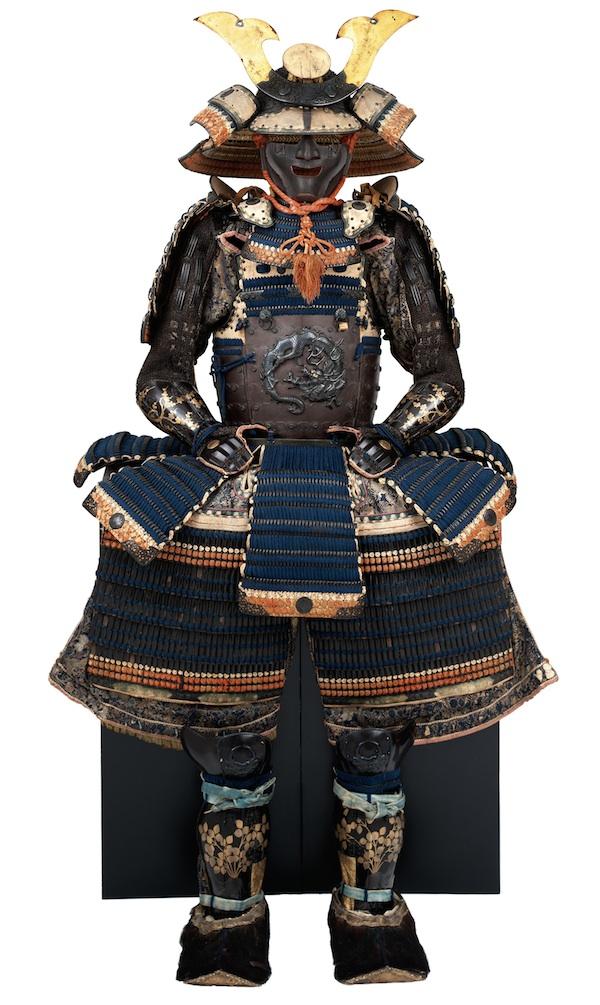
A complete samurai armor suit in the Edo style, comprising a multi-plate kabuto with large kuwagata crest, iron menpō (facial mask) with detachable nose and yak hair mustache, large sode (shoulder guards), a smooth hotoke-dō cuirass with applied/embossed dragon motif, kusazuri skirt of laced lamellae, haidate, kote sleeves, and suneate shin guards. The lacing (odoshi) is predominantly indigo-blue with tan/orange highlights; components are lacquered iron with leather and textile coverings.
Curator Questions
Curated by Jade
Assessment:
This is a textbook Edo-style tōsei gusoku. Features supporting an Edo date include the indigo kebiki-odoshi lacing, large sode, hotoke-dō cuirass with decorative dragon device, and a kabuto with prominent kuwagata. However, many surviving suits are assembled in the late Edo–Meiji period from mixed parts for display, and without close-ups of plate construction, interior lacquer, and rivet work, period attribution cannot be confirmed. A word about fakes.. Japanese armor is heavily reproduced and frequently reassembled; bright, uniform finishes, modern hardware, and synthetic lacing are red flags. Your suit presents appropriate materials and proportions from the photos, but further inspection (helmet bowl construction, menpō interior, lacing fiber, and inside of the dō) is needed to elevate confidence.
Individual Images:
none
Provenance:
Not provided
Condition:
Condition undetermined (insufficient detail images to assess lacing integrity and lacquer wear)
Identification Score: 95%
Distinctive configuration—kabuto with kuwagata, menpō, hotoke-dō with dragon, sode, kusazuri—clearly identifies it as a Japanese samurai armor of the Edo tōsei gusoku type.
Authenticity Score: 55%
Period-compatible elements are visible, but there are no detail photos of plate seams, lacquer interiors, or textile weave. Many suits are late Edo/Meiji assemblies or modern reproductions; thus I assume reproduction/assembly until proven otherwise. A word about fakes.. the samurai armor field contains numerous modern replicas and composite suits; cautious scoring reflects that reality.

Share: