Premium upgrade: Jade delivers your appraisal as a guided podium narration with synced visuals and voiceover.
Output is a narrated, animated slideshow with video intro and outro, sandwiching the autoplay voiceover sequence in actual video.
Qing Dynasty Style Ancestor Portrait of a Lady清代风格仕女祖先画像
LANGUAGE UNLOCK
Glossary Roundup
Original Presentation Script
Hello, I'm Minky, and today we're looking at a fascinating piece of Chinese history: an ancestor portrait. These portraits were an essential part of traditional Chinese family veneration, serving as a focal point for rituals honoring deceased relatives.
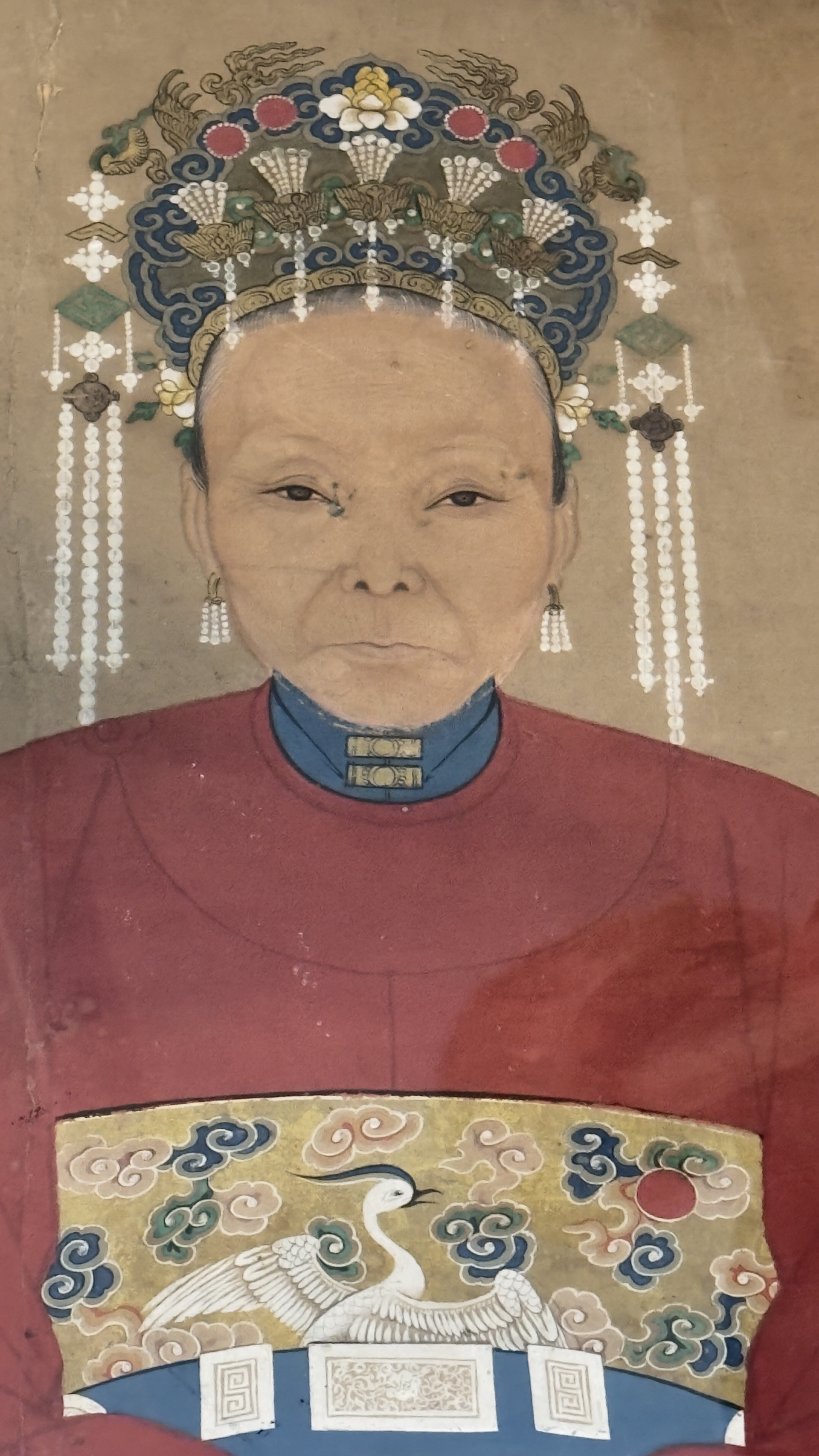
This particular painting depicts an elderly woman dressed in formal, highly symbolic attire. Based on the style and the specific details of her clothing, we can date this piece to the late 19th or early 20th century, during the late Qing Dynasty or early Republic period.
Let's look closely at her garments. The most telling feature is the square 'rank badge' or 'buzi' on her chest. It features a silver pheasant, which in the Qing dynasty hierarchy, indicated that her husband was a civil official of the fifth rank. Her elaborate headdress is also notable, painted to simulate pearls and the highly prized 'tian-tsui' or kingfisher feather inlay. The painting is executed in ink and color, likely on paper or silk, though it's hard to be certain while it remains in its frame. The somewhat flat, stylized execution is very typical of these portraits, which were often produced by workshops rather than individual named artists.
Condition-wise, we can see some creasing and toning to the background, which is exactly what we expect to see in a piece of this age. It adds to the authentic patina.
Taking into account its age, condition, and the current market for decorative Asian arts, a conservative auction estimate for this authentic period portrait would be between $300 and $500. It's a wonderful window into the social structures and familial piety of late imperial China.
Used for this report's TTS and avatar presentation.
Peer review completed, but this run did not return structured market value ranges.
Maker's Marks / Writing:None visible
Date:2026-08-25 13:06:16.193558
Description:
A Chinese ancestor portrait depicting an elderly woman in formal attire. She wears an elaborate headdress adorned with pearls, kingfisher feather inlay (tian-tsui) style decoration, and floral motifs. Her red robe features a rank badge (buzi) displaying a silver pheasant, indicating the wife of a fifth-rank civil official. The painting is executed in ink and color, likely on paper or silk, and is framed.
一幅中国祖先画像,描绘了一位身着正装的老年妇女。她戴着华丽的头饰,上面装饰着珍珠、点翠风格的装饰和花卉图案。她的红色长袍上有一个补子,上面有一只白鹇,表明她是五品文官的妻子。这幅画是用墨和颜色绘制的,可能在纸或丝绸上,并装裱在画框里。
Curator Questions
Curated by Jade
Assessment:
This is a traditional Chinese ancestor portrait. The style, clothing, and rank badge are consistent with late Qing Dynasty conventions. The execution is somewhat flat, which is typical for many commercially produced ancestor portraits of the late 19th and early 20th centuries, intended for domestic veneration rather than high art. The condition appears fair with some visible wear and creasing, consistent with age.
这是一幅传统的中国祖先画像。其风格、服装和补子与晚清时期的惯例一致。画法有些扁平,这是19世纪末和20世纪初许多商业生产的祖先画像的典型特征,这些画像旨在用于家庭供奉,而不是高级艺术品。状况看起来尚可,有一些可见的磨损和折痕,与年龄相符。
Individual Images:
detail of face and headdress
detail of upper half
detail of torso and rank badge
whole portrait in frame
Provenance:
None provided
Condition:
Fair to Good (visible creasing, some surface wear, and toning consistent with age; not examined out of frame)
Identification Score: 95%
The subject matter, clothing (rank badge, headdress), and frontal pose clearly identify this as a Chinese ancestor portrait.
主题、服装(补子、头饰)和正面姿势清楚地表明这是一幅中国祖先画像。
Authenticity Score: 80%
The wear, toning of the paper/silk, and stylistic execution suggest it is an authentic period piece from the late 19th or early 20th century, rather than a modern reproduction. However, without examining the material out of the frame, a definitive authentication is limited.
纸张/丝绸的磨损、色调和风格执行表明它是19世纪末或20世纪初的真实时期作品,而不是现代复制品。然而,如果不检查画框外的材料,明确的鉴定是有限的。
Image Memory Note
None
None
Keywords
Chinese, Ancestor Portrait, Qing Dynasty, Rank Badge, Silver Pheasant, Headdress, Asian Art
中国, 祖先画像, 清代, 补子, 白鹇, 头饰, 亚洲艺术
The report was edited after initial Artmink draft. Original AI draft preserved in Artmink audit history.
Peer Review Summary
Dating Range
Late 19th to early 20th Century (Late Qing to Republic Period)
Fair Market Value
Pending structured market values
Replacement Value
Pending structured market values
Archived Matches
No archive matches yet
Research Confidence
Insufficient Data
Peer Review
Key Visible Evidence
Images reveal a framed Chinese ancestor portrait depicting a female figure with a highly stylized, flat facial rendering characteristic of late-period workshop production. The subject is adorned in a red robe featuring a central rank badge (buzi) that displays a white bird with a long, scalloped tail, visually consistent with a silver pheasant. The headdress is painted to simulate pearl and kingfisher feather (tian-tsui) ornaments. The substrate, which appears to be paper, exhibits overall toning and creasing.
Market and Source Support
Historical references for Qing Dynasty mandarin squares confirm that the silver pheasant was the designated insignia for a fifth-rank civil official. The compositional formula—a frontal pose, red robe, and specific rank badge—is the standard convention for female ancestor portraits of the late Qing and Republic eras. The contrast between the generic, pattern-book execution of the garments and the specific facial features is a documented hallmark of commercial ancestor portrait workshops from this period.
Needs Verification
['The portrait must be examined out of its frame to definitively identify the substrate (paper versus silk) and to check for hidden edge damage or mounting alterations.', 'Magnified inspection of the pigments and paper fibers is necessary to absolutely rule out a later 20th-century decorative reproduction, though the visible wear appears natural.']
Audit Conclusion
The report's claims are supported by the visual evidence and historical context. The identification of the rank badge as a silver pheasant (fifth rank) and the attribution to the late 19th or early 20th century align well with the painting's stylistic execution and apparent material aging.

Share: