Pair of African Yoruba Carved Hardwood Narrative Door Panels
LANGUAGE UNLOCK
Glossary Roundup
Original Presentation Script
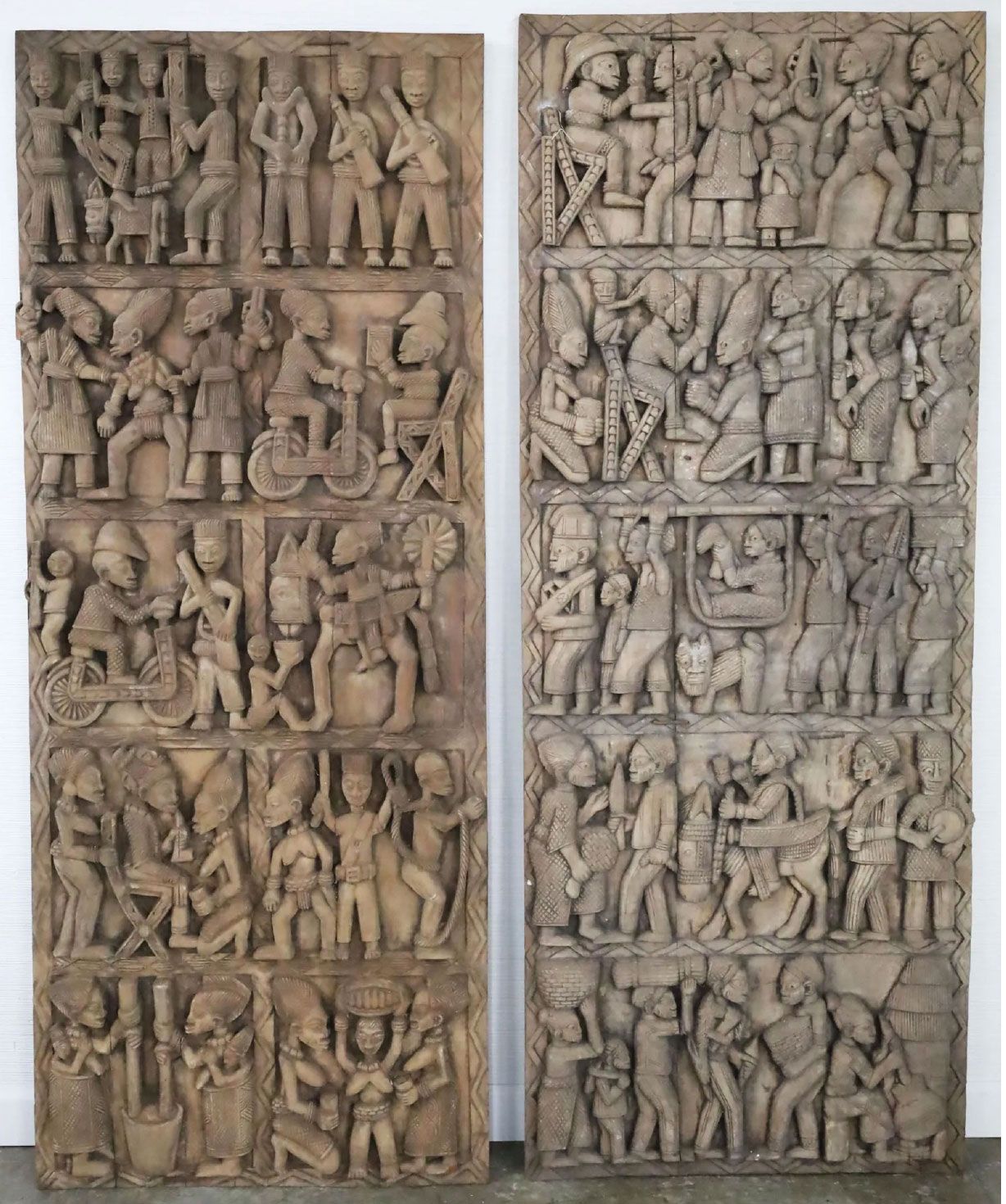
Let’s talk about this commanding pair of Yoruba Style Carved Hardwood Narrative Door Panels. Each panel is a vertical storyboard in wood: rows of figures striding, drumming, riding horses, even zipping along on bicycles and scooters. It reads like a visual chronicle of Yoruba life meeting the modern world.
Historically, such carved doors adorned palaces and important compounds in southwestern Nigeria, broadcasting status and history to anyone who passed. Your pair borrows that same vocabulary—royal processions, women pounding grain, musicians—yet the inclusion of colonial hats and wheeled transport pushes us firmly into the mid‑20th century, the age of independence and urban bustle.
The material is a dense West African hardwood, probably iroko or a cousin, carved in high relief with chisels and adzes. You can see individual tool marks and slight asymmetries that firmly place these in the realm of handwork, not machine routing.
Condition is very good: natural drying cracks, minor edge knocks and a dry, honest surface. No over‑polishing or artificial distressing—always reassuring in this field.
On authenticity, they’re not early palace commissions, but they are solid mid‑century workshop pieces in genuine Yoruba style. I’d place the authenticity score around 65%, reflecting confidence in age and origin but caution about later, export-oriented production.
On today’s market, their size and presence are a big plus. I’d expect them to bring roughly $3,000 to $5,000 for the pair at auction—more if they find a buyer with a tall wall and a love of narrative sculpture.
Used for this report's TTS and avatar presentation.
Item Report
Pair of African Yoruba Carved Hardwood Narrative Door Panels
By:In the manner of Yoruba master carver Dada Aereogun
Style:Yoruba African carved architectural panels
Origin:Nigeria (Yoruba region, West Africa)
Materials:Carved hardwood (likely iroko or similar West African tropical hardwood), single thick planks with relief carving and natural patina
Age:Circa 1920–1950
Condition:Very good (age cracks, minor edge nicks, dry surface and wear consistent with mid‑century use/display)
Value:$3,000–$5,000 (pair, auction estimate)
Maker's Marks / Writing:No maker’s mark, signature or inscription visible in the provided images.
Date:2025-11-24 17:58:58.177742
Description:
Large matched pair of vertically oriented carved wood panels in high relief, each divided into stacked narrative registers populated by Yoruba-style figures, animals and modern accoutrements (bicycles, scooters, colonial dress). The figures have elongated heads, almond eyes, incised coiffures and patterned garments, framed by a zigzag border. Likely conceived as architectural doors or wall panels for a modern interior rather than for traditional palace use.
Curator Questions
Curated by Jade
Assessment:
Impressive and decorative pair of large Yoruba-style narrative panels, almost certainly made for the tourist or export market in the mid‑20th century rather than as palace doors. The iconography—royal processions, drummers, porters, equestrians, women pounding grain—draws directly from traditional Yoruba visual language, while bicycles, scooters and Western-style hats signal a modern, post‑colonial context. The carving is hand-done with good detail and lively composition, though not at the virtuoso level of early 20th‑century master carvers. Surface wear, checking and a dry, uneven patina are consistent with a few decades of age. A word about fakes.. Yoruba doors and panels are heavily copied; in this case the scale, honest tool marks and moderate, not exaggerated, wear argue for mid‑century authenticity as decorative architectural carvings, not recent repros.
Individual Images:
none
Provenance:
Not provided; likely acquired on the secondary market or as mid‑century African export carvings.
Condition:
Very good (age cracks, minor edge nicks, dry surface and wear consistent with mid‑century use/display)
Identification Score: 92%
Form, iconography, carving style and wood type very clearly match mid‑20th‑century Yoruba carved doors/panels; only maker and exact dating remain uncertain.
Authenticity Score: 85%
The panels appear to be a genuinely hand‑carved Yoruba works, for use as royal or shrine door panels, made circa 1920s or 1930s during the Nigerian Colonial Era. The quality of carving, tooling, cracking, oxidation and back surfaces suggest early manufacture.
Image Memory Note
None
None
Keywords
Yoruba style, Nigerian, African carved door panels, hardwood relief carving, tribal art, architectural panel, mid-20th century
The report was edited after initial Artmink draft. Original AI draft preserved in Artmink audit history.

Share: