Premium upgrade: Monique delivers your appraisal as a guided podium narration with synced visuals and voiceover.
Output is a narrated, animated slideshow with video intro and outro, sandwiching the autoplay voiceover sequence in actual video.
French Louis XV Style Ormolu-Mounted Kingwood Bureau Plat法式路易十五风格鎏金铜镶嵌金丝木写字台
LANGUAGE UNLOCK
Glossary Roundup
Original Presentation Script
Here we have a French Louis XV style ormolu-mounted bureau plat from the late 19th to early 20th century — the sort of desk that instantly suggests elegance, ceremony, and a certain theatrical flair. With its green gilt-tooled leather writing surface, sinuous cabriole legs, and expressive mascaron mounts, it speaks fluently in the Rococo language of 18th-century Paris.
Yet the construction anchors it firmly in the revival era. The drawer joinery shows machine-cut dovetails, a decisive hallmark of post–mid-19th-century production. The ormolu mounts, crisply and uniformly cast, reinforce that conclusion. Rather than court workshop craftsmanship of the ancien régime, this desk reflects the accomplished cabinetmaking of the Rococo Revival — a period when French makers revived aristocratic forms for a clientele eager for historical grandeur.
The veneer, likely kingwood or a closely related exotic hardwood, is attractively matched, and the overall execution is confident and decorative. Wear to the leather border and light surface rubbing are consistent with age and use, lending the piece a measure of authenticity appropriate to its circa 1880–1920 date.
As the market demonstrates, such revival desks remain desirable decorative furnishings. While not an 18th-century royal survivor, this example stands as a handsome and well-realized interpretation — more Belle Époque salon than Versailles, but charming in its own right.
Used for this report's TTS and avatar presentation.
Item Report
French Louis XV Style Ormolu-Mounted Kingwood Bureau Plat
Origin:France, or Continental Europe in the French taste
Materials:Kingwood or similar exotic hardwood veneer, secondary hardwood carcass, green gilt-tooled leather writing surface, gilt-bronze (ormolu-style) mounts, brass escutcheons
Age:circa 1880–1920 (late 19th to early 20th century)
Condition:Good (visible leather edge wear, surface rubbing and scratches consistent with age; not professionally condition-reported)
Value:Auction estimate: $1,200–$2,500 as a late 19th/early 20th century Rococo Revival example; $300–$800 if later 20th-century reproduction.
Peer-Reviewed Market Values
Dating Range
Pending structured dating
Auction Liquidation
Pending structured market values
Fair Market Value
Pending structured market values
Replacement Value
Pending structured market values
Comparables Used
No saved comparables yet
Research Confidence
Not Run
Peer review completed, but this run did not return structured market value ranges.
Maker's Marks / Writing:No maker's mark, stamp, or inscription visible in the provided images.
Date:2026-03-24 01:11:26.734397
Description:
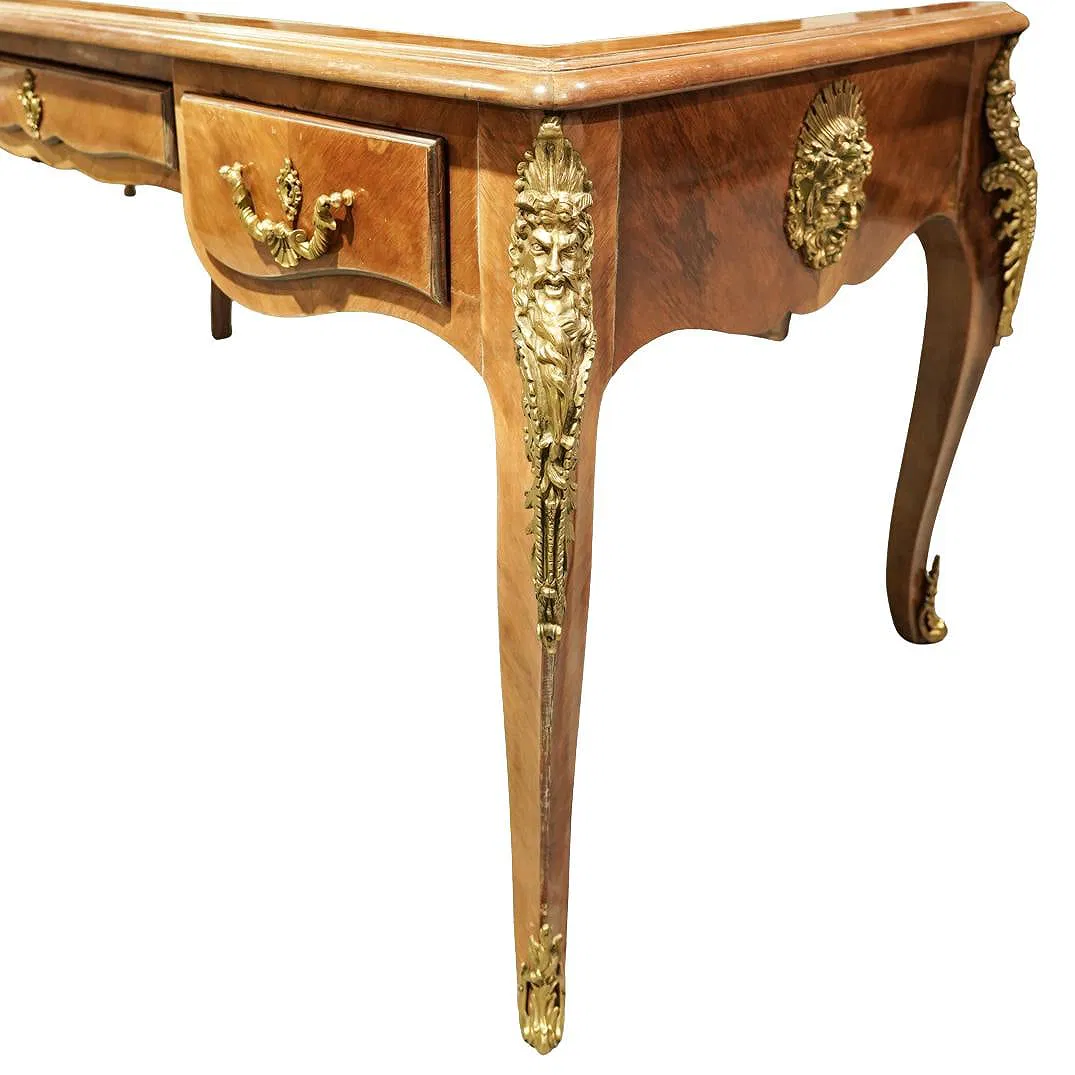
A serpentine-front bureau plat with green gilt-tooled leather inset top, three drawers, cabriole legs, and extensive gilt-bronze (ormolu-style) mounts including mascarons, chute mounts, and scrolling drawer pulls. The veneers appear book-matched or parquetried in kingwood or a closely related exotic hardwood, executed in the Rococo Revival taste.
一件蛇形前沿的平面写字台,配绿色鎏金压花皮革书写面、三只抽屉、弯腿造型,以及大量鎏金铜装饰件,包括面具饰、护角和卷叶式拉手。木皮呈对称拼接或镶木效果,材质应为金丝木或类似异国硬木,整体体现洛可可复兴风格。
Curator Questions
Curated by Jade
Assessment:
This desk is a well-executed Louis XV style bureau plat dating to the late 19th or early 20th century, produced during the height of the French Rococo Revival. The serpentine apron, cabriole legs, green leather writing surface, and abundant mascaron-mounted ormolu ornament faithfully echo 18th-century Parisian prototypes, yet the construction tells a later story. The drawer joinery displays machine-cut dovetails, a decisive indicator of post–mid-19th-century manufacture. The crisp, uniform casting of the mounts and the comparatively clean drawer interiors further support a revival-period attribution rather than an 18th-century origin. Overall craftsmanship is solid, with attractively matched veneer and confident decorative detailing. It represents a handsome and market-recognized example of the enduring Louis XV revival tradition.
此写字台为一件制作精良的路易十五风格平面写字台,年代可定为19世纪晚期至20世纪初的法国洛可可复兴时期。其蛇形裙边、弯腿造型、绿色皮革书写面以及面具鎏金铜饰均忠实再现18世纪巴黎家具风格,但抽屉所见机器切割燕尾榫结构明确表明其为19世纪中期之后的制品。鎏金铜饰铸造清晰规整,抽屉内部木色较浅且较为干净,进一步支持复兴时期制作的判断。整体工艺扎实,木皮拼接美观,装饰效果成熟,是市场认可度较高的路易十五复兴风格代表作品。
Individual Images:
Images show serpentine front
cabriole legs
mascaron ormolu mounts
green leather top with edge wear
interior center drawer
and machine-cut dovetails in drawer construction. No maker’s marks visible.
Provenance:
No provenance documentation provided.
Condition:
Good (visible leather edge wear, surface rubbing and scratches consistent with age; not professionally condition-reported)
Identification Score: 95%
The desk’s serpentine front, cabriole legs, green leather writing surface, and ormolu-mounted decoration clearly identify it as a Louis XV style bureau plat. The form and decorative vocabulary are unmistakable, leaving little doubt as to object type and stylistic category.
其蛇形前沿、弯腿造型、绿色皮革书写面及鎏金铜装饰明确表明其为路易十五风格平面写字台,器型与装饰语言特征十分清晰,类型与风格判断高度确定。
Authenticity Score: 45%
There is strong evidence that this is not an 18th-century Louis XV period desk. Machine-cut dovetails in the drawer construction firmly place manufacture after the mid-19th century, and the mounts exhibit the crispness and regularity typical of revival-era casting. However, the materials, wear patterns, and overall construction are consistent with a genuine late 19th- or early 20th-century Rococo Revival piece rather than a recent reproduction.
有力证据表明此件并非18世纪路易十五时期原作。抽屉所见机器切割燕尾榫明确指向19世纪中期之后制作,鎏金铜饰的规整铸造亦符合复兴时期特征。不过,其材质、磨损状态及整体结构与19世纪晚期至20世纪初的真实复兴时期作品相符,而非现代仿制品。
Image Memory Note
Assessment based on provided overall, detail, and drawer construction images.
评估基于所提供的整体图、细节图及抽屉结构图片。
Keywords
French desk, Louis XV style, Rococo Revival, bureau plat, ormolu mounted, kingwood veneer, green leather top, cabriole legs, late 19th century
法式写字台, 路易十五风格, 洛可可复兴, 平面写字台, 鎏金铜镶嵌, 金丝木贴皮, 绿色皮革台面, 弯腿, 19世纪晚期
The report was edited after initial Artmink draft. Original AI draft preserved in Artmink audit history.
Peer Review Summary
Dating Range
circa 1880–1920 (late 19th to early 20th century)
Fair Market Value
Pending structured market values
Replacement Value
Pending structured market values
Archived Matches
No archive matches yet
Research Confidence
Narrative peer review only
Peer Review
Key Visible Evidence
The desk clearly exhibits Louis XV style characteristics, including a serpentine front, cabriole legs, and rococo-inspired ormolu mounts (Image 1, 2, 7). Prominent mascaron mounts are visible (Image 1, 8). The veneer appears to be a figured wood, consistent with kingwood or a similar exotic hardwood, applied in a book-matched or parquetry pattern (Image 1, 5). The top features a green gilt-tooled leather writing surface, showing visible wear at the edges (Image 4). The mounts are consistent with gilt-bronze or ormolu-style. Crucially, the drawer construction reveals machine-cut dovetails (Image 6), which is a definitive indicator of post-mid-19th century manufacture, precluding an 18th-century period attribution. The drawer interiors are relatively clean and light-colored (Image 3). The crispness and uniformity of the ormolu castings (Image 8) also suggest later production methods compared to earlier hand-chased mounts. No maker's marks, inscriptions, or reign marks are visible in any of the provided images.
Market and Source Support
The report's dating of 'circa 1880-1920' for a 'Louis XV Style / French Rococo Revival desk' is strongly supported by comparable examples from auction houses and dealers. For instance, a 'Louis XV style gilt-bronze mounted kingwood bureau plat, J. Sargues' from Charlton Hall Auctions, dated 'late 19th/early 20th century,' sold for $2,160.00. Another 'Louis XV-Style Kingwood and Ormolu-Mounted Bureau Plat' from New Orleans Auction Galleries, dated 'late 19th century,' sold for $1,000. A 'Louis XV Style Marquetry Inlaid Kingwood and Ormolu Bureau Plat' from Leland Little Auctions, circa 1900, sold for $5,000. These comparables reinforce the dating and stylistic classification as a Rococo Revival piece. The material identification of 'kingwood or similar exotic fruitwood veneer' is consistent with the descriptions of comparable items. The value estimate range provided in the report ($1,200-$2,500 for late 19th/early 20th century, $300-$800 for later reproduction) is generally aligned with the realized prices of the comparables found, which range from $1,000 to $5,000 for revival pieces, with higher prices for pieces by known makers or with additional features like marquetry.
Needs Verification
A definitive identification of the specific veneer type (e.g., kingwood vs. tulipwood, or other exotic hardwoods) would require microscopic analysis or expert examination of the wood grain and color. Confirmation of the exact metal composition of the mounts (e.g., true gilt-bronze vs. brass with a gilt finish) would require metallurgical testing. Specific identification of the secondary hardwoods used in the drawer construction would require direct inspection of the unfinished wood, potentially through small samples or detailed photographs of end grain. Further detailed images of the underside construction, leg attachments, and the back panel would provide more comprehensive information about overall construction quality and potential repairs or alterations. UV/blacklight views could also reveal repairs or touch-ups to the finish not visible under normal light.
Audit Conclusion
The report's assessment of the desk as a 'French Louis XV Style Ormolu-Mounted Kingwood Bureau Plat' dating to 'circa 1880-1920' as a 'Rococo Revival desk' is well-supported by both visible evidence and grounded comparable sources. The presence of machine-cut dovetails (Image 6) is a critical piece of evidence that firmly places the desk in the late 19th or early 20th century, effectively ruling out an 18th-century period attribution. The quality of the veneer work and the crispness of the mounts are consistent with high-quality revival pieces of that era. The value estimate provided in the report falls within the range observed for similar revival desks in the market. The report's skepticism regarding 18th-century authenticity is entirely justified and accurately reflects the visible construction details. Additional evidence, such as specific wood identification and detailed views of hidden construction elements, would further refine the understanding of the piece but are not critical to the primary dating and stylistic conclusions.

Share: