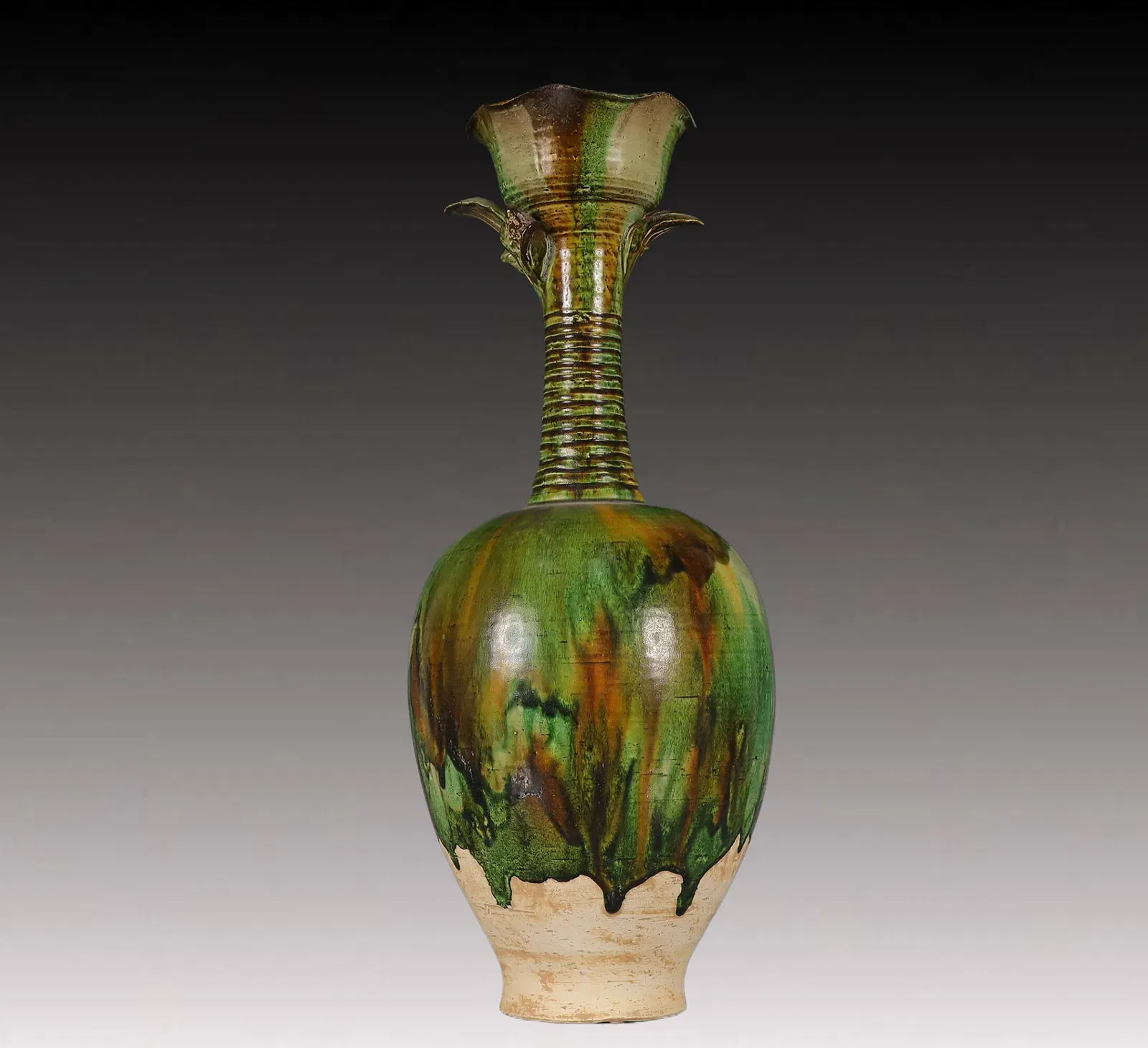
Welcome to a journey into the heart of Tang dynasty craftsmanship with a captivating vase — a towering example of sancai glazed earthenware, where hues of green, amber, and brown cascade across its form like a liquid tapestry. This vessel, with its globular body and slender, ribbed neck, invites us to reflect on an era when such artistry was thrumming with cultural significance. In the world of Chinese ceramics, few techniques are as emblematic of the Tang dynasty as the sancai glaze. Originating from the 7th to the 10th centuries, these pieces were often used in burials, serving as a ceremonial bridge to the afterlife. Yet, they weren't confined to burial rites alone — their allure made them coveted decorative wares as well, capturing the spirit of their age. Crafted from earthenware and adorned using a lead-based glaze, this vase showcases the technical prowess of its unknown artisan. The unrestrained flow of color, heavy pooling, and animal mask ring handles are distinctly Tang — blending dramatic aesthetics with skilled execution. In our examination, this vase shows signs of graceful aging. Its glaze flows thickly and evenly, while its unglazed foot bears the orange-peel texture typical of authentic burial wares, untouched by modern interventions. No apparent signs of restoration disrupt its historical narrative. As we contemplate authenticity, the vase stands at a crossroads of desire and skepticism. Though visually in line with traditional sancai wares, scientific verification through Thermoluminescence testing is essential, given the prevalence of expert replicas. With an authenticity score of 70%, we remain cautiously optimistic. Collectors should note the estimated value at auction varies significantly — from $7,000 to $15,000, contingent upon definitive confirmation of its Tang period origin. So, does this piece whisper the true stories of Tang artistry, or does it echo a modern recreation’s tale? Either way, its beauty captures the imagination, forging a connection across the ages.
Used for this report's TTS and avatar presentation.
Item Report
Tang Dynasty Sancai Glazed Earthenware Vase
唐代三彩釉陶瓶
By:unknown (typical for Tang dynasty wares)
Style:Tang Dynasty Sancai Ware / 唐三彩
Origin:China
Materials:earthenware, lead-glazed with green, amber, and brown pigments
Age:circa 8th century AD (Tang Dynasty)
Condition:Very Good (no obvious restoration or repairs, natural glaze wear, expected period pitting on unglazed base)
Value:$7,000 - $15,000 (if authentic Tang period, at auction; replica value is much less)
Maker's Marks / Writing:No visible maker’s marks or inscriptions, as is typical for Tang sancai wares.
Date:2025-07-03 03:17:26.503100
Description:
This is a tall earthenware vase featuring classic 'sancai' (three-color) glaze, displaying dripping hues of green, amber, and brown over a buff ceramic body. The vessel exhibits a globular lower body and a ribbed, elongated neck with two animal mask ring handles and a flared, lobed mouth. The sancai glazing method, popular during the Tang dynasty (7th-10th centuries), was primarily used for burial goods but also produced decorative wares. The thick glaze flow and vivid coloring are emblematic of authentic Tang sancai ceramics.
这是一件高大的陶制瓶,施有典型的“三彩”釉(绿色、琥珀色、褐色),色彩在米黄色陶体上自然流淌。器物下腹呈圆鼓状,颈部细长并有环状凸鼓纹饰,两侧饰以兽面衔环耳,口沿呈荷叶状敞口。三彩釉烧造工艺盛行于唐代(7-10世纪),多用于随葬明器,也有制作装饰性器物。釉色流淌厚重,色泽鲜艳,展现了唐代三彩陶器的典型风格。
Curator Questions
Curated by Jade
Assessment:
This vase is an example of classic Tang dynasty sancai-ware featuring traditional form, coloring, and glaze flow patterns. The craftsmanship and visible surface aging align with known period examples. However, the prevalence of high-quality modern replicas means close inspection for authenticity is essential, especially of the glaze, construction, and wear patterns. The bottom shows some expected “orange peel” texturing and unglazed foot, typical of Tang period burial wares, and coloring is deep and well-rendered. Provided it passes scientific testing (TL analysis), this would be desirable for collectors of early Chinese ceramics. A word about fakes: The sancai ware market is flooded with both low- and high-quality forgeries, so buyers should demand technical analysis before acquisition. And that's etched in Jade..!
此瓶为唐代典型三彩陶器,造型、釉色及流淌效果都较为规范,表面工艺和自然陈旧痕迹与唐代出土实物相符。底部露胎、桔皮状细腻纹理及无釉处理,均为唐三彩明器之常见特征,釉色浓郁层次分明,属高等级三彩胎釉表现。鉴于三彩陶器市场赝品极多,建议在收藏前务必进行科学检测(如热释光分析)。如果确认为唐代真品,对中国早期陶瓷艺术收藏具有重要价值。关于赝品提醒:三彩类藏品存在大量仿制品,购藏须提高警惕,务必委托权威机构出具检测报告。And that's etched in Jade..!
Individual Images:
The detail images show the ribbed neck and lobed
flower-shaped mouth with glaze pooling at the tips. The animal mask ring handles are molded and applied. Glaze shows typical running/dripping patterns
especially at the transition between glazed and unglazed areas. The bottom is unglazed
with concentric turntable marks and some pitted
slightly roughened surface—no visible modern tool marks or resin patches. No apparent fractures
major chips
or signs of contemporary repair.
Provenance:
No provenance details provided.
Condition:
Very Good (no obvious restoration or repairs, natural glaze wear, expected period pitting on unglazed base)
Identification Score: 95%
The proportions, coloring, glaze flow, and form are highly consistent with known Tang sancai vases. Characteristic elements like the ribbed neck, flared mouth, and application of multiple glazes are definitive of the form.
造型、釉色、流淌效果及器口装饰均高度吻合唐三彩瓶的定型特征,颈部起鼓棱、荷叶口和三色釉面为典型识别要素,综合判断为唐代三彩瓶无误。
Authenticity Score: 70%
Visual cues support period authenticity, including glaze characteristics, wear, and the unglazed foot, but due to rampant modern reproductions, authenticity cannot be definitively confirmed without Thermoluminescence (TL) testing. The piece does not show glaring signs of modern fakery, but the high market prevalence of expert forgeries requires caution.
凭表观特征初步判断与唐代真品相似,釉色流淌与露胎底部均较自然,虽无明显现代伪作迹象,但因仿品极多,热释光等科学检测不可或缺,鉴定真伪仍需谨慎。
Image Memory Note
The object is a tall Chinese sancai-glazed vase with a bulbous body, slender ribbed neck, lobed flower-shaped mouth, and molded animal mask ring handles. Green, amber, and brown glazes flow dramatically from the neck onto the body, ending in irregular drip patterns above an unglazed lower portion and foot. The unglazed foot features visible concentric turntable marks and natural pitting. There are no visible signatures, inscriptions, or modern restoration marks. No cracks, major chips, or repairs are apparent; the glaze shows natural variance and pooling, especially at the ribbed neck and mouth. No collector's stickers or new marks evident.
该器为中国唐代三彩釉瓶,腹部圆鼓,颈部细长并饰凹凸筋纹,口部荷叶状分瓣,瓶颈两侧饰兽面衔环。整体釉色以绿、琥珀及褐色为主,自颈部流淌至腹部,露胎与釉面交界处呈自然流痕,下方露胎无釉,足底为圈足拉坯旋纹并见自然沙眼。全器未见铭文、款识或现代修补痕迹,无明显裂缝与崩口,釉色堆积自然。未见藏家贴纸或其他新痕迹。
Keywords
Tang dynasty, sancai, Chinese ceramics, earthenware, lead glaze, burial ware, China, antique
唐代,三彩,陶瓷,陶器,铅釉,明器,中国,古董
The report was edited after initial Artmink draft. Original AI draft preserved in Artmink audit history.

Share: