Materials:Ink wash (and possible pen) on paper; alternatively aquatint/photogravure on wove paper (not confirmed, not examined out of frame)
Age:circa 1900–1930
Condition:Very Good (even age toning and possible light foxing; under glass and not examined out of frame)
Value:USD 80–200
Maker's Marks / Writing:Possible faint pencil signature/inscription at lower left margin; illegible in the provided image. No visible edition number or printer’s blindstamp.
Date:2025-10-05 14:10:24.492540
Description:
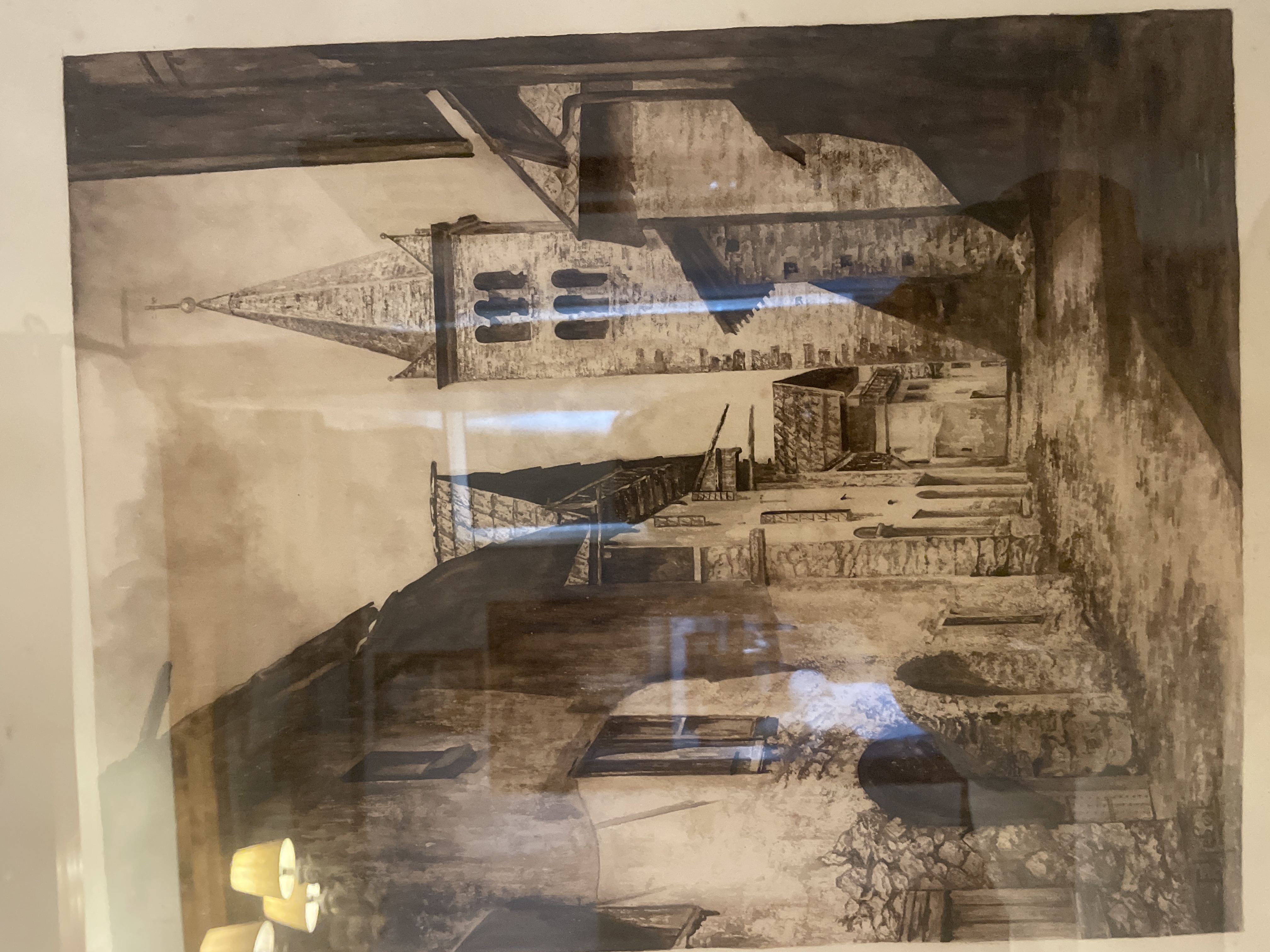
Framed sepia-toned architectural street view depicting a narrow cobbled lane lined with rough-plastered stone houses and a prominent Romanesque church bell tower with paired arched openings and a steep spire topped by a cross. Executed in a realistic manner with careful textural detail to masonry and roof tiles. Medium appears to be hand-applied ink wash (possibly with pen work) on paper; an alternative possibility is an etching with aquatint or photogravure enhanced by wash. The composition and architecture suggest an Alpine or Northern Italian village.
Curator Questions
Curated by Jade
Assessment:
This is a well-rendered early 20th-century European architectural view, most consistent with Northern Italy given the Romanesque campanile and vernacular stone houses. The piece appears to be a hand-executed ink wash drawing or an intaglio print (etching/aquatint) with rich sepia tones; without examining out of frame, the exact technique cannot be confirmed. Market value hinges on authorship and medium: an original drawing or hand-signed etching would sit at the upper end of the estimate; a photogravure or later reproduction would be lower. A word about fakes.. Architectural prints and drawings are often encountered as photogravures or later reproductions that can look deceptively like originals under glass; confirm by checking for a plate mark, ink sheen, and paper texture outside the image area.
Individual Images:
whole item
Provenance:
Not provided
Condition:
Very Good (even age toning and possible light foxing; under glass and not examined out of frame)
Identification Score: 75%
High confidence that this is an early 20th-century European village street scene with a Romanesque bell tower, executed in sepia on paper. Medium and exact technique remain uncertain due to reflections and the work being under glass, so not scored higher.
Authenticity Score: 55%
The work likely dates to the early 20th century and may be original hand work; however, the possibility of a period photogravure or later reproduction remains without an out-of-frame inspection. No clear plate mark or deckled edges are visible, and the signature is not decipherable in the photo.
Image Memory Note
Vertical/portrait-format framed work under glass with a light mat. The image shows a narrow cobbled street receding to a vanishing point, flanked by rough stone and plaster buildings with small windows and wooden shutters; left foreground includes a low arched doorway of stacked stone. Right mid-ground features a tall Romanesque bell tower with two tiers of paired arched louvered openings and a steep pyramidal spire topped by a ball and cross. Roofs are pitched, some with shingles or tiles rendered. Tonal range is sepia/brown; sky is softly washed. No obvious dot matrix pattern is visible from the photo; surface looks continuous tone. A potential pencil inscription/signature appears at the lower left margin area but is obscured by glare and mat; characters are not legible (might begin with an 'F' or similar). No title plate or caption is visible. Reflections of a double-lamp fixture are seen on the glazing, indicating glass. Paper shows overall warm toning; no tears or creases visible within the viewable area. No clear plate mark is visible beyond the image edge due to mat coverage. Frame details not fully visible.
Keywords
European Realism, architectural view, village street scene, church tower, Romanesque campanile, sepia, ink wash on paper, etching aquatint, Italy, early 20th century
The report was edited after initial Artmink draft. Original AI draft preserved in Artmink audit history.

Share: