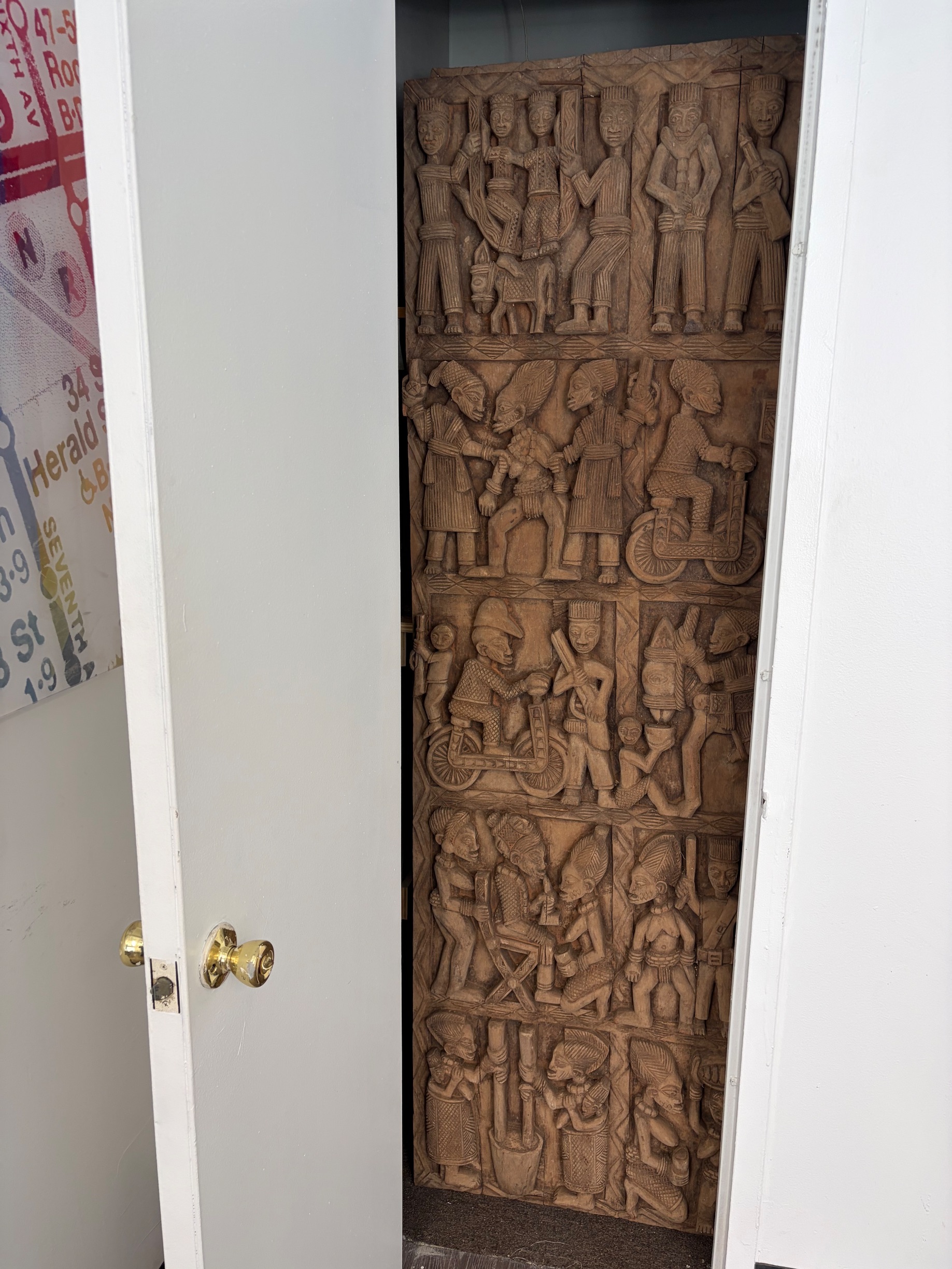
What we’re looking at here is a Yoruba-style carved wooden narrative door panel — the kind traditionally found on palace compounds in southwestern Nigeria. These doors are not merely architectural; they are storytelling devices, visual chronicles of status, ceremony, and community life.
Notice the stacked registers filled with court attendants, musicians, and dignitaries. But look closer — bicycles and scooters appear among the figures. That detail is crucial. True 19th-century palace doors rarely depict such modern transportation. This blending of courtly tradition with 20th-century life strongly suggests a later carving, likely produced between 1970 and 1990 for the collector or export market.
The hardwood — likely iroko — is well carved, with confident relief and geometric framing motifs typical of Yoruba workshops. However, the surface lacks the deep oxidation, handling polish, and embedded grime we expect from a door that hung for generations in a palace courtyard. The cracking is consistent with natural drying rather than extreme age.
A word about copies.. Yoruba palace doors are among the most reproduced forms in African art. The market is filled with later workshop examples, many beautifully made. One must be extremely cautious before declaring any example a 19th-century original.
Authenticity score: 35% for true period palace use.
At auction, a confirmed early palace door could reach $4,000 to $7,000. This later workshop example would likely realize $800 to $1,500.
Still, as a commanding piece of sculptural storytelling, it absolutely holds the room — and that, in itself, is powerful.
Used for this report's TTS and avatar presentation.
Item Report
Yoruba-Style Carved Wooden Narrative Door Panel
By:Unknown workshop carver
Style:Yoruba Style (likely later 20th century)
Origin:Nigeria (Yoruba region), or possibly Benin
Materials:Carved hardwood (likely iroko or similar West African hardwood), iron rod elements
Age:Late 20th century (circa 1970–1990)
Condition:Very Good (minor cracks, surface dryness, structurally stable)
Value:If authentic early 20th century: $4,000–$7,000 at auction. As a late 20th century decorative/workshop piece: $800–$1,500 at auction.
Maker's Marks / Writing:No visible maker’s mark or inscription.
Date:2026-03-09 17:18:19.255147
Description:
A large, vertically oriented carved wooden door or wall panel depicting multiple registers of figural scenes, including musicians, riders on bicycles and scooters, attendants, and ceremonial motifs, executed in high relief with geometric borders.
Curator Questions
Curated by Jade
Assessment:
This is a large Yoruba-style carved door panel inspired by traditional palace doors of southwestern Nigeria. The narrative scenes combining courtly figures with modern elements such as bicycles strongly suggest a later 20th-century commission rather than a 19th-century palace door. The carving is competent and stylistically faithful but lacks the deep patina, surface encrustation, and wear expected of a true period palace door exposed to decades of handling and climate. The presence of modern iron reinforcement and relatively fresh surface coloration further support a later date. It remains an impressive decorative and cultural statement piece.
Individual Images:
whole carved door panel
upper register detail
mid register with bicycle rider
side register detail
upper right figures detail
ritual vessel scene detail
lower right figures detail
seated chief scene detail
bicycle rider closeup
iron rod and crack detail
Provenance:
No provenance documentation provided.
Condition:
Very Good (minor cracks, surface dryness, structurally stable)
Identification Score: 92%
The format, relief structure, geometric framing, facial scarification patterns, and narrative registers strongly correspond to documented Yoruba palace door carvings.
Authenticity Score: 35%
While stylistically accurate, the relatively uniform surface tone, limited age-related erosion, visible modern cracking patterns, and inclusion of modern motifs suggest a late 20th-century workshop carving rather than a true 19th-century palace door. Given the prevalence of reproductions in this category, caution is warranted.
Image Memory Note
None
None
Keywords
Yoruba Style, carved wooden door, Nigerian panel, palace door carving, narrative relief, West Africa, Nigeria
The report was edited after initial Artmink draft. Original AI draft preserved in Artmink audit history.


Share: