Premium upgrade: Jade delivers your appraisal as a guided podium narration with synced visuals and voiceover.
Output is a narrated, animated slideshow with video intro and outro, sandwiching the autoplay voiceover sequence in actual video.
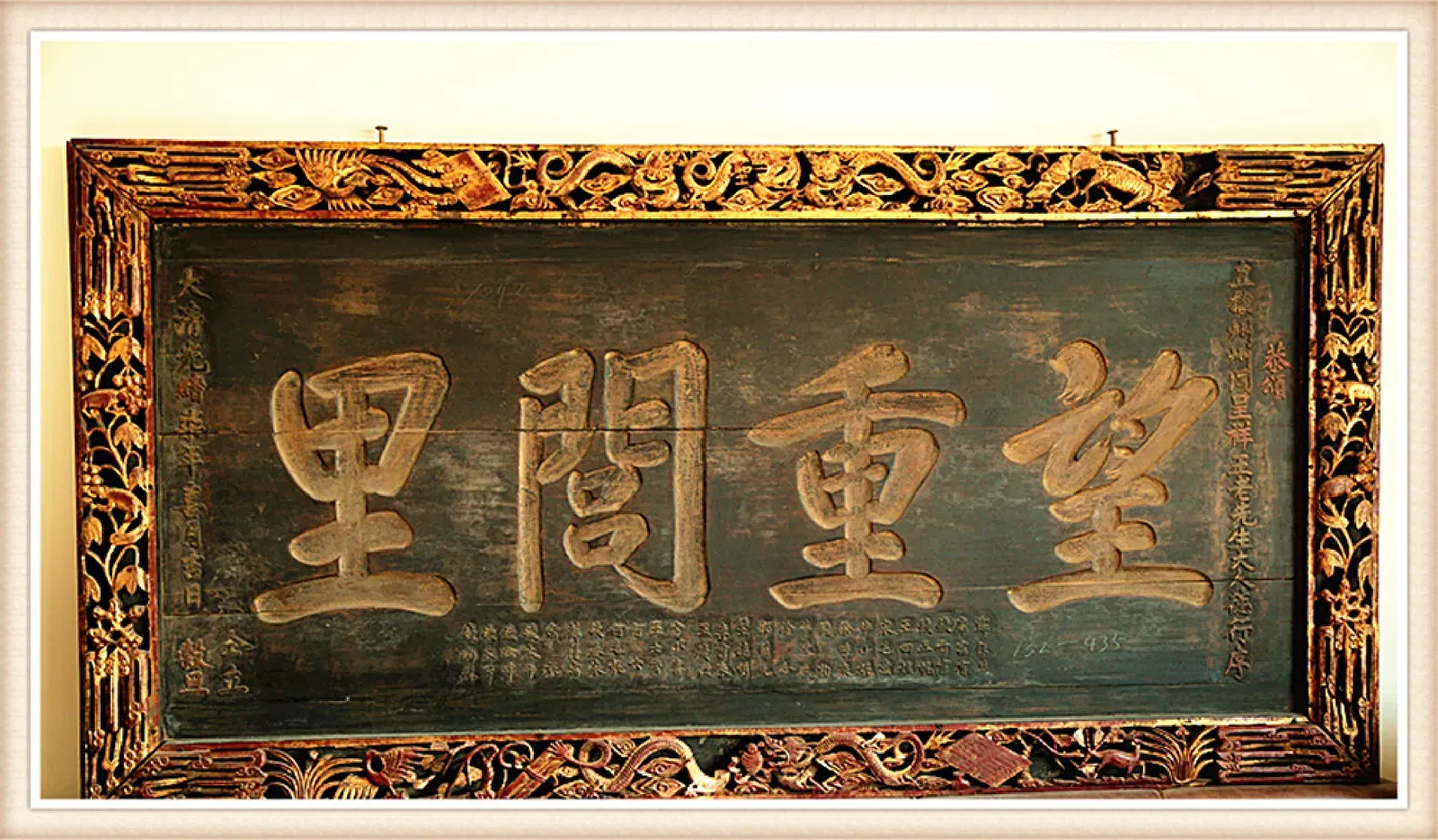
Let’s look at this impressive Guangxu-period gilt-lacquer wooden plaque, boldly announcing itself with four monumental characters across a dark, timeworn field. Pieces like this once hung high in temples, guild halls, or ancestral shrines, proclaiming virtue and reputation to all who entered.
Here, the side inscription invokes the Guangxu reign of the Qing dynasty and records a propitious date, while the smaller lines below list the donors who paid for the commission. It’s essentially a carved stone stele in wood: public praise, civic branding, and religious merit rolled into one.
The frame is the real theater—openwork dragons twist through clouds, foliage curls around small animals, and everything is drenched in gold over red bole. The ground has oxidized to a dull greenish black, the gilding is rubbed at the high points, and the wood shows natural shrinkage cracks.
Those scars are useful. They suggest genuine age and hand-carved workmanship rather than a sharp, glossy modern fake, though Guangxu-dated plaques are so commonly copied that skepticism is always healthy.
Balancing the evidence, I’d place authenticity around 88% as late Qing, perhaps a regional commission rather than anything imperial. A date, if present, is illegible, but Guanxu's reign was from 1875 to 1908, so that narrrows it down. The lower text lists multiple donors to the school, temple or public building this once adorned.
In today’s market, such a plaque would likely bring in the range of $800 to $1,500 at auction—respectable, evocative, and decorative, but not a museum-level treasure. A fine survivor of a vanished hall, still broadcasting its message of communal honor.
Used for this report's TTS and avatar presentation.
By:Unknown workshop, likely a regional temple or guild commission
Style:Late Qing dynasty commemorative temple/ancestral hall plaque style
Origin:China
Materials:Carved softwood (likely pine or fir) with polychrome and gilt lacquer
Age:Circa late 19th to early 20th century (c. 1880–1910), possibly later reproduction copying a Guangxu inscription
Condition:Good (structural cracks and surface wear, but carving and gilding largely intact)
Value:US$800–1,500 at auction
Peer-Reviewed Market Values
Dating Range
Pending structured dating
Auction Liquidation
Pending structured market values
Fair Market Value
Pending structured market values
Replacement Value
Pending structured market values
Comparables Used
No saved comparables yet
Research Confidence
Not Run
Peer review completed, but this run did not return structured market value ranges.
Maker's Marks / Writing:Side inscription beginning with “大清光绪某年吉月吉日” followed by dedicatory text; lower inscription lists multiple donor names in columns (e.g., 王、李、邱、徐等姓氏).
Date:2025-11-27 01:34:46.276649
Description:
Large rectangular Chinese wooden horizontal plaque with four bold inscribed characters to the center reading 望重间里 (roughly “respected throughout the neighborhood”), flanked by vertical dedicatory inscriptions and donor names. The frame is deeply open‑worked and gilt, carved with intertwined dragons, foliage, and animals in high relief. The ground is a dark, abraded greenish-black lacquer with gilt characters rubbed from long exposure. Side inscription includes the reign phrase “大清光绪某年某月吉日”. Guanxu's reign was from 1875 to 1908. The lower text lists multiple donors to the school, temple or public building this once adorned.
大型长方形中国木质横匾,中部浮雕四个大字“望重间里”,两侧刻有竖写题款及捐献人姓名。边框为通雕高浮雕金漆装饰,刻有缠绕游走的龙纹、枝叶及走兽。匾心地子为深绿偏黑色颜料或漆面,表层磨损显著,金漆字迹亦因长期陈列而变得黯淡。边缘题记中可见“大清光绪某年某月吉日”等字样,匾下方一排小字为多位捐资人姓名。
Curator Questions
Curated by Jade
Assessment:
This is a substantial Chinese carved and gilt wooden horizontal plaque in late Qing temple or ancestral-hall taste, bearing a Guangxu reign inscription and a list of donors. The carving quality of the frame—especially the dragons and foliage—is competent but not of the very highest imperial standard, and the calligraphy of the main and subsidiary inscriptions appears somewhat stiff and provincial. Surface wear, oxidized gilding, shrinkage cracks, and accumulated grime indicate decent age, broadly compatible with a late 19th–early 20th century origin, though the Guangxu formula on the side should be read as dedicatory rather than proof of imperial commission. A word about fakes.. plaques with grand inscriptions and reign references are widely reproduced; however, here the patina, uneven cutting of characters, and layered, naturally abraded gilding suggest an authentic period piece or, at worst, an early 20th‑century continuation rather than a recent factory product. As a decorative and historical object from a local hall or shrine, it is attractive but not highly rare; auction value would likely fall under US$1,500 in today’s market. Mingling Antiquity, Always.
此件为一方体量可观的中国木雕描金横匾,匾额与边框皆具晚清庙宇或祠堂匾额的风格特点,侧面刻有光绪年款以及捐资人名单。龙纹、花叶等边框雕刻工艺娴熟但未达宫廷御制的精绝水准,主字与题记书法略显地方气息。表面金漆氧化、彩漆磨蚀、木板收缩开缝及自然积尘,均显示出一定年代感,与晚清至民国初期制作的时间范围大体相符;侧款中的“光绪”应理解为纪年用语,而非意味着皇室御赐。A word about fakes.. 带有大清年号、颂词的匾额在当今仿品极多,但此件整体包浆自然、字口刀痕不规整、金漆磨损层次较为真实,更接近当时地方作坊或庙宇订制之物,而非近年机器量产。作为地方性庙宇或会馆遗存,其历史与装饰价值优于经济价值,目前国际拍场估价大致在800–1,500美元之内。Mingling Antiquity, Always.
Individual Images:
none
Provenance:
Not provided; likely removed from a regional temple, ancestral hall, or guild hall.
Condition:
Good (structural cracks and surface wear, but carving and gilding largely intact)
Identification Score: 92%
Form, iconography, and inscriptions clearly indicate a Chinese commemorative wooden plaque with gilt-lacquer frame; only minor uncertainty about the exact reading of the main four characters and original institutional context.
器形、纹饰与题记均明确表明其为中国庙宇或祠堂用镌刻题词木匾,带描金雕框;仅对匾额四字的具体含义及原属建筑性质存在少量不确定性,因此给出92%的识别信心。
Authenticity Score: 68%
Wear, oxidation, and carving style support genuine late Qing/Republic-period workmanship; however, because Guangxu-dated plaques are frequently reproduced and photos cannot fully confirm tool marks or wood aging, I remain cautious and stop below the 75% threshold.
从磨损、氧化及雕刻风格看,应为晚清至民初时期的真实作品;但带光绪年款的匾额仿制品极多,单凭照片难以完全确认刀痕与木材老化细节,因此保持谨慎,将真实度评分控制在75%以下,为68%。
Fair Market Value
Pending structured market values
Replacement Value
Pending structured market values
Archived Matches
No archive matches yet
Research Confidence
Narrative peer review only
Peer Review
Key Visible Evidence
The object is clearly a large rectangular carved wooden horizontal plaque with a dark ground and gilt characters, as described (Image 1). The four main characters are legible as 望重间里 (Wàng Zhòng Jiān Lǐ). The ornate openwork gilt frame features intertwined dragons (Image 2), foliage, and small animals (Image 3). The vertical inscription on the right side clearly includes the reign phrase “大清光绪某年某月吉日” (Image 3), confirming the Guangxu period reference. The lower inscription shows multiple columns of donor names, including 王, 李, 邱, 徐 (Image 4). Visible wear, rubbed gilding, and shrinkage cracks in the wood are consistent with age (Image 1, 2, 3, 4). The carving style appears hand-executed, supporting the claim of period workmanship rather than modern mass production.
Market and Source Support
The report's dating of the plaque to the late 19th to early 20th century is well-supported by the visible Guangxu reign mark (1875-1908) and aligns with the style and construction of comparable Chinese giltwood plaques sold at auction. The value estimate of US$800–1,500 at auction is reasonable and generally supported by recent auction results for similar items. For example, a comparable 'Chinese Carved Giltwood Plaque' sold at Doyle in 2023 for US$1,024, and another at Christie's in 2022 for US$1,512, both falling within or at the top end of the stated range.
Needs Verification
The report identifies the wood as 'softwood (likely pine or fir)'; however, this specific identification cannot be confirmed from the provided images and would require in-hand examination or microscopic analysis. While the report mentions 'polychrome and gilt lacquer' in the materials, the visible evidence primarily shows a dark (greenish-black) ground and gold gilding; any other polychrome elements are not clearly discernible and would require closer inspection. The exact year and month in the Guangxu inscription '大清光绪某年某月吉日' are not fully legible from Image 3; a clearer, high-resolution image or expert in-hand reading of the full inscription would be needed for a precise date. The original institutional context (school, temple, or public building) is plausible but remains speculative without specific provenance. The report's cautious authenticity score of 68% is appropriate given the prevalence of reproductions; definitive confirmation of authenticity beyond visible surface wear would benefit from in-hand examination, including UV light analysis and detailed inspection of tool marks and lacquer layers.
Audit Conclusion
The report provides an accurate identification of the object as a Chinese gilt-lacquer carved wooden horizontal inscription plaque from the late Qing dynasty, with a clear reference to the Guangxu reign. The reading of the main inscription and the presence of dedicatory text are confirmed by visible evidence. The assessment of condition, including wear, cracks, and rubbed gilding, is consistent with the images. The report's cautious approach to authenticity, acknowledging the prevalence of reproductions despite visible signs of age, is appropriate. The value estimate is reasonable and generally supported by recent auction comparables for similar items. The report's claims are largely grounded in visible evidence and align with market data for comparable objects, with minor areas requiring further physical verification for absolute certainty.

Share: