Qing Style Famille Verte Porcelain Double-Gourd Wall Vase清式五彩葫芦形瓷挂瓶
LANGUAGE UNLOCK
Glossary Roundup
Original Presentation Script
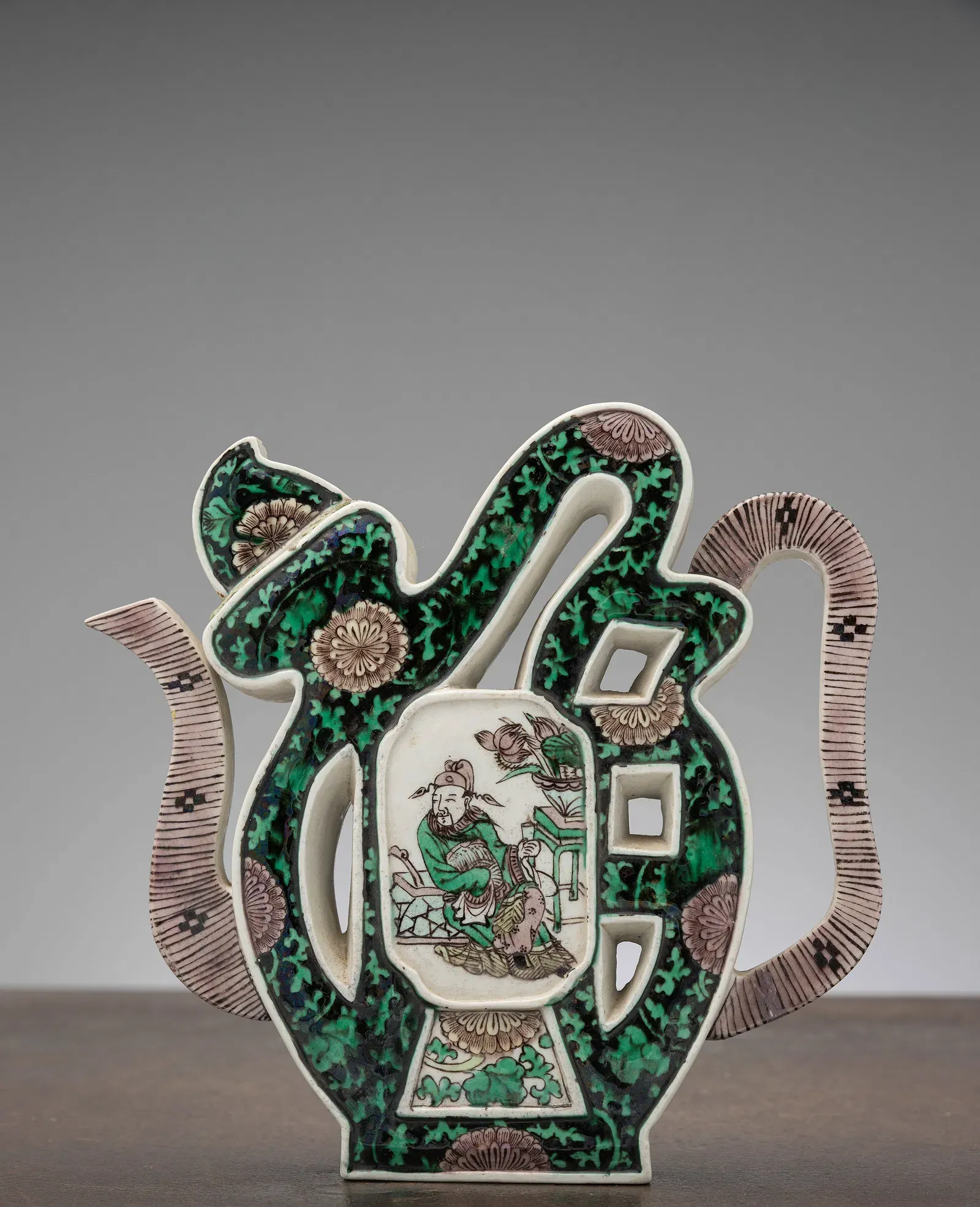
At first glance, this charming double-gourd wall vase captures the playful elegance of Qing dynasty design. Its looping silhouette, openwork carving, and jewel-like famille verte enamels evoke the decorative exuberance of the Kangxi era.
The base bears the four characters “Da Qing Kangxi Nian Zhi” — ‘Made in the Kangxi years of the Great Qing.’ That’s a powerful claim. Kangxi-period famille verte, produced between 1662 and 1722, represents one of the high points of Chinese overglaze enamel decoration and is avidly collected worldwide.
But craftsmanship tells the deeper story. The porcelain body here is uniformly white and matte, the enamels sit rather flatly on the surface, and the molded contours feel mechanically crisp. Genuine 17th-century examples usually show subtle asymmetry, kiln grit on the base, glaze wear, and a depth of enamel application developed through time and handling.
Condition-wise, this piece is excellent — almost too excellent. The absence of meaningful wear or patina is telling.
So where do we land? As a decorative Qing-style reproduction, likely late 20th or early 21st century, I would assign an authenticity score of 20%. At auction, it would likely bring between $300 and $800. Were it truly Kangxi period, the figure would soar into the $15,000–25,000 range.
A beautiful homage — but not a survivor of the Kangxi kilns. And that’s etched in Jade..!
Used for this report's TTS and avatar presentation.
Item Report
Qing Style Famille Verte Porcelain Double-Gourd Wall Vase
清式五彩葫芦形瓷挂瓶
By:Unknown
Style:Qing Style (Kangxi Mark) Famille Verte Porcelain
Origin:China
Materials:Porcelain with overglaze famille verte enamels
Age:Late 20th to early 21st century
Condition:Excellent (no significant visible damage; modern piece, not officially graded)
Value:If authentic Kangxi period (1662–1722): $15,000–25,000 at auction. As a modern reproduction: $300–800 at auction.
Maker's Marks / Writing:Underside bears four-character mark: 大清康熙年制 (“Made in the Kangxi years of the Great Qing”).
Date:2026-02-13 18:31:26.241106
Description:
A molded porcelain wall vase in the form of a stylized double-gourd with openwork elements, decorated in famille verte enamels with floral motifs and figural reserve panels. The base bears a four-character Kangxi mark.
一件模制成葫芦形并带镂空装饰的瓷质挂瓶,施五彩(康熙风格)釉彩,饰花卉纹及人物开光图案。底部署有四字“康熙年制”款。
Curator Questions
Curated by Jade
Assessment:
This molded double-gourd wall vase is decorated in the famille verte palette associated with the Kangxi reign (1662–1722) and bears a four-character underglaze mark reading “大清康熙年制” (Made in the Kangxi years of the Great Qing). However, the crispness of the molding, the uniform matte-white body, the relatively flat and modern-looking enamels, and the overall lack of age-related wear strongly suggest a late 20th or early 21st century decorative reproduction. The openwork carving lacks the refinement and subtle asymmetry typical of genuine Kangxi period examples, and the mark appears neatly written but without the calligraphic vitality of 17th-century imperial wares.
FAKERY CHECK: The presence of a Kangxi mark alone is not proof of age. FAKER FLAG #6 applies here—spurious Kangxi marks are extremely common on modern decorative porcelain. The surface shows minimal patina, no kiln grit adhering to the base, and no convincing glaze wear.
A word about copies.. Famille verte wares of the Kangxi era are among the most frequently reproduced categories in Chinese ceramics. Modern workshops produce convincing decorative versions with apocryphal reign marks specifically to enhance appeal. Collectors must assume reproduction unless period characteristics are clearly evident.
Based on stylistic and material evidence, this piece is best categorized as a modern Qing-style decorative object rather than a 17th-century work. {chavatar_catchphrase}
此件葫芦形挂瓶采用康熙时期常见的五彩装饰风格,底署“大清康熙年制”四字款。然而,从模制线条的生硬程度、胎体洁白均匀的质感、釉彩较为平板且缺乏自然老化痕迹等方面判断,更符合20世纪末至21世纪初的装饰性仿品特征。镂空部分缺乏康熙时期器物常见的细腻与自然刀味,款识书写工整但缺少17世纪御窑款识的书法神韵。
【仿伪分析】仅有“康熙”款并不能证明年代。依据伪造警示第六条——仿康熙款极为常见。底部未见自然窑砂粘附,釉面缺乏真实磨损与包浆,整体做旧痕迹不足。
关于复制品需特别说明:康熙五彩为中国瓷器中最常被仿制的门类之一,现代作坊大量生产带有寄托款的装饰瓷器以提高吸引力。收藏者在无充分断代依据前,应默认其为仿品。
综合判断,此器应为现代清式风格装饰瓷,而非17世纪康熙朝实物。{chavatar_catchphrase}
Individual Images:
front double-gourd vase
side view of vase
side profile view
reverse three-quarter view
back of vase
underside with Kangxi mark
detail of seated scholar panel
detail of child with teapot panel
Provenance:
No provenance documentation provided.
Condition:
Excellent (no significant visible damage; modern piece, not officially graded)
Identification Score: 95%
The gourd form, famille verte palette, figural reserves, and Kangxi mark clearly identify it as a Qing-style famille verte wall vase.
从葫芦造型、五彩设色、人物开光及“康熙年制”款识判断,其类型为清式五彩挂瓶无疑。
Authenticity Score: 20%
Modern surface quality, lack of wear and patina, and a very common apocryphal Kangxi mark strongly indicate a contemporary reproduction.
釉面新净、缺乏自然磨损与包浆,加之常见的寄托“康熙”款,强烈指向现代仿制品。

Share: