Japanese Edo-Style Gusoku Samurai Armor with Kabuto and Storage Box
LANGUAGE UNLOCK
Glossary Roundup
Original Presentation Script
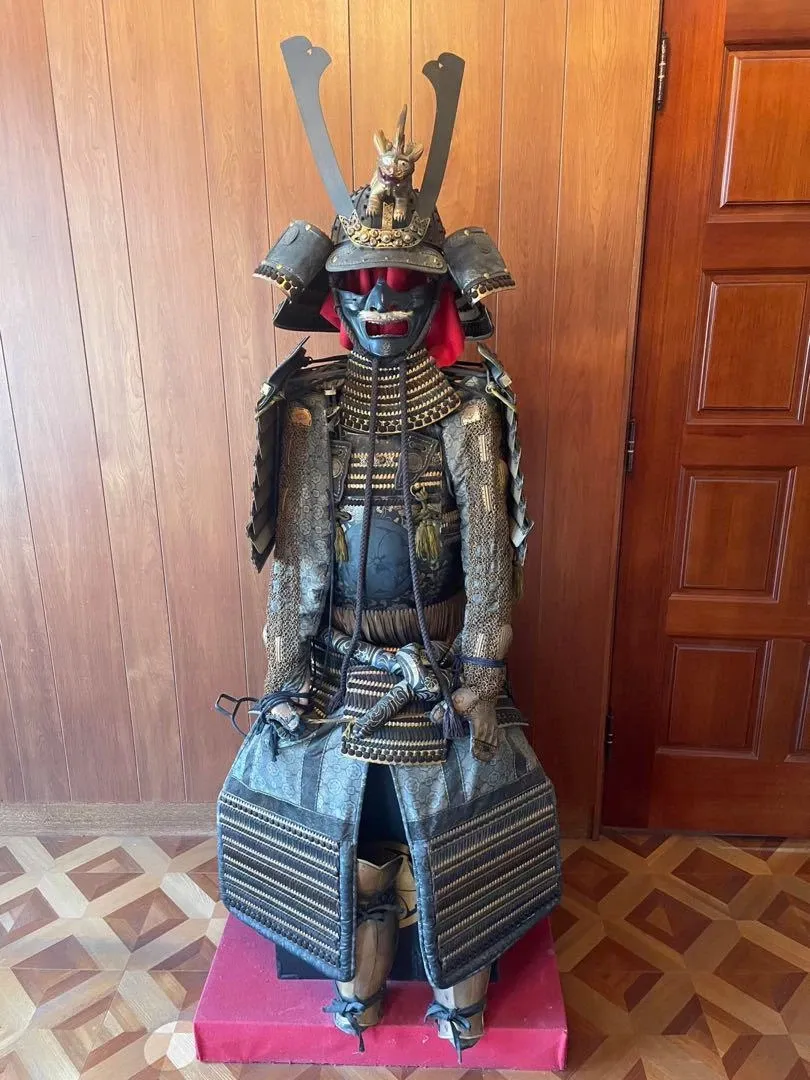
Let’s meet this imposing figure: a full Japanese Gusoku Samurai Armor, complete with helmet, mask, and storage box—exactly the kind of piece that turns a living room into a daimyo’s audience hall.
At first glance, it reads as late-Edo drama: tall kuwagata crests, a bold menpō with jaunty moustache, and a cuirass emblazoned with a family crest. The decorative beast perched on the kabuto is pure theatre, echoing historic maedate while leaning into 20th‑century fantasy.
Look closely at the materials: the lacing is extraordinarily uniform, the brocades are crisp and saturated, and the lacquered plates show use but not centuries of wear. This feels workshop-made for display—iron and lacquer, yes, but assembled with modern textiles and techniques rather than hand-laced in a feudal arsenal.
Condition is very good: some dust, minor scuffs, but no major breaks or collapsed lacing. For a true Edo suit that would be suspiciously clean; for a decorative piece, it’s exactly what collectors like to see.
On authenticity, I’d place this around 25%: convincing in style, likely mid–late 20th century in date, possibly incorporating an older component or two but fundamentally a modern ensemble. As such, I’d expect it to bring roughly $2,000–$5,000 at auction; a fully documented Edo-period suit of similar impact would start closer to the high five figures.
So: not a battlefield veteran—but a very charismatic storyteller from the age of the samurai revival.
Used for this report's TTS and avatar presentation.
Item Report
Japanese Edo-Style Gusoku Samurai Armor with Kabuto and Storage Box
By:Unknown armor workshop, likely 20th century
Style:Japanese samurai armor, Edo revival / decorative replica
Age:Likely mid–late 20th century (circa 1960–1990), in Edo-period style
Condition:Very good (light wear and dust, textiles and lacing largely intact; appears display-used rather than combat- or museum-worn)
Value:If by some chance largely Edo-period with later restorations: auction estimate approximately $18,000–$30,000 USD. As a 20th-century decorative / composite replica (most likely scenario): approximately $2,000–$5,000 USD at auction, depending on local demand and completeness.
Maker's Marks / Writing:No clear maker’s signature or internal inscription visible in the provided photos; any mei would typically be inside the kabuto bowl or on armor plates, which are not shown.
Date:2025-12-11 23:56:38.617534
Description:
Full suit of Japanese samurai armor (gusoku) displayed on a stand, with iron/steel lamellar cuirass, sode (shoulder guards), kusazuri (tassets), kote (armored sleeves with chain mail), haidate and suneate (thigh and shin guards), and a menpō face mask with white moustache. The helmet (kabuto) is fitted with tall black kuwagata crests and a whimsical seated beast maedate, and is matched with a lacquered cuirass decorated with a mon motif, extensive silk lacing in muted golds and blues, and brocade-covered components. A black wooden armor chest with a gold family crest is included. The overall look closely follows mid–late Edo-period styles, but construction and finish suggest a 20th-century decorative/replica set rather than a period battlefield suit.
Curator Questions
Curated by Jade
Assessment:
This is a visually impressive, complete suit of Japanese samurai armor in Edo-period style, including its wooden storage box with painted mon. The bright, even lacquer, very regular machine-made silk lacing, crisp modern-looking brocades and the caricature-like beast maedate all point to a 20th-century decorative reproduction or composite rather than a genuine Edo battlefield gusoku. The armor appears well made for display and would be attractive as an interior focal piece or for thematic collections, but should not be marketed as an original 17th–18th century suit without expert hands-on verification. A word about fakes.. Japanese arms and armor are heavily reproduced for the tourist and decorator market, so one must assume reproduction until close technical details (plate shaping, lacquer age, interior signatures) prove otherwise.
Individual Images:
none
Provenance:
Not provided.
Condition:
Very good (light wear and dust, textiles and lacing largely intact; appears display-used rather than combat- or museum-worn)
Identification Score: 92%
Form, components, and construction clearly identify the object as a full suit of Japanese samurai armor (gusoku) with kabuto, menpō, and armor chest; only the precise age/originality of parts is uncertain.
Authenticity Score: 25%
The armor closely imitates Edo-period styles but the uniform lacing, clean brocades, modern-feeling sculpted maedate, relatively limited patina and general decorative presentation are typical of 20th-century replica suits made for display. Without interior views showing convincing age, signatures, and construction, the safer assumption is a modern decorative or composite set with little if any Edo-period core.
Image Memory Note
None
None
Keywords
Japanese, samurai armor, gusoku, kabuto, menpo, Edo style, replica armor, Japan
The report was edited after initial Artmink draft. Original AI draft preserved in Artmink audit history.

Share: