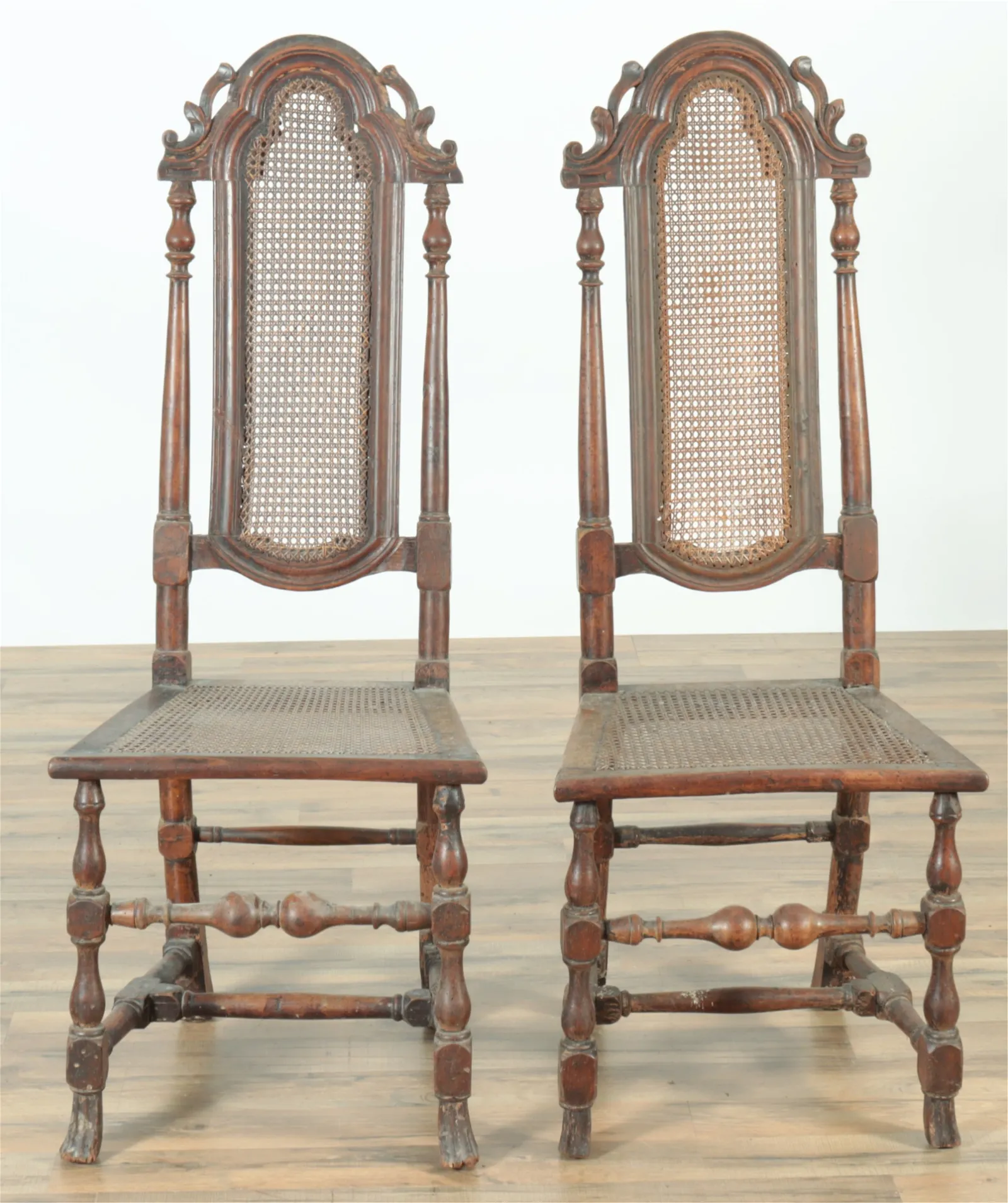
Continental Baroque Period Walnut and Caned High-Back Chairs (Pair)
LANGUAGE UNLOCK
Glossary Roundup
Original Presentation Script
Imagine for a moment a grand salon in a Baroque-era chateau: opulent, architectural, and filled with the waltzes of strings. Such is the setting where today's splendid feature might have once taken pride of place — a pair of Continental Baroque Period Walnut and Caned High-Back Chairs. These are no mere furnishings; they are historical artifacts, imbued with a heritage of craftsmanship from the elegant yet complex Baroque period, spanning from around 1680 to 1720. Their inviting form with high backs, turned elements, and charmingly intricate cane work, transports us back to a time when furniture was both art and utility. A testament to evolution in design, these chairs echo the bold and elaborate architectural lines distinctive to Baroque aesthetics, perhaps hailing from France or Northern Italy. At the heart of their allure lies their medium: rich walnut wood, chosen for its durability and paired with caned elements of rattan, bringing a touch of both airiness and sophistication. Their construction speaks silently of old-world craftsmanship, from the pegged mortise-and-tenon joints to the turned baluster stiles that dance with shadow and light. Yet, every piece tells its own story of passage time — and these chairs carry their years well. See the wear that authenticates them: small abrasions, subtle repairs, especially to the caning, signaling centuries of faithful service rather than carelessness. Such scars enhance their narrative, not diminish it, whispering tales of gatherings that have smoothed their surfaces and features. Authenticity here is felt rather than declared, with an impressive score of 80%. While we cannot boast a detailed provenance, we trust the design, wear, and material — guiding our appraisal estimate to a respectful range of $800 to $1,500 at auction. In closing, may these chairs, steeped in history, always speak softly of the grace and artistry that shaped them — enriching the collector who sees them not merely as objects, but as doorways to another time.
Used for this report's TTS and avatar presentation.
Item Report
Continental Baroque Period Walnut and Caned High-Back Chairs (Pair)
By:Unknown (handcrafted, likely a regional workshop)
Style:Baroque, Continental European
Origin:Likely France or Northern Italy
Materials:Walnut wood, cane (rattan)
Age:circa 1680–1720
Condition:Good (visible wear to cane, surface abrasions, repair to stretchers, some old restoration)
Value:$800–$1,500 (for the pair, at auction)
Maker's Marks / Writing:None visible
Date:2025-07-03 15:53:44.806933
Description:
This is a matched pair of Baroque period high-back chairs, likely dating from the late 17th to early 18th century. The chairs are made from walnut wood and feature arched, scrolled crest rails, turned baluster stiles and legs, and intricate caned panels in both the back and the seat. The design showcases strong architectural influences with elaborate scrolled pediments and an emphasis on verticality. The presence of original caning, some wear consistent with age, and pegged mortise-and-tenon construction (as evidenced in some joints) suggest authenticity. The stretchers are also turned and show honest wear from use, especially near the feet.
Curator Questions
Curated by Jade
Assessment:
A handsomely proportioned and decorative pair of authentic Baroque period side chairs, exhibiting excellent period details and the expected patina and wear of 300+ year old walnut. Signs of historical repairs and evolved wear to the cane and stretchers confirm regular and honest use. A word about fakes: Reproduction Baroque-style chairs are common, yet these chairs show the kind of wear, joinery methods, and quality of carving/turning associated with authentic period examples.
Individual Images:
No additional images were provided
so only the frontal view can be assessed. From this view
surface wear is visible on the arms
crest rail
and legs. The right chair appears structurally sound but with cane damage
while the left shows similar wear and possible restoration on the stretcher. Some irregularity in turning suggests hand craftsmanship.
Provenance:
None provided
Condition:
Good (visible wear to cane, surface abrasions, repair to stretchers, some old restoration)
Identification Score: 95%
The distinctive mix of features—arched and scrolled crest rail, baluster turning, caned panel, and period wear—align strongly with authentic late 17th–early 18th century Baroque chairs from Continental Europe. The age, craftsmanship, and details leave little doubt as to type.
Authenticity Score: 80%
The construction methods, honest wear, original caning (with repairs), and period-appropriate materials strongly indicate these are authentic Baroque period chairs rather than modern reproductions. The only slight deduction in the score is due to the possibility of historical or later repairs and the lack of detailed provenance.
Image Memory Note
Image shows a pair of tall, high-back Baroque period chairs with arched and scrolled crest rails, elaborate turned stiles and legs, and caned seat and back panels. Both show consistent wear to the front legs, feet, and cane—especially on the lower seat portions. There is no visible inlay or marquetry. Hardware is not visible and joints appear mortise and tenon with pegged construction. No visible maker’s mark or inscriptions on the front, sides, or crest rail.
Keywords
Baroque, period chairs, continental furniture, walnut, caned, 17th century, antique chairs, Europe
The report was edited after initial Artmink draft. Original AI draft preserved in Artmink audit history.


Share: