Jade : Chinese Fine and Decorative Arts
Jade Presents

Original Presentation Script
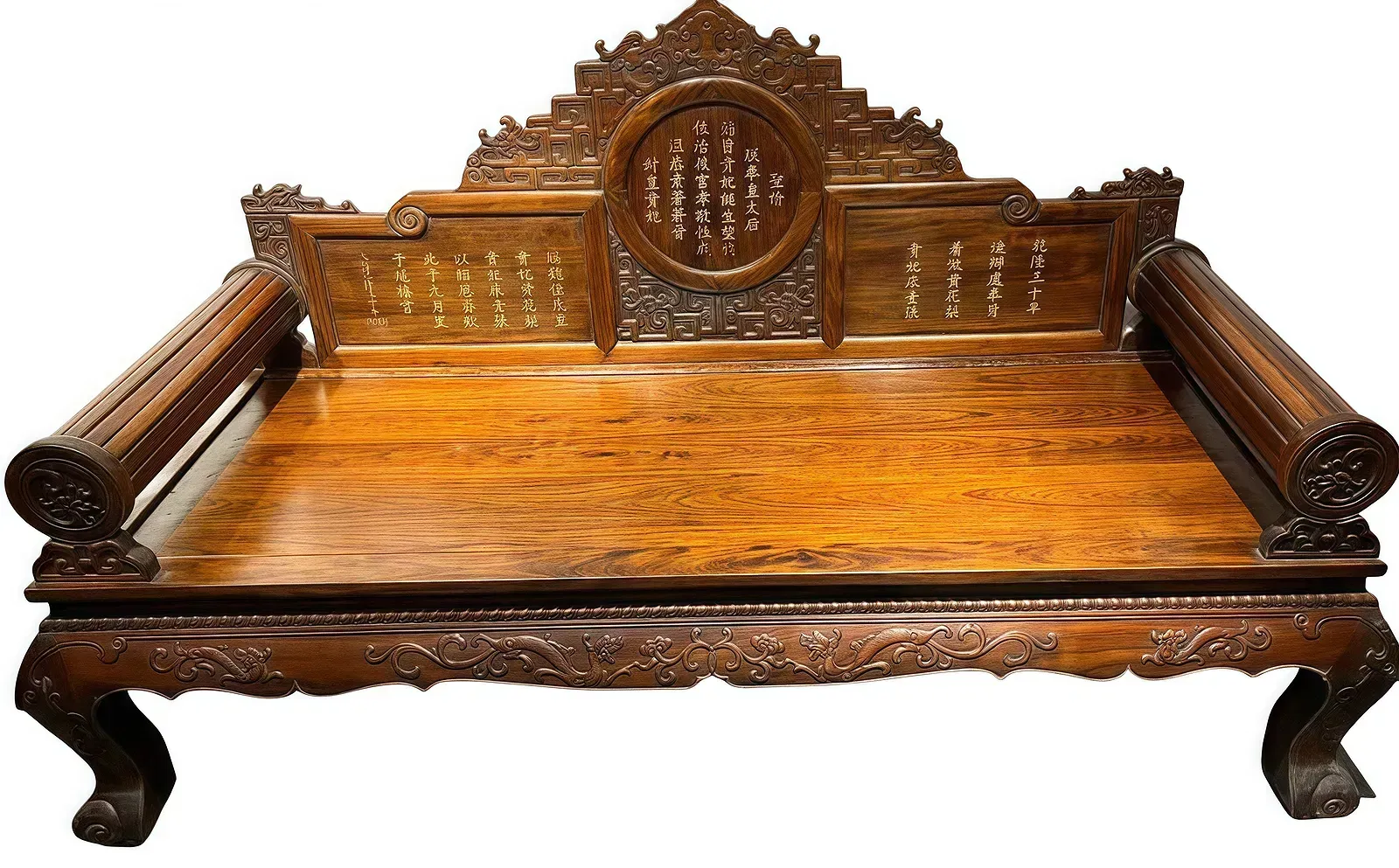
Ladies and gentlemen, we are presented with an imposing and refined Chinese Luohan Chuang, a daybed form deeply rooted in scholarly and aristocratic life. Most striking is the inscription dating the piece to the Qianlong Thirtieth Year—1765—and referencing production at the Imperial Workshops. The architectural silhouette, stepped backrest, and balanced proportions align with mid-Qing design sensibilities. The hardwood displays a rich reddish tone and animated grain often associated with huanghuali. The carved apron and cabriole legs demonstrate confident workmanship, while the fluted cylindrical armrests lend an air of disciplined elegance. The inscription’s claim of imperial commission is significant. Should it withstand technical and documentary scrutiny, it would place the piece firmly within the distinguished context of Qing court craftsmanship. At present, the carving, material appearance, and overall structure strongly support a Qing-dynasty aesthetic, though confirmation of wood species and inscription authenticity requires physical examination. In sum, this is a compelling and potentially important example of Qing hardwood furniture, combining literati form, decorative carving, and historically ambitious inscription.
Used for this report's TTS and avatar presentation.
Item Report
Chinese Huanghuali Luohan Chuang (Daybed) with Qianlong Thirty-Year Inscription
清代黄花梨罗汉床(乾隆三十年铭文)
Merge Reports: Yes (reconciled). Approval remains manual.
Material identification and inscription authenticity require in-person expert examination for definitive confirmation.
Style: Chinese Qing Dynasty Furniture
Origin: China
Materials: Huanghuali-type hardwood, consistent in appearance with Dalbergia odorifera (visual assessment only)
Age: Qianlong Period, Qing Dynasty, inscribed Qianlong 30th Year (1765), authenticity of inscription unverified
Condition: Very Good to Excellent (visually well-preserved; restoration history undetermined without technical examination)
Value: If period Qing (18th century) and of huanghuali: $150,000 - $300,000 USD; If later example or reproduction: $30,000 - $80,000 USD
Peer-Reviewed Market Values
- Dating Range
- Pending structured dating
- Auction Liquidation
- Pending structured market values
- Fair Market Value
- Pending structured market values
- Replacement Value
- Pending structured market values
- Comparables Used
- No saved comparables yet
- Research Confidence
- Insufficient Data
Peer review completed, but this run did not return structured market value ranges.
Maker's Marks / Writing: Right panel inscription: "乾隆三十年 造辦處奉旨 着做黄花梨 貴妃床壹張" (Qianlong 30th Year, 1765, made by Imperial Order at the Imperial Workshops, to be made of huanghuali, one Concubine's Bed). Central and left panels contain literary inscriptions. Authenticity of inscriptions unverified.
Date: 2026-07-12 17:52:50.451088
Description:
A monumental Chinese Luohan Chuang (daybed) featuring a high, stepped backrest with intricate open fretwork and three inset calligraphic panels. The central panel is circular, flanked by two rectangular panels. The right panel bears an inscription reading "乾隆三十年 造辦處奉旨 着做黄花梨 貴妃床壹張" (Qianlong 30th Year, made by Imperial Order at the Imperial Workshops, to be made of huanghuali, one Concubine's Bed). The wood displays a rich reddish-brown tone with prominent grain patterning across the seat planks and back panels. The seat is constructed of multiple wide boards. The apron is deeply carved with scrolling motifs, and the cabriole legs terminate in pronounced feet. The cylindrical armrests are vertically fluted, reinforcing the refined architectural character of the piece. 一张体量宏大的中国罗汉床,带有高耸的阶梯式靠背,配以精美的透雕及三块嵌板铭文。中央为圆形铭文板,两侧为长方形铭文板。右侧铭文为“乾隆三十年 造辦處奉旨 着做黄花梨 貴妃床壹張”。木材呈红褐色调,座面及背板可见清晰而富于变化的纹理。座面由多块宽板拼接而成。牙板深雕卷草纹,弯腿造型有力。扶手为圆柱形并饰以纵向凹槽,整体结构端庄典雅。
Curator Questions
Curated by Jade
Assessment:
This Luohan Chuang presents as a high-quality example of Chinese hardwood furniture in the Qing dynasty taste, bearing an inscription dated to the Qianlong Thirtieth Year (1765) and referencing production at the Imperial Workshops (Zao Ban Chu). The form, carving, and overall proportions are consistent with mid-Qing design principles. The wood exhibits coloration and grain patterns commonly associated with huanghuali, though definitive species identification requires in-hand examination. The inscription explicitly claims imperial commission and material specification. Such claims, while compelling, require independent verification through technical examination, study of carving technique and patination, and comparison with documented imperial workshop pieces. Without documentary provenance or physical analysis, the imperial attribution and precise dating remain plausible but unconfirmed. As it stands, the piece demonstrates strong aesthetic and structural qualities aligned with Qing dynasty craftsmanship and represents a significant and potentially valuable example of Chinese scholar’s furniture. 此件罗汉床整体呈现出清代硬木家具的高水准风格,铭文题为乾隆三十年(1765年),并称由造办处奉旨制作。其造型、比例与雕刻风格符合清中期家具的审美特征。木材色泽与纹理特征与黄花梨常见特征相符,但仅凭图像无法最终确认木材种类。 铭文明确提及御制及用材说明,此类记载具有吸引力,但仍需通过实物检测、雕刻刀法与包浆状态分析,以及与有档案记录的宫廷作坊器物进行比对,方可确认其真实性。在缺乏文献来源与技术检测的情况下,其宫廷出处与确切年代应视为有依据但尚待验证。 总体而言,该器在形制与工艺层面展现出清代风格特征,是一件具有重要艺术与潜在市场价值的中国文人家具实例。
Individual Images:
- Full front view; detail of central circular inscription; detail of right inscription panel; close-up of right inscription text; carved apron and leg detail; seat plank grain detail. Further images of underside
- joinery
- and tool marks recommended.
Provenance:
Not provided.
Condition:
Very Good to Excellent (visually well-preserved; restoration history undetermined without technical examination)
Identification Score: 95%
The form, structure, decorative program, and legible inscription clearly identify the object as a Chinese Luohan Chuang. The date "Qianlong 30th Year" (1765) is explicitly stated in the inscription. 从形制、结构、装饰风格及清晰可读的铭文判断,可明确识别为中国罗汉床。铭文中明确写有“乾隆三十年”(1765年)。
Authenticity Score: 70%
The craftsmanship and visible hardwood grain are consistent with Qing-period furniture traditions. However, confirmation of the wood as Dalbergia odorifera and verification of the "Qianlong 30th Year" Imperial Workshops inscription require physical examination, tool-mark analysis, and documentary comparison. In the absence of such testing, the period attribution and imperial claim remain plausible but unproven. 工艺水平与可见木纹特征与清代家具传统相符。然而,木材是否为降香黄檀(黄花梨)以及“乾隆三十年造办处奉旨”铭文的真实性,仍需通过实物检测、刀痕分析与档案比对加以确认。在缺乏技术检测的情况下,其断代与宫廷属性属合理推测但尚未最终证实。
Image Memory Note
Six images reviewed showing full view and inscription details. 共查看六张图片,包括整体及铭文细节。
Keywords
Chinese furniture, Luohan Chuang, Qing Dynasty, Qianlong 1765, Huanghuali, Zao Ban Chu, Imperial inscription, Hardwood daybed, Carved apron, Scholar furniture 中国家具, 罗汉床, 清代, 乾隆三十年, 黄花梨, 造办处, 宫廷铭文, 硬木家具, 雕刻牙板, 文人家具
Peer Review Summary
Peer Review
Key Visible Evidence
The object is a Luohan Chuang (daybed) with a stepped backrest, intricate fretwork, and three inset panels, as seen in Image 1. Cylindrical fluted armrests, a carved apron with scrolling motifs, and cabriole legs are also clearly visible in Image 1. The wood exhibits a rich, reddish-brown hue and distinct grain patterns across the seat and backrest panels (Image 1, 3). The right inscription panel (Image 3, 4) clearly reads "乾隆三十年 造辦處奉旨 着做黄花梨 貴妃床壹張" (Qianlong 30th Year, made by Imperial Order at the Imperial Workshops, to be made of huanghuali, one Concubine's Bed). The central inscription is also legible in Image 2.
Market and Source Support
The report's claim of "Huanghuali wood (Dalbergia odorifera)" is plausible given the visible grain and color, which are consistent with high-quality Chinese hardwoods often associated with huanghuali. However, definitive identification of Dalbergia odorifera solely from images is not possible without specialized examination. The inscription explicitly states "Qianlong 30th Year" (1765) and "Imperial Workshops" (Zao Ban Chu), which, if authentic, would place it firmly in the mid-Qing Dynasty. However, the presence of such an inscription does not, by itself, constitute independent historical documentation or provenance for imperial manufacture.
Needs Verification
Definitive identification of the wood as Dalbergia odorifera (huanghuali) requires in-hand examination, including grain analysis, density testing, and potentially UV light examination for characteristic fluorescence. The authenticity of the "Qianlong 30th Year" and "Imperial Workshops" inscription requires independent historical research into imperial records or comparable documented pieces, as well as close examination of the carving technique and patination of the inscription itself. Detailed images of joinery, underside construction, and tool marks would be necessary to further confirm the age and construction methods consistent with mid-Qing Dynasty furniture versus later reproductions or revival pieces. The claim of "excellent condition" with "possible historical restoration" needs verification through UV light examination to detect repairs, touch-ups, or replacements.
Audit Conclusion
The object's form and visible craftsmanship are consistent with a high-quality Chinese Luohan Chuang. The legible inscriptions provide specific claims regarding date, material, and origin. However, the critical claims of "huanghuali wood" and "Imperial Workshops" provenance, while explicitly stated in the inscription, remain unproven from the supplied images and require rigorous independent verification. Therefore, the report's dating and material attribution are plausible but unproven without further diagnostic evidence and historical documentation.
Comparables (Similar Items)
No archived comparables matched this report yet.
Share: