Chinese Qing Style Blue-and-White Porcelain Bottle Vase with Budai Figures中国青花布袋和尚纹玉壶春式瓶
LANGUAGE UNLOCK
Glossary Roundup
Original Presentation Script
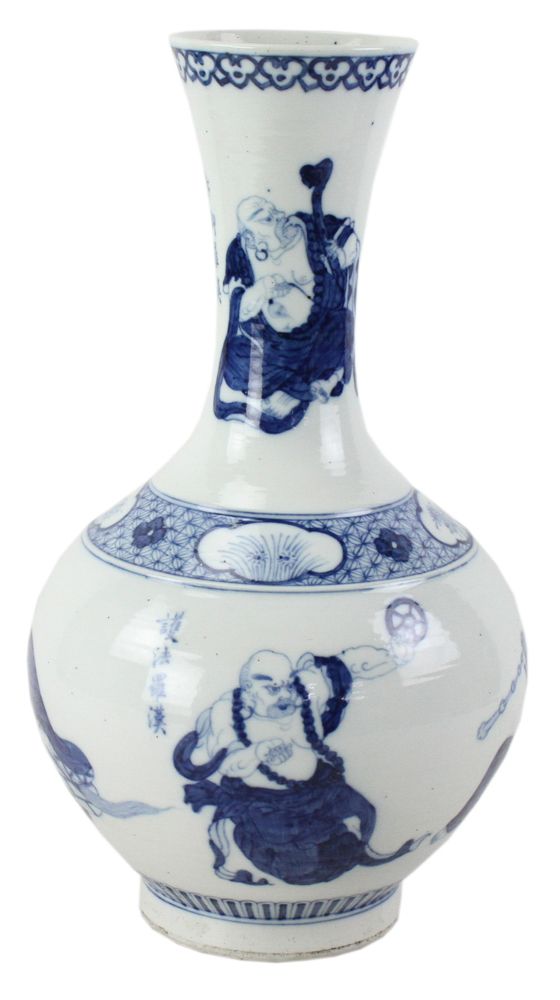
Let’s take a look at this Chinese Qing style blue-and-white porcelain bottle vase, dancing with images of the Laughing Buddha, Budai. With its globular body and long, flaring neck, it follows the classic bottle or yuhuchun silhouette that collectors associate with Kangxi elegance.
Blue-and-white scenes of Budai, inscriptions, and auspicious objects tap into a long tradition of playful, auspicious figural wares. The base even carries a bold six-character mark, “Made in the Kangxi period of the Great Qing,” inviting us to dream of the 17th century.
But the materials and workmanship tell a more modern story. The porcelain is very white and uniform, the cobalt a steady mid-blue without much of the ‘heaping and piling’ that gives true Kangxi pieces their smoky depth. The foot is sharply cut and quite clean, more consistent with twentieth-century Jingdezhen practice than early Qing kilns.
Condition is very good: no apparent chips or cracks, just a few firing specks and light wear to the foot, so it presents beautifully on a shelf.
When we weigh authenticity, the evidence points firmly to a Kangxi-style homage rather than a period masterpiece. I’d place the authenticity score around 25%, and value it accordingly: perhaps $300–$700 as a decorative 20th-century reproduction, versus many thousands were it genuinely Kangxi. A charming tribute to imperial taste—without the imperial price tag.
Used for this report's TTS and avatar presentation.
Item Report
Chinese Qing Style Blue-and-White Porcelain Bottle Vase with Budai Figures
Materials:Porcelain with underglaze cobalt-blue decoration and clear glaze
Age:Likely 20th century (Republic period to late 20th century), Kangxi reign mark
Condition:Very good (no obvious chips or cracks visible; minor firing specks and light base wear only, not officially condition-reported)
Value:If authentic Kangxi period: US $8,000–$15,000 at auction; as a 20th-century Kangxi-style reproduction: US $300–$700
Maker's Marks / Writing:Six-character underglaze-blue reign mark on base: 大清康熙年制 (Made in the Kangxi period of the Great Qing). Additional cursive inscriptions alongside the figures, likely poetic or auspicious phrases, partially legible.
Date:2025-12-16 18:20:09.166069
Description:
Porcelain bottle-form vase with globular body and tall flaring neck, painted in underglaze cobalt blue on a white ground. The body shows lively images of Budai (the Laughing Buddha) holding a sack and rosary, surrounded by auspicious objects and calligraphic inscriptions. A band of cartouches with floral sprays and diaper pattern encircles the shoulder; the neck has further figure panels and a floral scroll at the rim. The base bears a six-character underglaze-blue mark reading “大清康熙年制” (Made in the Kangxi period of the Great Qing), written in regular script within the recessed foot.
瓷质玉壶春式瓶,鼓腹细长颈,上口外撇。通体以青花绘制,白釉地略带青灰。腹部绘布袋和尚形象,袒胸露腹,手执数珠与布袋,周围点缀祥云及吉祥物,并书有数行行书款识。肩部一周绘菱格锦地开光,内饰花卉与折枝,颈部再绘人物开光,口沿为连珠花卉回纹。圈足内以青花书“大清康熙年制”六字楷书款。
Curator Questions
Curated by Jade
Assessment:
This is a Chinese blue-and-white porcelain bottle vase decorated with Budai figures and bearing a six-character Kangxi reign mark to the base. The shape, subject, and palette consciously emulate late 17th–early 18th century Kangxi wares, but several factors indicate a later Kangxi-style piece rather than an imperial-period original. The glaze is very bright and even, the cobalt is relatively flat in tone with limited ‘heaping and piling,’ and the footrim and base appear quite clean and mechanically finished, lacking the characteristic kiln grit and gentle wear of a 300-year-old vessel. The calligraphy of the base mark is also somewhat stiff and evenly spaced compared to genuine Kangxi imperial script. “A word about fakes..” blue-and-white Kangxi-marked vases are among the most frequently reproduced categories in the Chinese art market, so caution is essential. On balance, this vase is best regarded as a 20th-century Jingdezhen product made in homage to Kangxi blue-and-white, decorative and collectible but not of the period it claims. - this is Jade signing off! My red seal stamp goes CHOP!
此件为中国青花瓷布袋和尚纹玉壶春式瓶,圈足内署“大清康熙年制”六字楷书款。造型、题材与设色明显仿效十七至十八世纪之康熙青花器,但多处细节显示其应为后世仿制而非康熙朝真品。其釉面光洁明亮,整体光泽偏新,青花发色较为单一,缺少康熙官窑常见的“积墨”“晕散”等变化,圈足修胎整齐、底部较为干净,少见历经三百年使用应有的磨损与窑垢。同时底款书写略显板正呆板,与康熙官窑款识的神韵存在差距。“A word about fakes..” 带康熙款之青花瓶在当今市场中赝品极多,须格外警惕。综合釉色、胎质、足墙及款识等因素,此瓶更可能为二十世纪景德镇仿康熙风格制品,可作装饰与收藏之用,但不宜视作康熙时期原作。 - this is Jade signing off! My red seal stamp goes CHOP!
Individual Images:
none
Provenance:
Not provided
Condition:
Very good (no obvious chips or cracks visible; minor firing specks and light base wear only, not officially condition-reported)
Identification Score: 92%
Form, decoration, and Kangxi mark are clear, and the Budai iconography and border patterns are typical; high confidence that this is a Kangxi-style blue-and-white bottle vase, even if not of the period.
器形、纹饰及康熙款均较明确,布袋和尚题材与各类边饰皆为常见组合,因此对于其“仿康熙风格青花玉壶春瓶”的性质判断把握较大。
Authenticity Score: 25%
The bright, even glaze, relatively uniform cobalt, clean and sharply cut footrim, and modern-looking Kangxi mark suggest a 20th-century reproduction rather than a 17th–18th century original; lacking convincing age wear or kiln characteristics of true Kangxi porcelain.
釉面光亮均匀,青花色调单一,圈足修整利落且底部过于洁净,加之款识笔意略显生硬,更符合二十世纪仿品特征,而与真正康熙朝瓷器常见的窑烧痕迹及自然陈旧感不符,因此真实性评分偏低。

Share: