Chinese Ming Period Blue and White Porcelain Floral Dish中国明代青花缠枝花卉纹盘
LANGUAGE UNLOCK
Glossary Roundup
Original Presentation Script
Here we have a Chinese blue and white porcelain dish of Xuande type — a form that looks deceptively simple until you realize simplicity, in early Ming porcelain, is often the luxury. The shallow profile, scrolling floral medallion, and disciplined border work place it squarely in one of the most admired design traditions in Chinese ceramics.
Now, the base bears the six-character mark 大明宣德年制 — 'Made in the Xuande reign of the Great Ming.' That is a famous and dangerous phrase in the marketplace, because Xuande-marked wares are copied endlessly. But this example arrives with something far more convincing than wishful thinking: old labels, exhibition history, publication references, and a named collecting pedigree tied to Sir Harry Garner and Sotheby's London.
The porcelain body, cobalt tone, footrim, and painted ornament all read as consistent with serious age. Importantly, it does not have the slick, overconfident finish of so many modern fakes. The mark itself is plausible, and the decoration has that calm, assured hand collectors hope to see.
Condition appears very good from the photographs, with honest age, minor wear, and old label residue, but no obvious major breaks or restorations visible here. A hands-on examination under strong light would still be ideal.
Authenticity score: 82%. Auction estimate: about $80,000 to $180,000 if genuinely Xuande period; $8,000 to $25,000 if a later antique Xuande-marked example; only $300 to $1,500 if modern. In short: a dish with the rarest ceramic accessory of all — believable history.
Used for this report's TTS and avatar presentation.
Item Report
Chinese Ming Period Blue and White Porcelain Floral Dish
中国明代青花缠枝花卉纹盘
By:Unknown imperial or high-quality Jingdezhen workshop
Style:Ming dynasty blue and white porcelain, Xuande-type court style
Origin:China
Materials:Porcelain, underglaze cobalt blue
Age:Early 15th century, likely circa 1426-1435 if period; alternatively a later but still old example copying Xuande imperial wares
Condition:Very good (visible age, minor wear and label residue, no major damage evident in photos)
Value:Auction estimate: if authentic Ming Xuande period example, approximately $80,000-$180,000; if later antique mark-and-period style example, approximately $8,000-$25,000; if modern reproduction, approximately $300-$1,500.
Maker's Marks / Writing:Underglaze blue six-character mark on base: '大明宣德年制' ('Made in the Xuande reign of the Great Ming'). Labels read 'Peter Boode Chinese Antiques London,' 'Oriental Ceramic Society 1954 Exhib'n 60,' and a small label 'H.H.G.'
Date:2026-03-25 11:43:37.662518
Description:
Shallow porcelain dish painted in underglaze cobalt blue with a central roundel of scrolling floral vines and composite blossoms, the cavetto with a narrow scrolling border, and the exterior with matching floral scroll decoration. The base bears a six-character Xuande mark in underglaze blue, reading 'Da Ming Xuande Nian Zhi' ('Made in the Xuande reign of the Great Ming').
浅腹瓷盘,以釉下钴蓝绘饰,盘心为团花式缠枝花卉纹,内壁饰细密卷草边饰,外壁同样绘缠枝花卉纹。底部青花双圈内书六字宣德款“大明宣德年制”,意为“大明宣德年间制造”。
Curator Questions
Curated by Jade
Assessment:
This appears to be a Chinese blue and white porcelain dish of Xuande type, with unusually strong supporting provenance and literature references. The form, restrained decoration, porcelain body, foot treatment, and calligraphic six-character mark are all broadly consistent with an early Ming attribution. The old collection labels and publication history materially strengthen the case, though photographs alone cannot absolutely confirm period. The surface shows credible age, and the piece does not present the glaringly glossy, over-finished, or mechanically stiff character often seen in modern forgeries. A word about copies.. Chinese blue-and-white porcelain is one of the most heavily reproduced categories in the market, and Xuande-marked wares in particular are copied relentlessly; even so, this example photographs better than most and benefits from unusually persuasive old-label provenance.
此件看起来为中国青花瓷盘,属宣德式样,并具有异常有力的来源与出版记录支持。其器形、含蓄的纹饰、瓷胎、足部处理以及青花六字款识,整体上都与明初归属较为吻合。旧藏家标签与著录记录显著增强了其可信度,尽管仅凭照片仍无法百分之百确认其确为本朝器。表面呈现出较可信的老化痕迹,也不见现代伪品常见的那种过分光亮、过度修饰或机械呆板的特征。A word about copies.. 中国青花瓷是市场上复制最泛滥的门类之一,尤以署宣德款者仿制最多;即便如此,此件从照片看仍优于大多数市场常见仿品,且拥有相当有说服力的早期旧标签来源。
Individual Images:
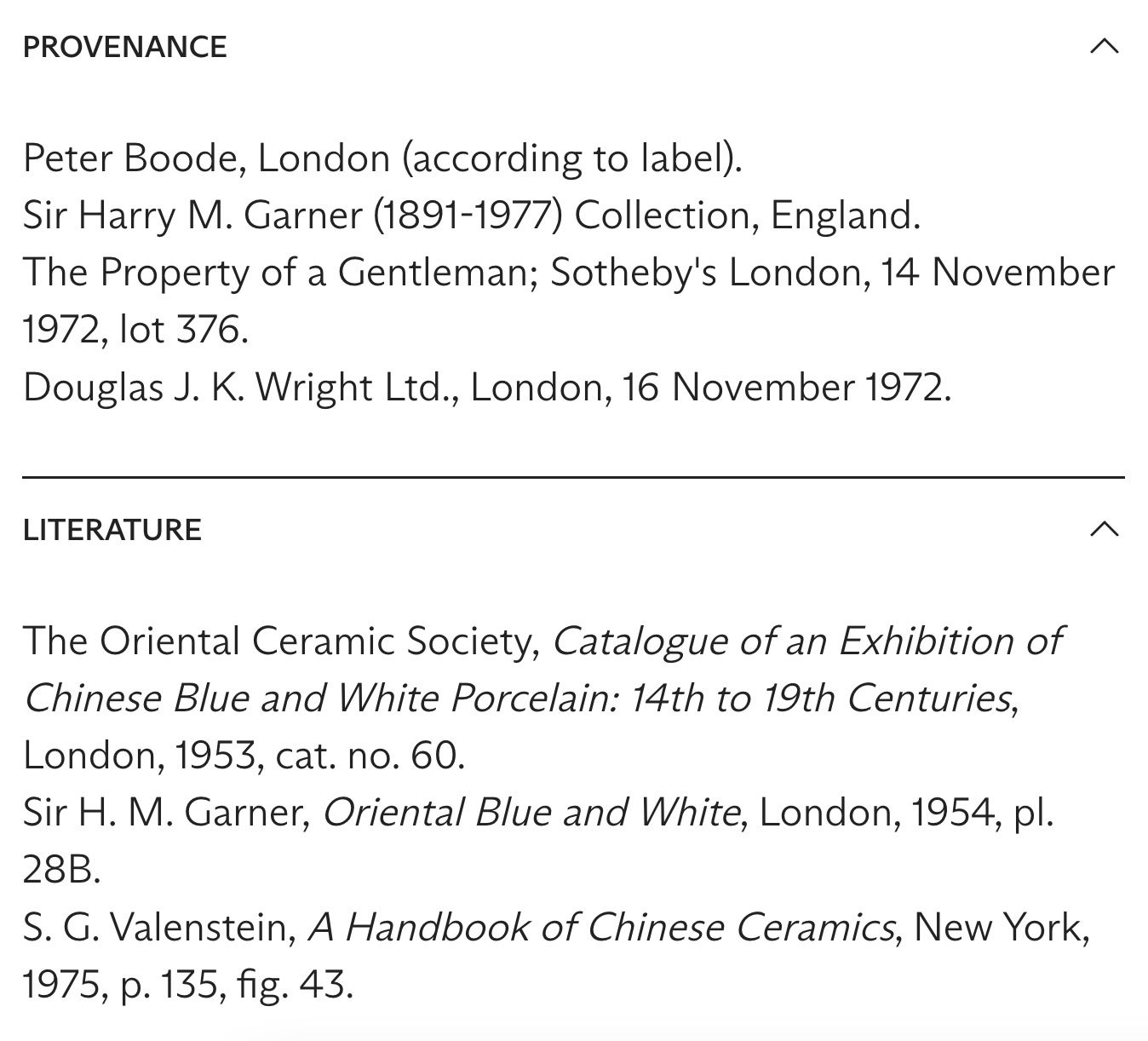
detail of provenance and literature
front dish
base of dish
side view dish
detail of Xuande mark
detail of exterior decoration
detail of interior painting
Provenance:
According to the provided image: Peter Boode, London (according to label); Sir Harry M. Garner (1891-1977) Collection, England; Sotheby's London, 14 November 1972, lot 376; Douglas J. K. Wright Ltd., London, 16 November 1972. Literature cited in the image: Oriental Ceramic Society, Catalogue of an Exhibition of Chinese Blue and White Porcelain: 14th to 19th Centuries, London, 1953, cat. no. 60; Sir H. M. Garner, Oriental Blue and White, London, 1954, pl. 28B; S. G. Valenstein, A Handbook of Chinese Ceramics, New York, 1975, p. 135, fig. 43.
Condition:
Very good (visible age, minor wear and label residue, no major damage evident in photos)
Identification Score: 95%
The object is clearly identifiable as a Chinese blue and white porcelain dish with Xuande-type decoration and mark. Multiple views show the form, decoration, base, and labels clearly enough to identify the category and likely art-historical placement with high confidence.
此器可明确识别为中国青花瓷盘,具宣德式纹饰与款识。多张图片清楚展示了器形、纹样、底部及旧标签,因此可较高把握地判断其类别及大致艺术史定位。
Authenticity Score: 82%
The authenticity score is relatively high because the dish carries old dealer and exhibition labels, published literature references, and a named collection history extending back to the mid-20th century. The mark 'Da Ming Xuande Nian Zhi' is appropriately written for a Xuande attribution, and the decoration has the controlled elegance expected of serious early wares. The footrim and glaze also look plausibly old. Fakery check: the labels could in theory be transferred, but nothing here suggests the crude calligraphy, shiny new glaze, or artificial aging associated with modern fakes. The provenance image is not in itself proof, but unlike many bogus provenance claims, this one is specific, dated, and tied to known publications and auction history. On balance, this photographs as a likely authentic early Ming or at minimum a genuinely old, high-level antique rather than a modern forgery.
真实性评分相对较高,原因在于此盘带有旧古董商标签、展览标签、出版著录,以及可追溯至二十世纪中期的具名收藏来源。款识“大明宣德年制”的书写方式与宣德归属基本相符,纹饰也具有明初精品常见的克制与雅致。足圈与釉面看上去也具备可信的老化特征。仿伪核查:理论上标签可能被后配,但本器未见现代伪品常有的拙劣书法、过新发亮的釉面或刻意做旧痕迹。来源图片本身并非绝对证明,但与许多含糊不清的伪来源不同,此处信息具体、可定位日期,并与已知出版及拍卖记录相连。综合判断,从照片看,它较可能是一件真正的明初器,至少也是一件年代可靠、等级较高的老瓷,而非现代伪造品。
Image Memory Note
None
None
Keywords
Chinese porcelain, blue and white, Ming period, Xuande type, floral dish, underglaze cobalt, Jingdezhen, six-character mark, Peter Boode, Sir Harry Garner, China
中国瓷器, 青花, 明代, 宣德式, 花卉纹盘, 釉下钴蓝, 景德镇, 六字款, Peter Boode, Harry Garner, 中国
The report was edited after initial Artmink draft. Original AI draft preserved in Artmink audit history.

Share: