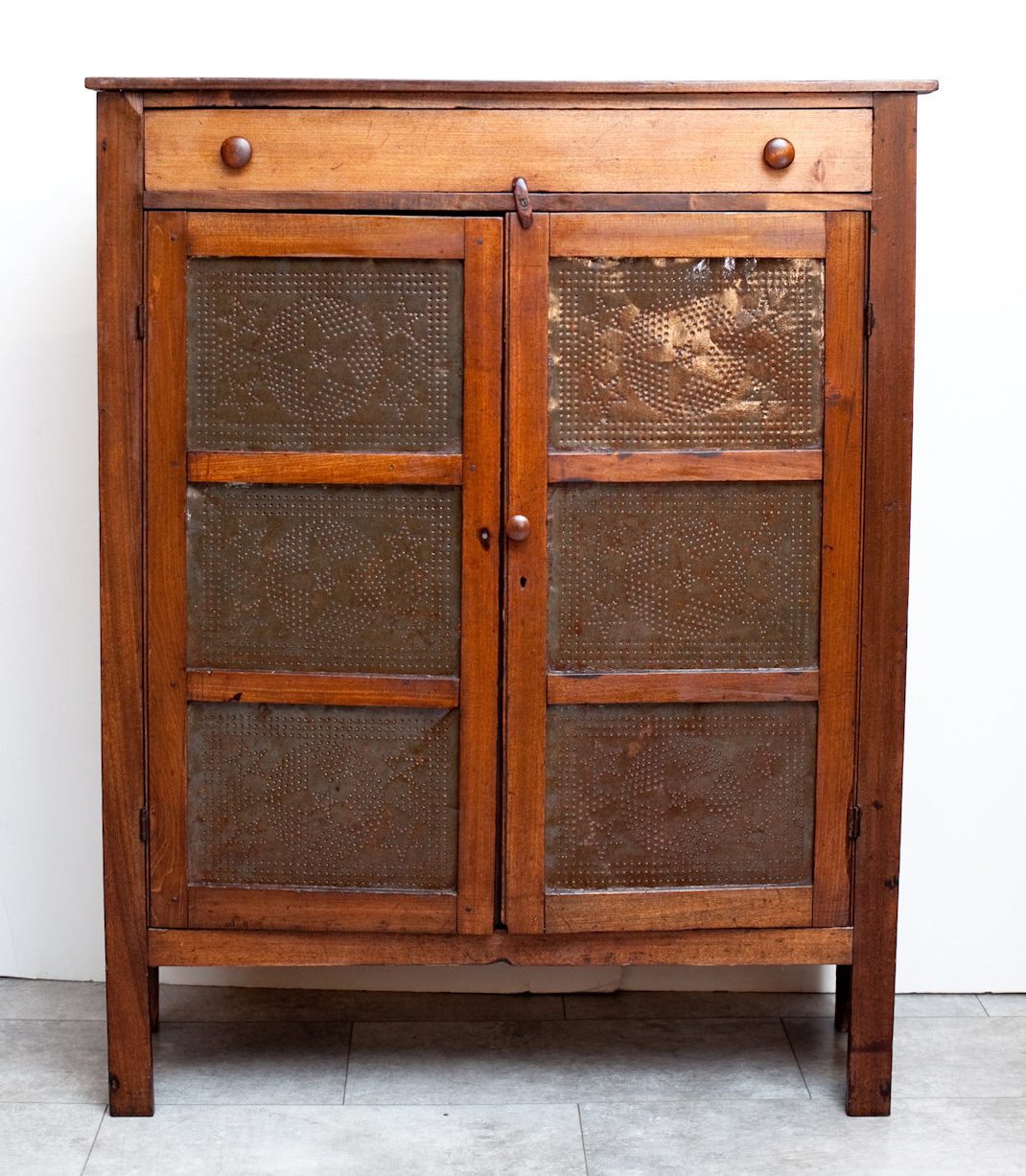
Welcome, Friend, to the world of 19th-century American craftsmanship, embodied in this charming American Primitive Walnut Pie Safe. With its simple, functional form, this pie safe once served as a practical solution for food storage, safeguarding homemade delicacies from the vagaries of the natural world. Its walnut case and decorative punched tin panels invite us to explore the rustic beauty and utility that defined rural American life between 1850 and 1870.
Transporting us back to a time when such items were the staples of Midwest and Southern households, this piece transcends mere furniture. It captures the essence of an era—its cultural heartbeat resonating through the geometric floral and star motifs meticulously hand-punched into the tin panels. Such designs were not just decorative but spoke volumes of its creator's artistic vision and resourcefulness.
Delving into its craftsmanship, the pie safe is built from solid walnut, a medium-brown wood treasured for its durability and rich patina. Original wood knobs and iron hardware accentuate its rustic charm. The hand-cut joinery, in particular, highlights the earnest, straightforward quality of its construction, reflecting the skills of an unknown but no less dedicated craftsperson.
Though time has left its gentle mark, the pie safe's condition is rated as Very Good. The expected signs of wear—a testament to its authentic use—include surface wear, edge nicks, and a graceful patina. Given its longevity, minor shrinkage and dings scarcely diminish its historical allure.
Proudly it stands with a strong degree of authenticity, supported by convincing signs of age such as aged patina and details faithful to its 19th-century origins. However, the absence of additional structural images tempers full certainty, with an authenticity score resting at a commendable 85%. In today's market, this genuine piece could fetch between $700 and $1,200 at auction, a noteworthy appraisal for a slice of Americana. Such pieces not only enrich collections but bring history to life's living spaces.
Used for this report's TTS and avatar presentation.
Item Report
American Primitive Walnut Pie Safe
By:Unknown (likely rural workshop or individual craftsman)
Style:American Primitive / Country
Origin:United States
Materials:Walnut wood, punched tin, iron hardware, wood knobs
Age:circa 1850-1870
Condition:Very Good (expected surface and edge wear, rich patina, minor wood shrinkage/splits, original hardware evident)
Value:$700-$1,200 (auction liquidation value estimate for authentic 19th-century pie safes in similar condition)
Maker's Marks / Writing:No makers marks or inscriptions visible on the frontal image.
Date:2025-07-22 21:13:48.345427
Description:
A classic American pie safe from the mid-19th century, crafted primarily from walnut with punched tin panels. The piece features a rectangular case, a single large upper drawer with wooden knob pulls, and two lower doors fitted with decorative punched tin inserts depicting folk floral and star motifs. The form is simple and functional, reflecting rural American craftsmanship, likely from the Midwest or Southern United States. The warm patina, hand-cut joinery, and naive design are characteristic of primitive furniture made circa 1850-1870.
Curator Questions
Curated by Jade
Assessment:
This is an attractive and well-preserved example of American country furniture. The walnut case displays appealing patina, and the punched tin panels—featuring geometric floral designs—point to authentic mid-19th-century rural craftsmanship. Signs of age, such as minor wear and surface irregularities, reinforce its period origins. Notably, the distinctive one-drawer-over-two-door configuration and use of tin inserts were practical solutions for food storage pre-refrigeration. A word about fakes: This category can see good-quality late 20th-century reproductions; however, the construction style, wear pattern, and materials here appear consistent with genuine antique production.
Individual Images:
N/A (only main frontal image provided—no detail or close-up images to further comment on joinery
tin punchwork
hardware
or interior).
Provenance:
No provenance documentation provided.
Condition:
Very Good (expected surface and edge wear, rich patina, minor wood shrinkage/splits, original hardware evident)
Identification Score: 97%
The form, materials, motifs, and construction details closely match those of American pie safes from the 1850-1870 period. The presence of original tin panels with hand-punched decoration increases confidence in identification.
Authenticity Score: 85%
There is convincing evidence of age, including the patina on wood and tin, 19th-century joinery methods, and honest surface wear. The simple hand-turned knobs and visible aging to the tin reinforce authenticity. However, without understructure or backside photos, perfect certainty is elusive, as some high-quality reproductions exist.
Image Memory Note
The object is a two-door American pie safe constructed from walnut, with a single upper drawer and two doors below, each featuring two rectangular panels of punched tin with floral and star motifs. Wood is medium-brown with evidence of age, including wear to door edges and slight shrinkage at lower door framing. Drawer and door both have simple, round wood knobs. There is no visible writing, makers mark, or brand. No major repairs or damages can be seen, but minor dings and wear along the bottom rail and a few possible small chips or dents are visible. No interior or rear view is offered; front and overall shape is rectilinear with a slight overhang to the top.
Keywords
pie safe, punched tin, walnut, 19th century, American Primitive, country furniture, United States, folk art, food cupboard
The report was edited after initial Artmink draft. Original AI draft preserved in Artmink audit history.


Share: