Pair of Late 17th–Early 18th Century English William & Mary / Early Queen Anne Period Oak and Cane Side Chairs
LANGUAGE UNLOCK
Glossary Roundup
Original Presentation Script
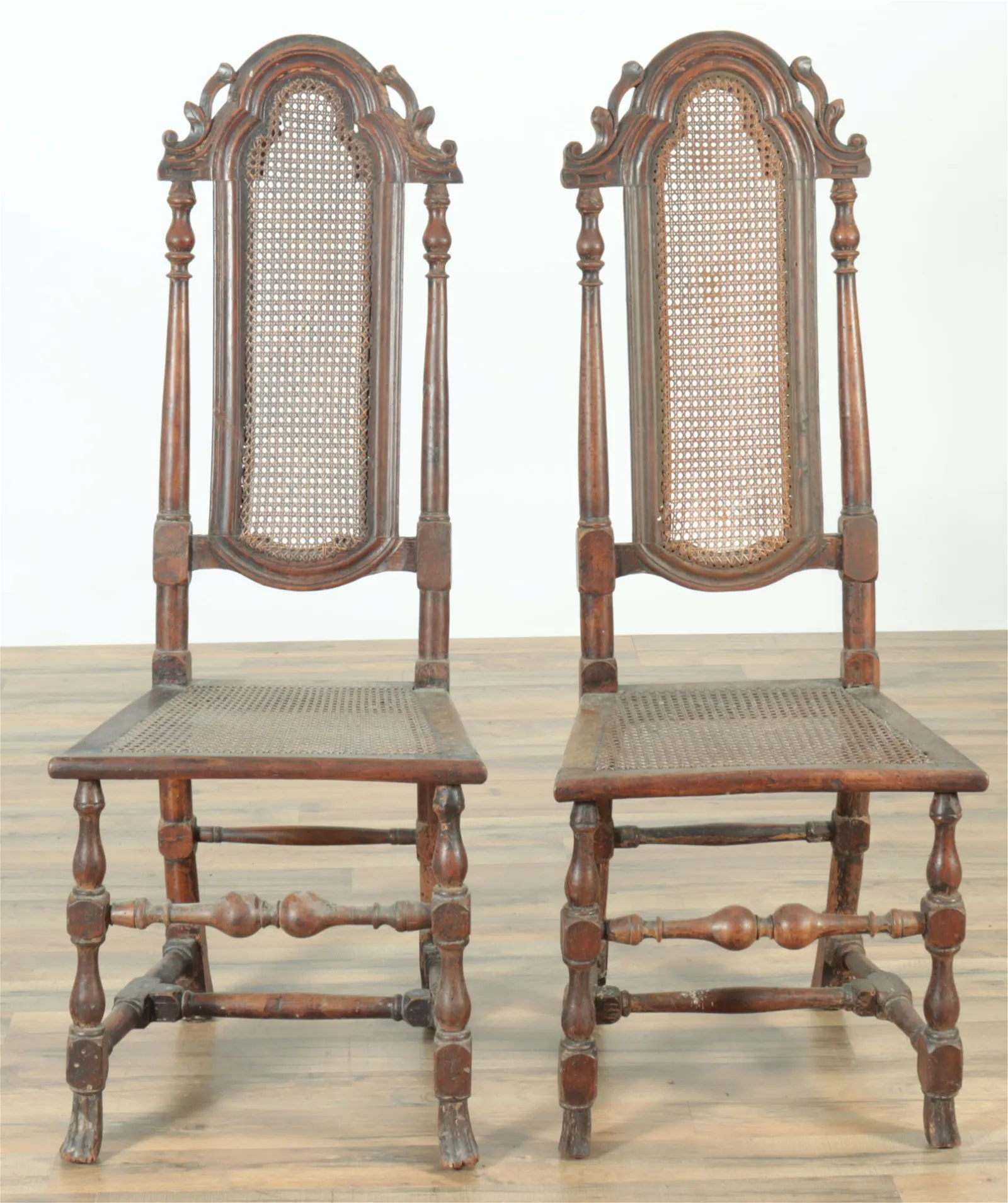
Let’s take a look at this striking pair of English survivors: a duo of William & Mary–to–early Queen Anne period oak and cane side chairs, standing tall with those wonderfully architectural crests.
These were the status dining chairs of late 17th- and early 18th‑century England—tall, formal, and a touch theatrical. The scrolled, arched backs and bold baluster turnings echo the Baroque taste of William & Mary, softening toward the refinement of early Queen Anne.
They’re fashioned in oak with rattan caning, both back and seat. The turning is slightly irregular, just as you’d expect from hand-lathed work, and the stretchers have that worn, oval sheen that speaks of centuries of shoes and skirts brushing past.
Condition-wise, these have earned their wrinkles: abrasions to the rails, bruised legs, and broken or sagging cane. None of that is fatal; for chairs of this age, a bit of imperfection is almost a certificate of authenticity—though the caning will likely need professional replacement if they’re to be used.
On authenticity, I’d place them around 65 out of 100: the details and patina look right, but without underside and joint photos, one must allow for the existence of 19th‑century revival copies. If period, I’d expect them to bring in the range of $800 to $1,500 for the pair at auction; if later reproductions, more like $200 to $400.
... Charles here, signing off: Let the Mink have a Think!
Used for this report's TTS and avatar presentation.
Item Report
Pair of Late 17th–Early 18th Century English William & Mary / Early Queen Anne Period Oak and Cane Side Chairs
By:Unknown cabinetmaker, English
Style:William & Mary / Early Queen Anne Period English furniture
Origin:England
Materials:Oak (possibly mixed hardwoods), cane (rattan) for seats and backs
Age:Circa 1690–1720
Condition:Fair to good (structurally mostly intact but with evident surface wear, scuffs, and damage/losses to cane seats and backs; likely old repairs)
Value:If period and largely original: $800–1,500 USD for the pair at auction. If later revival/reproduction (19th–20th century): $200–400 USD for the pair.
Maker's Marks / Writing:No maker’s marks or inscriptions visible in the provided image.
Date:2025-12-10 15:05:10.125785
Description:
A matched pair of high-back side chairs in the late William & Mary to early Queen Anne idiom, with tall arched and scrolled crest rails framing caned backs, turned uprights and baluster-turned stretchers. Each chair has a rectangular caned seat on block-and-baluster turned legs joined by shaped front stretchers and low side and back stretchers. The wood appears to be stained oak (possibly with some beech or mixed hardwood secondary elements), with an old, worn surface and original or very early caning patterns, now partly broken.
Curator Questions
Curated by Jade
Assessment:
A characterful pair of late 17th–early 18th century English caned side chairs, stylistically straddling William & Mary and early Queen Anne, with high arched backs and bold baluster turning. The proportions, construction, turning style, and wear patterns are consistent with genuine period work, though surface wear, losses to caning, and possible old repairs are evident. These are good, honest vernacular examples rather than aristocratic London workshop pieces, but they retain considerable decorative and historical interest.
Individual Images:
none
Provenance:
Not provided.
Condition:
Fair to good (structurally mostly intact but with evident surface wear, scuffs, and damage/losses to cane seats and backs; likely old repairs)
Identification Score: 88%
The high, arched, scrolled backs with caning, combined with block-and-baluster turned legs and stretchers, match well-documented English William & Mary / early Queen Anne side-chair forms. Overall design and wear are consistent, though some construction details are not visible, so a small margin of uncertainty remains.
Authenticity Score: 65%
Form, turning style, surface oxidation, and irregular wear suggest genuine late 17th–early 18th century manufacture, possibly with later stretcher repairs and recaning. However, without close-up joinery views (seat rails, pegged joints, underside), one must remain cautious; well-made 19th-century revival examples do exist. A word about fakes.. cane-back chairs of this general type have been widely reproduced in Europe and elsewhere, so strict scrutiny of tool marks and patina is essential before declaring them definitively period.
Image Memory Note
None
None
Keywords
English, William & Mary, Queen Anne, period chairs, oak cane chairs, 17th century furniture, 18th century furniture, high-back side chairs
The report was edited after initial Artmink draft. Original AI draft preserved in Artmink audit history.

Share: