Jade : Chinese Fine and Decorative Arts
Jade Presents

Original Presentation Script
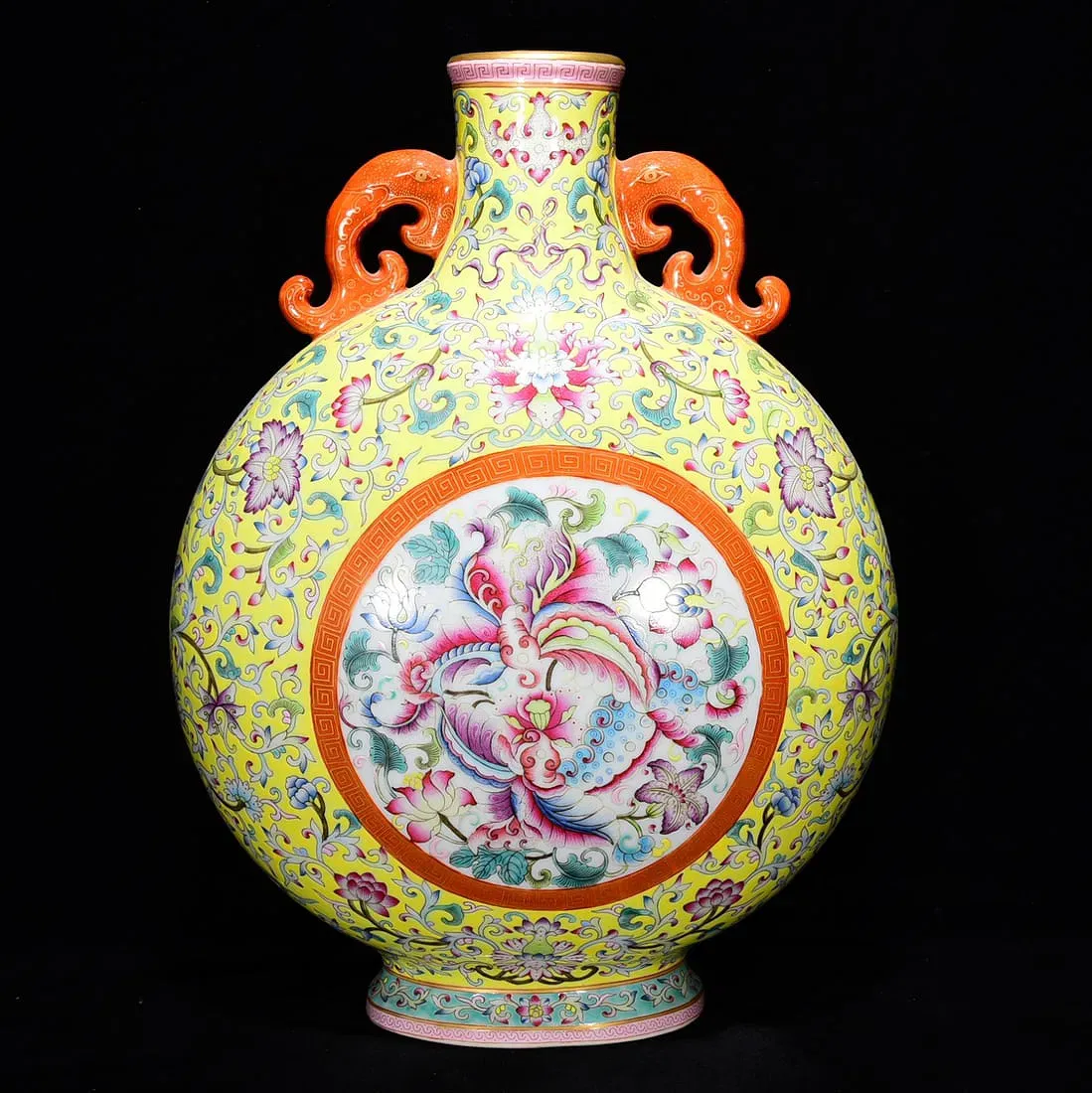
Here we have a Chinese Qing Style famille rose yellow-ground double-handle moon flask — a form that has long fascinated collectors because it combines sculptural elegance with imperial bravado. The flattened body, tall neck, and dramatic elephant-head handles all nod toward Qing court taste, especially the sort of exuberant decorative language associated with Qianlong-inspired wares. Now, the base bears a six-character Qianlong seal mark, which translates to 'Made in the Qianlong period of the Great Qing.' That sounds thrilling — but in Chinese porcelain, marks alone prove very little. In fact, they often prove too much. The decoration is lively: dense floral scrolls on a bright yellow ground, richly colored famille rose enamels, and a large central floral medallion framed by an iron-red key-fret border. But the enamels look very fresh, the gloss very new, and the overall execution a bit too uniform for an 18th-century imperial object. The foot and underside also lack the convincing wear and kiln character one hopes to see on a true Qing-period survivor. So, while this is an attractive decorative porcelain piece, I would treat it as a modern reproduction, likely late 20th or early 21st century. Authenticity score: 18%. Conservative auction estimate: $200 to $600 as a later decorative example. If it were genuinely Qianlong imperial — and I do not believe it is — the value could leap into six figures or beyond. A handsome illusion, but not the emperor’s own vase.
Used for this report's TTS and avatar presentation.
Item Report
Chinese Qing Style Famille Rose Yellow-Ground Double-Handle Porcelain Moon Flask
中国清式粉彩黄地双耳瓷抱月瓶
By: Unknown
Style: Chinese Qing Style famille rose porcelain
Origin: China
Materials: Porcelain with overglaze famille rose enamels, yellow ground, iron-red/orange enamel, underglaze blue seal mark
Age: Likely late 20th to early 21st century
Condition: Very Good (appears visually clean, no obvious chips seen, but not examined in hand)
Value: Auction estimate: as a reproduction/decorative later example, $200-$600; if authentic Qianlong period imperial example, the value gap would be enormous and could exceed $100,000-$300,000+ depending on size, quality, condition, and proven provenance
Peer-Reviewed Market Values
- Dating Range
- Pending structured dating
- Auction Liquidation
- Pending structured market values
- Fair Market Value
- Pending structured market values
- Replacement Value
- Pending structured market values
- Comparables Used
- No saved comparables yet
- Research Confidence
- Not Run
Peer review completed, but this run did not return structured market value ranges.
Maker's Marks / Writing: Blue six-character seal mark reading 'Da Qing Qianlong Nian Zhi' (大清乾隆年制), translated as 'Made in the Qianlong period of the Great Qing.' The mark appears apocryphal rather than period-authentic.
Date: 2026-03-21 05:25:35.383255
Description:
A flattened moon flask-form porcelain vase with cylindrical neck, orange elephant-head scroll handles, dense yellow-ground famille rose floral scrollwork, and large circular floral reserve panels. The base bears a blue six-character Qianlong seal mark, but the overall appearance suggests a later decorative example rather than an 18th-century imperial period piece. 这是一件扁圆抱月瓶式瓷瓶,直口长颈,饰橙色象首卷云形双耳,通体施黄地粉彩缠枝花卉纹,并有大面积圆形开光花卉图案。底部书青花六字乾隆篆书款,但整体面貌更像后期装饰性作品,而非十八世纪乾隆御窑时期真品。
Curator Questions
Curated by Jade
Assessment:
This appears to be a Chinese Qing Style famille rose moon flask made as a later decorative reproduction, most likely in the late 20th or early 21st century. The form imitates Qing imperial taste, especially Qianlong-era yellow-ground wares, but several red flags argue strongly against period authenticity: the enamels are unusually bright and even, the surface is very glossy and fresh, the decorative execution is competent but somewhat mechanical, and the base mark looks like a neatly written apocryphal Qianlong seal mark rather than one supported by convincing age and imperial-quality workmanship. The elephant-head handles are attractively modeled but lack the subtle firing wear and softened edges expected on an 18th-century example. The footrim and underside also appear comparatively clean and regular. A word about copies.. Chinese export and domestic decorative porcelain is one of the most heavily reproduced categories in the market, and Qianlong-marked yellow-ground pieces are especially common targets for modern revival production and deliberate fakery. This should be treated conservatively as a modern reproduction unless supported by thermoluminescence testing, strong provenance, or expert in-hand examination. {chavatar_catchphrase} 这件器物看起来是一件中国清式粉彩抱月瓶,应为后期装饰性仿制品,年代大致在二十世纪晚期至二十一世纪初。其造型模仿清代宫廷审美,尤其接近乾隆时期黄地粉彩器,但有多项警示信号不支持其为到代真品:彩料色泽过于鲜亮均匀,表面光泽新而强,纹饰绘工虽熟练却略显机械,底部款识也更像工整书写的“寄托乾隆款”,而非建立在真正年代感与御窑工艺基础上的本朝真款。象首耳造型虽悦目,但缺乏十八世纪实物常见的自然火气消退与边缘磨蚀。足圈和底部也显得较为规整洁净。A word about copies.. 中国外销瓷与陈设瓷是市场上仿品最多的门类之一,而带乾隆款的黄地器尤为常见,既有现代仿古作品,也有刻意作伪之物。在没有热释光检测、可靠来源或上手专家检验之前,应保守视为现代复制品。{chavatar_catchphrase}
Individual Images:
- whole moon flask front
- whole moon flask alternate front
- upper half with handles
- detail of floral reserve
- back upper half
- detail of back decoration
- lower half front
- underside with seal mark
Provenance:
No provenance documentation shown in the images.
Condition:
Very Good (appears visually clean, no obvious chips seen, but not examined in hand)
Identification Score: 96%
The flask form, yellow famille rose ground, elephant-head handles, circular floral reserves, and blue six-character seal mark clearly identify this as a Chinese-style moon flask in the Qing taste. 其抱月瓶器形、黄地粉彩装饰、象首双耳、圆形开光花卉纹以及青花六字篆书款,都清楚表明这是一件仿清风格的中国式抱月瓶。
Authenticity Score: 18%
Low score due to the highly glossy new surface, very even modern-looking enamels, decorative but not imperial-level painting, regular footrim, and a spurious-seeming Qianlong seal mark. Under the strict reproduction-first rule, this should be considered a modern reproduction unless proven otherwise. 真实性评分较低,原因在于其表面光泽过新、彩料分布均匀而显现代、绘画虽装饰性强却未达御瓷水准、足圈过于规整,且乾隆篆书款看起来像寄托款。在“先按复制品看待,除非有力证据推翻”的严格原则下,应将其视为现代仿制品。
Image Memory Note
None None
Keywords
Chinese moon flask, Qing Style, famille rose, yellow-ground porcelain, elephant-head handles, Qianlong seal mark, reproduction, China 中国抱月瓶, 清式, 粉彩, 黄地瓷器, 象首耳, 乾隆款, 仿制品, 中国
Peer Review Summary
Peer Review
Key Visible Evidence
The object is a flattened moon flask-form porcelain vase with a cylindrical neck and two orange elephant-head scroll handles (Image 1, 2, 3). The body is adorned with dense yellow-ground famille rose floral scrollwork, featuring large circular reserve panels with a central floral motif (Image 1, 4, 7). The enamels are notably bright, opaque, and evenly applied, consistent with the Famille Rose palette (Image 4). The overall glaze surface exhibits a high, uniform gloss, lacking the subtle variations and minor imperfections often associated with 18th-century imperial porcelain (Image 1, 3, 4). The decorative execution, while competent, appears somewhat mechanical in its precision (Image 4, 6). The elephant-head handles are well-modeled but show no discernible firing wear or softened edges (Image 3). The footrim and underside are remarkably clean and regular, with no significant signs of age-consistent wear, grit, or oxidation (Image 8). The base bears a clearly legible blue six-character seal mark, which reads 大清乾隆年製 (Dà Qīng Qiánlóng Nián Zhì), translating to "Made in the Qianlong period of the Great Qing" (Image 8).
Market and Source Support
The identification of the decorative system as Famille Rose is supported by the visible opaque pink and vibrant overglaze enamels, a palette that became dominant from approximately 1720 onwards during the Qing dynasty [cite: RAG_PROMPT_SUPPLEMENT]. While the moon flask form and yellow ground with floral scrollwork are characteristic of Qing imperial taste, particularly during the Qianlong period (1736-1795), the technical execution observed in the images strongly suggests a later date of manufacture. The uniform gloss, bright enamels, and lack of expected age-related surface characteristics are inconsistent with authentic 18th-century imperial production [cite: RAG_PROMPT_SUPPLEMENT]. The presence of a six-character Qianlong seal mark (大清乾隆年製) on the base (Image 8) is noted, and the characters themselves are consistent with known Qianlong reign marks [cite: RAG_REF_1]. However, in Chinese porcelain, such prestigious reign marks are frequently apocryphal, especially on later reproductions, and do not alone authenticate an object [cite: RAG_PROMPT_SUPPLEMENT]. The stylistic and technical indicators observed on the vase itself take precedence over the mark for dating purposes. Comparables for similar yellow-ground Famille Rose moon flasks or vases with apocryphal Qianlong marks, often dated to the Republic period or later, show a consistent market for such decorative reproductions.
Needs Verification
A definitive determination of the exact age and authenticity would benefit from: in-hand examination to assess the tactile quality of the glaze, the weight and balance of the piece, and to detect any subtle firing imperfections or signs of artificial aging not visible in photographs; UV/blacklight examination to check for any repairs, restorations, or overpainting that might be concealed under normal light; thermoluminescence (TL) testing to provide a more precise age range for the porcelain body itself; microscopic analysis of enamels and glaze to examine the composition and application techniques; and detailed macro photography of the footrim to better assess any subtle wear patterns, firing grit, or oxidation that might indicate age or artificial treatment.
Audit Conclusion
The report's assessment that this is a "Chinese Qing Style famille rose moon flask made as a later decorative reproduction, most likely in the late 20th or early 21st century" is strongly supported by the visible evidence and grounded sources. The vibrant, uniformly applied Famille Rose enamels, the high and even gloss of the glaze, the clean and regular footrim, and the somewhat mechanical nature of the decoration (Image 1, 3, 4, 8) are all consistent with modern production rather than 18th-century imperial Qianlong wares. While the blue six-character Qianlong seal mark (大清乾隆年製) is clearly present and correctly transcribed (Image 8), it is widely recognized that such marks are commonly used on later decorative pieces and reproductions [cite: RAG_PROMPT_SUPPLEMENT]. The report's conservative auction estimate for a reproduction ($200-$600) is also consistent with market values for similar later decorative examples. The report accurately identifies the object's style and form while correctly flagging the authenticity concerns based on observable characteristics.
Comparables (Similar Items)
No archived comparables matched this report yet.
Share: