Premium upgrade: George delivers your appraisal as a guided podium narration with synced visuals and voiceover.
Output is a narrated, animated slideshow with video intro and outro, sandwiching the autoplay voiceover sequence in actual video.
Pair of George III Period Mahogany Demilune Card Tables
LANGUAGE UNLOCK
Glossary Roundup
Original Presentation Script
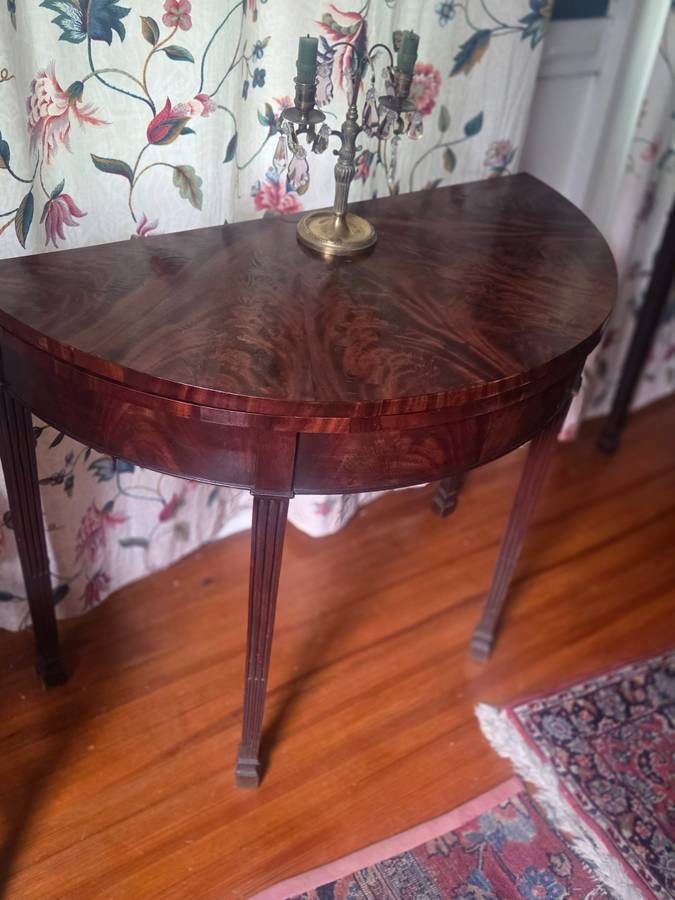
Presented here is a handsome pair of demilune, or half-moon, fold-over card tables. As the provided notes astutely point out, while we don't see them side-by-side in a single shot, the distinct, swirling patterns of the crotch mahogany veneer on the tops confirm we are looking at two separate, matching tables.
Stylistically, these tables are textbook examples of Neoclassical design, dating to the English George III or American Federal period, roughly 1790 to 1810. During this era, card playing was a central social pastime, and elegant, adaptable furniture like this was essential in any fashionable home.
The craftsmanship is evident in the spectacular use of figured mahogany. The tables are raised on elegant square, tapering legs that feature precise fluting and terminate in classic spade feet—details strongly associated with the influential designs of George Hepplewhite.
In terms of condition, they present beautifully. The finish is quite glossy, suggesting they have been sympathetically restored or repolished at some point in their history, which is common for pieces of this age. When opened, we can see some historical wear and circular marks on the interior playing surface, hinting at their past use.
While an in-person inspection of the secondary woods and joinery is always best to definitively confirm period authenticity over a high-quality Centennial reproduction, the visible evidence strongly supports a late 18th or early 19th-century origin. At auction, a genuine period pair of this caliber would carry a conservative estimate of $2,000 to $4,000. They are a truly elegant addition to any room.
Used for this report's TTS and avatar presentation.
Item Report
Pair of George III Period Mahogany Demilune Card Tables
By:Unknown
Style:Furniture
Origin:United Kingdom or United States
Materials:Mahogany veneer, hardwood
Age:c. 1790-1810
Condition:Very Good (appears refinished, minor surface wear and marks visible on interior)
Peer review completed, but this run did not return structured market value ranges.
Maker's Marks / Writing:None visible
Date:2026-11-08 00:20:32.857415
Description:
A pair of Neoclassical demilune (half-moon) fold-over card tables. The tables feature highly figured crotch mahogany veneered tops that open to reveal a circular playing surface, also veneered in mahogany. The plain aprons have subtle lower edge banding. The tables are raised on square, tapering, fluted legs that terminate in classic spade feet. As noted in the provided information, the images show two distinct tables with different veneer patterns, constituting a pair.
Curator Questions
Curated by Jade
Assessment:
These tables exhibit classic Neoclassical design elements, characteristic of the English George III or American Federal periods. The use of highly figured crotch mahogany and the elegant fluted legs with spade feet point to high-quality craftsmanship in the manner of George Hepplewhite. While the finish appears to have been restored, the overall form, proportions, and visible details suggest they are likely period pieces. However, an in-person inspection of the secondary woods, joinery, and hinges would be required for definitive authentication.
Individual Images:
whole table front view
whole table front view
top open showing interior
detail of mahogany top
whole table three-quarter view
Provenance:
According to the provided notes, this is a pair of tables, evidenced by the differing grain patterns shown in the photographs.
Condition:
Very Good (appears refinished, minor surface wear and marks visible on interior)
Identification Score: 95%
The form, style, and primary materials are clearly identifiable from the photographs as Neoclassical demilune card tables.
Authenticity Score: 75%
The design and visible materials are consistent with late 18th or early 19th-century construction. However, without views of the underside, hinges, and secondary woods, a definitive confirmation of period authenticity versus a high-quality later bench-made reproduction cannot be made from photos alone. The finish also appears somewhat refreshed.
Image Memory Note
None
None
Keywords
George III, Federal, Neoclassical, demilune, card table, fold-over table, mahogany, crotch mahogany, spade feet, fluted legs, pair, Hepplewhite style
The report was edited after initial Artmink draft. Original AI draft preserved in Artmink audit history.
Fair Market Value
Pending structured market values
Replacement Value
Pending structured market values
Archived Matches
No archive matches yet
Research Confidence
Insufficient Data
Research Findings
Key Visible Evidence
The provided images (Images 1-4) show two distinct demilune fold-over card tables, confirming a pair via differing crotch mahogany veneer patterns (Image 2 vs Image 4). The tables exhibit Neoclassical features, including square, tapering, fluted legs ending in spade feet. The highly glossy surface indicates refinishing. Notably, none of the supplied images show the tables open; therefore, the report's claim regarding visible historical wear on the interior playing surface cannot be verified from this set.
Market and Source Support
Auction and reference records confirm that mahogany demilune card tables with fluted tapering legs and spade feet are classic forms of the English George III and American Federal periods, typically dating to circa 1790-1810. The stylistic attribution to the Hepplewhite design vocabulary is accurate. Because high-quality late 19th-century Centennial reproductions closely mimic these forms, the report's caution regarding definitive photo-based authentication is well-founded.
Needs Verification
- Images of the tables open to verify the reported interior wear and playing surface material.
- Close-up views of the hinges, secondary woods, and underside swing-leg joinery to confirm period construction versus a later reproduction.
Advisory Conclusion
The report is largely supported regarding style, form, and primary materials, and its cautious stance on definitive dating is appropriate. However, the specific claim describing interior wear is unsupported by the supplied images, which only show the tables closed.

Share: