Premium upgrade: Monique delivers your appraisal as a guided podium narration with synced visuals and voiceover.
Output is a narrated, animated slideshow with video intro and outro, sandwiching the autoplay voiceover sequence in actual video.
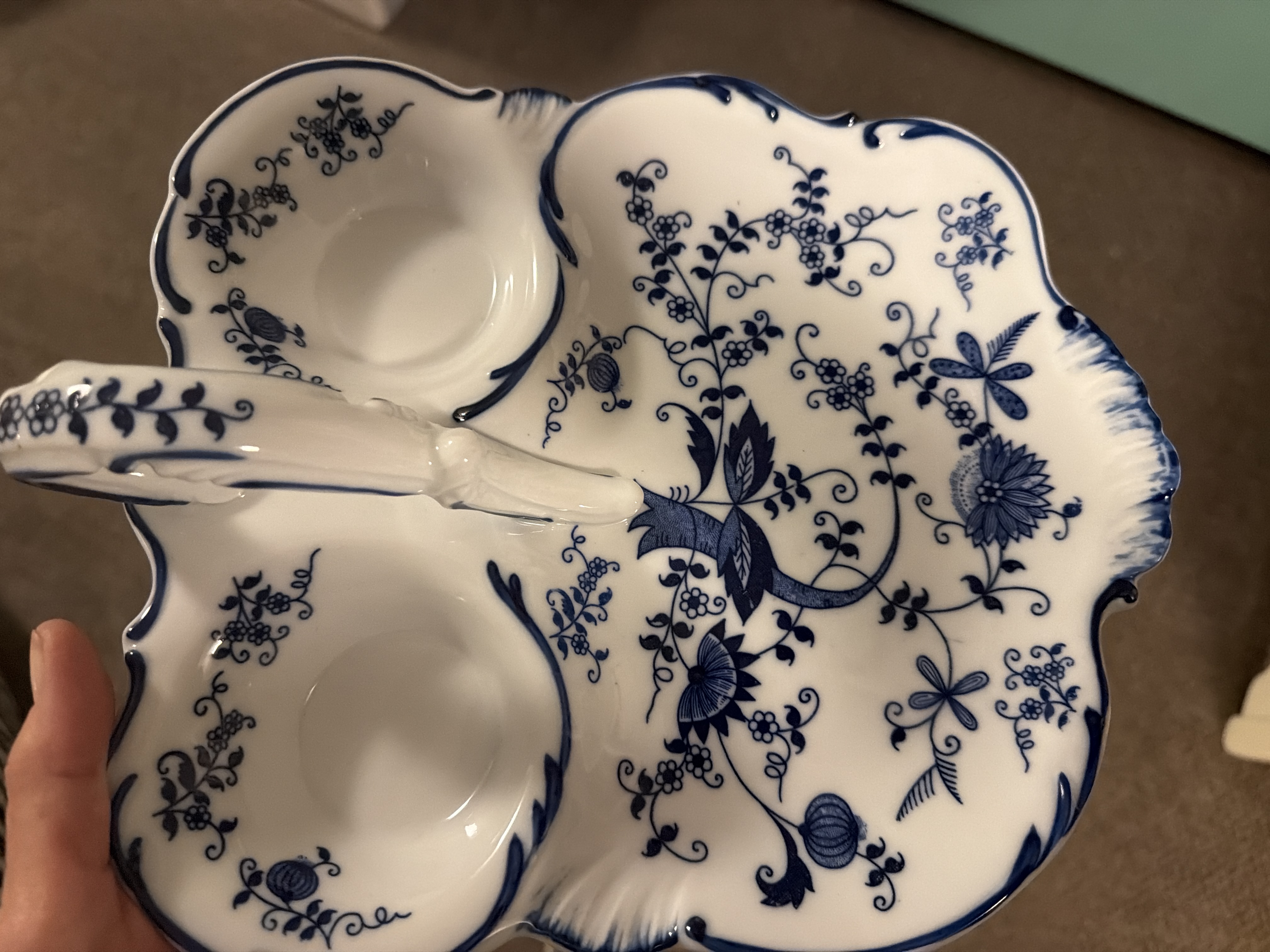
Blue Onion Pattern Porcelain Condiment Dish
LANGUAGE UNLOCK
Glossary Roundup
Original Presentation Script
Here we have a classic Blue Onion pattern porcelain condiment dish, likely mid-to-late 20th century. Its value hinges entirely on the maker's mark underneath. Unmarked or from a lesser maker, it's worth $30 to $80, but authentic Meissen could bring up to $200.
Used for this report's TTS and avatar presentation.
Expert Review Script
Here we have a classic Blue Onion pattern porcelain condiment dish or double salt cellar. Because this iconic pattern was widely reproduced, its exact age and value hinge entirely on the maker's mark underneath. Unmarked or from a lesser maker, it is generally valued between $30 and $80, but an authentic Meissen example could bring up to $200.
Peer review completed, but this run did not return structured market value ranges.
Maker's Marks / Writing:None visible in provided image
Date:2026-10-13 16:31:35.091646
Description:
A white porcelain divided condiment dish or double salt cellar featuring the classic underglaze 'Blue Onion' (Zwiebelmuster) pattern. The dish has a scalloped rim, a central loop handle with molded details, and two circular wells likely intended for salt and pepper shakers or small condiment pots. The pattern includes stylized floral motifs, bamboo, and the characteristic 'onions' (actually peaches or pomegranates) around the border.
Curator Questions
Curated by Jade
Assessment:
This is a functional serving piece in the enduringly popular Blue Onion pattern. The specific form, with two wells and a central handle, is traditionally used as a double salt cellar, salt and pepper stand, or condiment dish. The value and precise age are highly dependent on the manufacturer, which cannot be determined without seeing the hallmark on the underside. The piece appears to be in excellent condition based on the top-down view.
Individual Images:
overhead view of condiment dish
Provenance:
None provided
Condition:
Excellent (based on visible top view, no apparent damage)
Identification Score: 95%
The pattern (Blue Onion) and form (condiment dish/double salt) are easily identifiable. The exact maker is unknown without seeing the base.
Authenticity Score: 80%
The piece is a genuine porcelain dish in the Blue Onion style. However, 'authenticity' in this context usually refers to whether it is an original Meissen piece versus a later copy by another manufacturer. Without a mark, it is treated as a generic piece in this classic style.
Image Memory Note
None
None
Keywords
Blue Onion, Zwiebelmuster, porcelain, condiment dish, salt and pepper stand, double salt cellar, blue and white, serving dish, Germany
The report was edited after initial Artmink draft. Original AI draft preserved in Artmink audit history.
Peer Review Summary
Dating Range
20th Century (requires mark for precise dating)
Fair Market Value
Pending structured market values
Replacement Value
Pending structured market values
Archived Matches
No archive matches yet
Research Confidence
Insufficient Data
Peer Review
Key Visible Evidence
The provided image shows a top-down view of a white porcelain divided dish with a central loop handle and two circular wells. The piece is decorated in the classic underglaze blue 'Blue Onion' (Zwiebelmuster) pattern, featuring the characteristic central aster/chrysanthemum motif, bamboo, and border 'onions' (peaches/pomegranates). No maker's marks are visible from this angle.
Market and Source Support
Reference sources confirm this specific form is traditionally known as a double salt cellar, condiment stand, or relish dish. The Blue Onion pattern, while originated by Meissen in the 18th century, was widely reproduced by numerous European and Japanese manufacturers (such as Hutschenreuther, Teichert, and Blue Danube) throughout the 19th and 20th centuries.
Needs Verification
- An image of the underside is strictly required to identify the maker (e.g., Meissen crossed swords, Hutschenreuther mark, or Blue Danube stamp).
- The 'Mid to Late 20th Century' dating is a plausible baseline for generic reproductions, but the piece could be earlier (late 19th or early 20th century) depending on the specific hallmark.
Audit Conclusion
The report is largely supported by the visible evidence and appropriately cautious. The identification of the pattern and form is accurate, and the report correctly notes that definitive attribution, precise dating, and final valuation depend entirely on the unseen maker's mark.


Share: