Jade : Chinese Fine and Decorative Arts
Jade Presents

Original Presentation Script
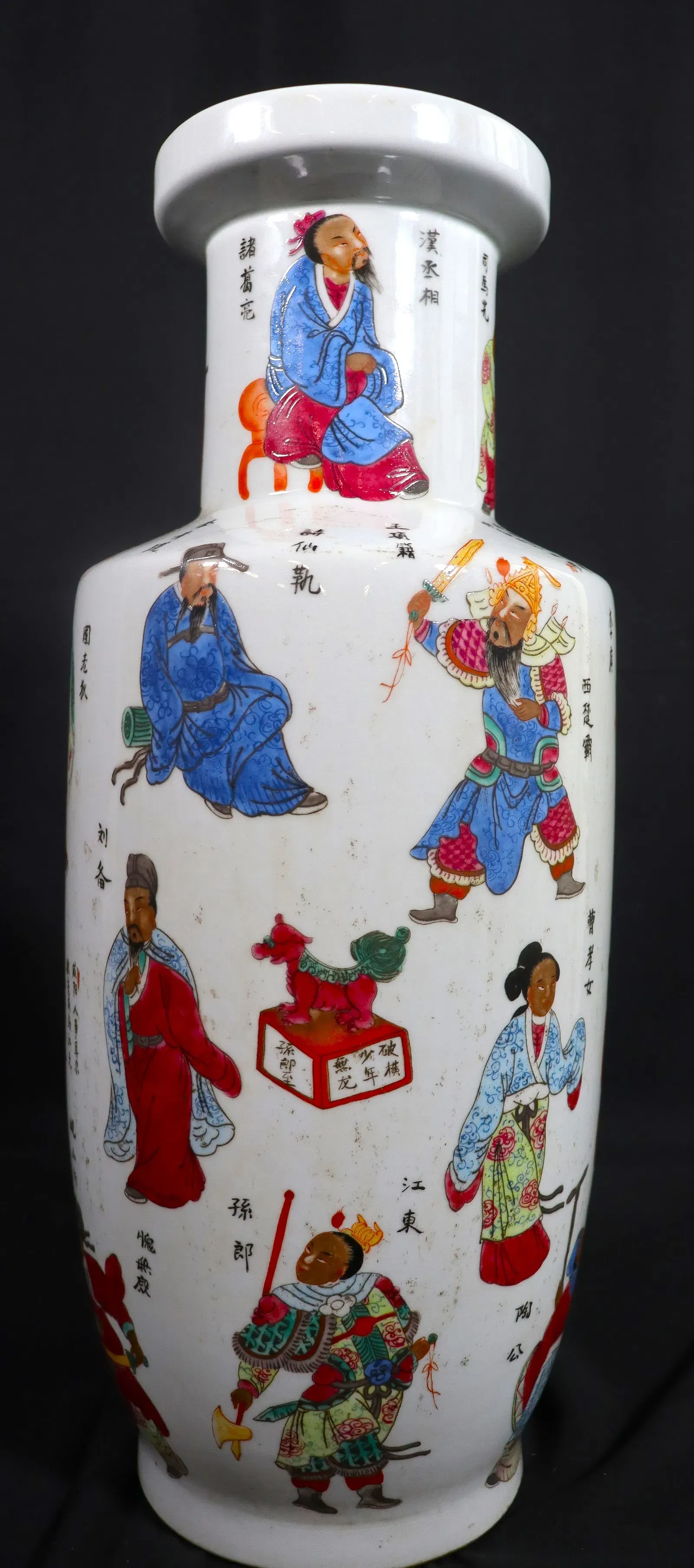
Here we have a Chinese famille rose porcelain rolwagen vase — tall, theatrical, and animated with a gathering of named figures from Chinese history and legend. Its broad rolled mouth and cylindrical body provide an expansive stage for the painter’s lively enamel work, while the calligraphic labels transform the surface into a kind of porcelain dramatis personae. On the base appears a six-character underglaze blue reign mark within a double circle: 大清康熙年製 — “Made in the Great Qing, Kangxi period.” At first glance, that would suggest a date between 1662 and 1722. However, the famille rose palette seen here — with its opaque pinks and bright, layered enamels — did not come into widespread use until after the Kangxi reign. The style of figural painting and the overall decorative ambition are characteristic of later Qing and Republic-period wares made in an earlier taste. The foot rim is unglazed, revealing a light buff biscuit, and there is modest wear consistent with handling and age. Condition overall appears good from the photographs, with some surface grime and light rubbing but no major visible cracks or losses. Taken together, the evidence points to a 20th-century decorative vase bearing an honorific or apocryphal Kangxi mark, rather than a true Kangxi-period imperial object. It remains an attractive and display-worthy example of Chinese figural porcelain, but it should be collected and valued as a later decorative work rather than as a 17th-century treasure.
Used for this report's TTS and avatar presentation.
Item Report
Chinese Late Qing Style Famille Rose Porcelain Rolwagen Vase with Kangxi Mark
中国晚清风格粉彩瓷棒槌瓶(康熙款)
Merge Reports: Yes (reconciled). Approval remains manual.
By: Unknown
Style: Chinese famille rose figural porcelain, Late Qing style decorative ware
Origin: China
Materials: porcelain, overglaze famille rose enamels, underglaze blue mark
Age: likely early to mid-20th century, circa 1920–1960
Condition: Good (visible surface wear and grime, minor rubbing, no major damage visible in photos, not professionally condition-checked)
Value: Auction estimate if authentic Kangxi period imperial example: $15,000–$40,000+; as the more likely 20th-century decorative vase with apocryphal mark: $300–$800
Peer-Reviewed Market Values
- Dating Range
- Pending structured dating
- Auction Liquidation
- Pending structured market values
- Fair Market Value
- Pending structured market values
- Replacement Value
- Pending structured market values
- Comparables Used
- No saved comparables yet
- Research Confidence
- Not Run
Peer review completed, but this run did not return structured market value ranges.
Maker's Marks / Writing: Blue underglaze six-character reign mark within double circle: 大清康熙年製 (“Made in the Great Qing, Kangxi period”). Numerous painted inscriptions identify figures; visible names include 关羽 (Guan Yu), 张子房 (Zhang Zifang), 姜尚 (Jiang Shang), 孙郎 (Sun Lang), 江东周公瑾 (Zhou Gongjin of Jiangdong), among others, suggesting a gathering of historical and literary figures rather than a single historical event.
Date: 2026-03-21 22:49:24.831950
Description:
A tall Chinese porcelain rolwagen vase with broad everted mouth, painted in famille rose enamels with numerous historical and literary figures identified by inscriptions. The vessel bears a blue underglaze six-character mark within a double circle on the base reading 大清康熙年製 (“Made in the Great Qing, Kangxi period”). Despite the Kangxi reign mark (1662–1722), the famille rose palette, figural style, and overall execution indicate a later decorative production. The painting style, bright opaque enamels, relatively even white body, and finish are consistent with late 19th- to early/mid-20th-century wares made in a Late Qing taste rather than a true Kangxi-period object. 这是一件中国高颈棒槌瓶,口沿外撇,通体以粉彩描绘多位带题名的历史及文学人物。底部青花双圈内书六字款“大清康熙年製”。虽署康熙年款(1662–1722),但其粉彩设色、人物画风及整体工艺特征显示为较晚时期的装饰性生产,更符合晚清风格的19世纪末至20世纪上半叶作品,而非康熙本朝器。
Curator Questions
Curated by Jade
Assessment:
This appears to be a Chinese figural famille rose rolwagen vase made in a Late Qing taste, most likely dating to the early–mid 20th century, bearing an apocryphal Kangxi reign mark. The six-character underglaze blue mark reads 大清康熙年製, yet the famille rose palette did not come into widespread use until after the Kangxi period. The enamels are comparatively bright and opaque, and the figural program—with numerous named historical and romance figures—reflects the lively decorative approach typical of later Qing and Republic-period production. The rim and foot construction, including the unglazed foot rim with light buff biscuit, are consistent with later workshop manufacture. Some surface grime and light wear are visible, particularly at the foot, but nothing suggests 17th-century origin. As is common in Chinese porcelain, later decorative wares frequently carry earlier imperial reign marks in honorific or apocryphal form. This vase is best understood as a decorative 20th-century piece rather than a true Kangxi-period object. 这件器物应为一件晚清风格的人物题材粉彩棒槌瓶,更可能制作于20世纪上半叶,底部所书“大清康熙年製”为寄托款。虽然署康熙年号,但粉彩体系在康熙时期尚未广泛成熟使用;本器所见鲜艳而不透明的彩料及繁密人物题材,更符合晚清至民国时期的装饰风格。口沿与足部结构(露胎浅黄色胎质)亦与后期作坊生产特征相符。表面可见轻微积垢与足缘磨痕,但无任何迹象支持其为17世纪作品。中国瓷器中,后期装饰瓷常见署前朝帝王年款的寄托现象,因此应将本器视为20世纪装饰性作品,而非康熙本朝器。
Individual Images:
- whole vase front
- side view of vase
- whole vase alternate view
- whole vase reverse
- overhead mouth of vase
- base of vase mark
Provenance:
No provenance documentation shown in the images.
Condition:
Good (visible surface wear and grime, minor rubbing, no major damage visible in photos, not professionally condition-checked)
Identification Score: 94%
The vase form, famille rose enamel palette, figural decoration with inscriptions, and clearly legible six-character Kangxi reign mark are all visible, making identification as a Chinese famille rose rolwagen vase secure, even if precise workshop attribution remains unknown. 从器形、粉彩设色、带题名的人物装饰以及清晰可读的六字“康熙年製”款识来看,可明确识别为中国粉彩人物棒槌瓶;但具体窑口或作坊仍难以确定。
Authenticity Score: 22%
Authenticity is scored low because the six-character mark reads 大清康熙年製 (“Made in the Great Qing, Kangxi period”), yet the famille rose palette and decorative style postdate the Kangxi reign (1662–1722). The bright, opaque enamels and the crowded figural program are characteristic of much later Qing and Republic-period decorative wares. The modest wear around the foot and mouth is consistent with age and handling but does not support a 17th-century attribution. The mark is best understood as apocryphal or honorific rather than period-authentic. 真伪评分较低,因为底款为六字“大清康熙年製”,而粉彩体系及装饰风格明显晚于康熙时期(1662–1722)。鲜艳不透明的彩料与繁密人物构图更符合晚清至民国时期的装饰瓷特征。足部与口沿虽有一定使用磨痕,但不足以支持其为17世纪器物。该款识应视为寄托或仿款,而非本朝真品。
Image Memory Note
None None
Keywords
Chinese vase, famille rose, figural porcelain, rolwagen vase, Kangxi mark, apocryphal mark, Republic period, decorative porcelain, China 中国花瓶, 粉彩, 人物瓷, 棒槌瓶, 康熙款, 寄托款, 民国时期, 装饰瓷, 中国
Peer Review Summary
Peer Review
Key Visible Evidence
The subject item is a Chinese porcelain rolwagen vase, decorated with numerous figural scenes in overglaze famille rose enamels (Images 1-4). The mouth rim is everted, and the foot rim is unglazed, revealing a light buff-colored biscuit (Image 5, 6). The base features an underglaze blue six-character reign mark within a double circle (Image 6). The mark clearly reads from right to left, top to bottom: 大清康熙年製 (Da Qing Kangxi Nian Zhi), translating to 'Made in the Great Qing, Kangxi period.' The report's claim of a 'four-character mark on the base reading 大清成化' is directly contradicted by visible evidence in Image 6, which shows a six-character mark with the reign name 康熙 (Kangxi), not 成化 (Chenghua).
Market and Source Support
The Kangxi reign (1662-1722) predates the widespread development and popularization of the famille rose palette, which emerged primarily during the Yongzheng (1723-1735) and Qianlong (1736-1795) periods. The vibrant, opaque enamels and figural style seen on the vase are characteristic of later Qing dynasty (late 19th century) and Republic period (early 20th century) decorative wares. Therefore, the presence of a Kangxi reign mark on a vase decorated in this famille rose style is an anachronism, strongly indicating an apocryphal or honorific mark applied to a later production piece. This aligns with the report's overall conclusion regarding the mark's spurious nature and the object's later dating, despite the specific misreading of the mark itself.
Needs Verification
While the mark reading is clear from Image 6, a macro photograph of the foot rim's biscuit and glaze interface could provide more granular detail on manufacturing techniques and wear patterns, potentially refining the 20th-century dating. UV light examination of the enamels could help identify any later touch-ups or repairs not visible under normal light, though the overall freshness of the enamels is already apparent.
Audit Conclusion
The report accurately identifies the vase as a Chinese famille rose rolwagen vase of Late Qing style, likely 20th century, with an apocryphal mark. However, the report contains a significant factual error in transcribing and identifying the base mark. The visible mark (Image 6) is a six-character underglaze blue mark reading 大清康熙年製 (Made in the Great Qing, Kangxi period), not a four-character mark reading 大清成化 (Great Qing Chenghua) as stated in the report. This correction does not alter the report's ultimate conclusion that the mark is apocryphal and the vase is a later decorative piece, as the Kangxi mark is anachronistic for this famille rose palette and decorative style. The report's dating of circa 1920-1960 remains plausible based on the visual evidence and historical context of porcelain production.
Comparables (Similar Items)
No archived comparables matched this report yet.
Share: