George : English Fine and Decorative Arts
George Presents

Original Presentation Script
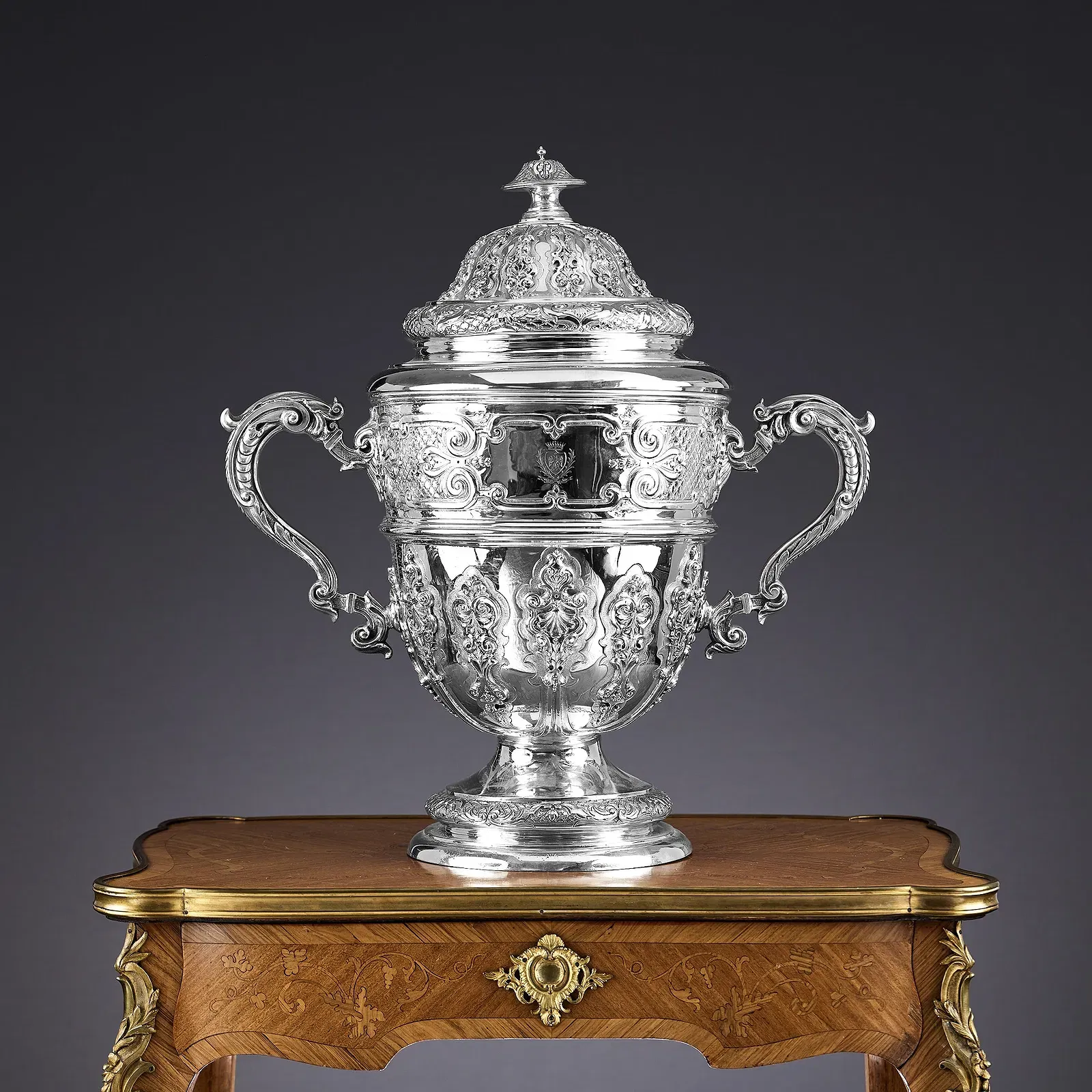
Here we have a splendid Victorian Rococo Revival silver two-handled covered sugar urn — the sort of table silver that turns a tea service into theatre. With its pierced domed lid, curling foliate handles, and lavish repoussé ornament, it belongs to that exuberant 19th-century taste that delighted in richness, movement, and aristocratic flourish. The shape and decoration point strongly to mid-Victorian England, likely around 1840 to 1870. This is a classic revival piece, borrowing the drama of earlier 18th-century Rococo and reinterpreting it with Victorian confidence. The engraved armorial crest adds a layer of personal history, though not necessarily grand provenance. What matters most here is craftsmanship. The chased and embossed ornament appears properly worked, the handles are well modeled, and the closeups suggest genuine silver construction rather than a flimsy modern imitation. Most encouraging are the visible hallmarks and the maker's stamp, which appears to read NEW & Co. Those details are the difference between romance and reality. Condition looks very good overall, with expected light scratching, polishing wear, and mild softening to some details. Happily, there is no obvious catastrophic damage in the photos. As for authenticity, I would place it around 78% likely to be a genuine Victorian period piece pending in-hand hallmark verification. Conservative auction estimate: $1,200 to $2,500 if authentic sterling silver; if it proved to be later plate or reproduction, more like $150 to $400. A handsome survivor of the Victorian dining table ... Charles here, signing off: Let the Mink have a Think!
Used for this report's TTS and avatar presentation.
Item Report
Victorian Rococo Revival Silver Two-Handled Covered Sugar Urn
By: NEW & Co. (maker's mark visible)
Style: Victorian Rococo Revival silver
Origin: England, likely London
Materials: silver, likely sterling silver
Age: circa 1840-1870
Condition: Very good (visible light wear and minor surface scratching, appears ungraded, no major damage seen in photos)
Value: Auction estimate: if authentic period silver, approximately $1,200-$2,500; if later silver-plate or reproduction, approximately $150-$400.
Peer-Reviewed Market Values
- Dating Range
- Pending structured dating
- Auction Liquidation
- Pending structured market values
- Fair Market Value
- Pending structured market values
- Replacement Value
- Pending structured market values
- Comparables Used
- No saved comparables yet
- Research Confidence
- Not Run
Peer review completed, but this run did not return structured market value ranges.
Maker's Marks / Writing: Engraved armorial crest with motto ribbon reading approximately 'NIL EA CIVITAS'; hallmarks visible; maker's mark appears to read 'NEW & Co'. Other assay symbols are present but not fully legible from the photos.
Date: 2026-03-19 09:56:50.518693
Description:
A richly ornamented two-handled covered sugar vase or sugar urn in high Victorian Rococo Revival taste, with scrolling handles, embossed and chased foliate cartouches, pierced domed cover, pedestal foot, and an engraved armorial device. Detail images show British-style hallmarks and a maker's stamp reading NEW & Co, indicating a 19th-century silver piece rather than a modern decorative reproduction.
Curator Questions
Curated by Jade
Assessment:
This appears to be a genuine mid-19th-century English Victorian silver covered sugar urn in the Rococo Revival manner. The form, repoussé ornament, pierced cover, and exuberant scroll handles are all consistent with the period. The close hallmark images are especially important: they strongly support age and British manufacture, and the visible wear, softening to high points, and patina in recessed areas are reassuring signs of authenticity rather than fakery. The engraved crest or armorial adds decorative and possibly heraldic interest, though it does not by itself establish noble provenance. A word about copies.. Victorian silver and Rococo Revival wares are widely reproduced, and many silver-plated pieces mimic sterling examples very convincingly; one must rely heavily on hallmarks, weight, and construction. Here, the marks and overall workmanship push the piece well above the reproduction category, though exact assay office and date letter should be confirmed in hand for a firmer attribution.
Individual Images:
- whole sugar urn
- whole sugar urn three-quarter view
- detail of engraved armorial
- sugar urn with lid off
- detail of hallmarks
- detail of hallmarks closer
Provenance:
No documentary provenance shown in the provided images.
Condition:
Very good (visible light wear and minor surface scratching, appears ungraded, no major damage seen in photos)
Identification Score: 94%
The form is clearly that of a covered sugar urn or sugar vase, and the decorative language is strongly Victorian Rococo Revival. Multiple views, including the lid removed and closeups of engraving and marks, make the object type highly identifiable.
Authenticity Score: 78%
I begin from the strict assumption of reproduction until proven otherwise. The fakery check is favorable here: the piece shows convincing period design, crisp yet not unnaturally sharp chasing, appropriate wear in recesses, and what appear to be genuine British hallmarks alongside a maker's mark for NEW & Co. The engraved armorial is plausible rather than sensational. Remaining caution is due because photographs do not fully confirm gauge, weight, or whether all components are original to one another, but this looks substantially more likely to be authentic Victorian silver than a modern copy.
Image Memory Note
None None
Keywords
Victorian Rococo Revival Silver Two-Handled Covered Sugar Urn, English silver, sterling silver, covered sugar vase, sugar urn, NEW & Co, hallmarked silver, Victorian, Rococo Revival, pedestal urn, armorial engraving, England
Peer Review Summary
Peer Review
Key Visible Evidence
The subject item is a highly ornamented two-handled covered urn, exhibiting characteristics of the Rococo Revival style (Images 1, 2, 4). An engraved armorial crest with a crown, shield, and a motto ribbon reading 'NIL EA CIVITAS' is visible on the body (Image 3). Close-up images of the hallmarks (Images 5, 6) clearly show a maker's mark 'M&W', a lion passant guardant (sterling standard mark), an uncrowned leopard head (London city mark), a sovereign's head (duty mark), and a lowercase Gothic date letter 'h'.
Market and Source Support
The report's claim of 'NEW & Co' for the maker's mark is contradicted by visible evidence; the mark clearly reads 'M&W' (Images 5, 6). This mark is consistently attributed to Mappin & Webb, a prominent English silversmith firm. The lion passant guardant confirms the sterling silver standard. The uncrowned leopard head indicates the London Assay Office and a date of 1822 or later. The presence of the sovereign's head (duty mark) further narrows the date to between 1784 and 1890. The date letter, a lowercase Gothic 'h', corresponds to the year 1863 in the London Gothic Lowercase cycle. This year is consistent with both the uncrowned leopard head (post-1822) and the duty head (1784-1890). Therefore, the hallmarks definitively date the piece to London, 1863, by Mappin & Webb.
Needs Verification
A definitive translation and heraldic identification of the armorial crest and motto 'NIL EA CIVITAS' would require specialized heraldic research. While the overall condition appears good, a hands-on inspection, including UV/blacklight views, would be necessary to definitively assess any professional restorations or repairs not visible in photographs. The actual weight and silver gauge of the piece cannot be verified from images and would be needed for a comprehensive assessment. A detailed in-hand examination of construction, fit, and matching marks (if any) on the lid and body would be required to confirm that all components are original to the piece.
Audit Conclusion
The report accurately identifies the object as a Victorian Rococo Revival two-handled covered urn in sterling silver, consistent with the visible style and hallmarks. However, the report contains a critical error in identifying the maker's mark, stating 'NEW & Co' when the visible mark is clearly 'M&W' (Images 5, 6). Based on the London hallmarks (uncrowned leopard head, duty head present, and Gothic lowercase 'h' date letter), the piece was assayed in London in 1863 by Mappin & Webb. This precise dating refines the report's broader 'circa 1840-1870' estimate. The overall assessment of authenticity as a genuine Victorian period piece is supported by the clear and consistent hallmarks. Further in-hand examination would be beneficial to confirm the originality of all components, precise weight, and to conduct a thorough condition assessment for any subtle restorations.
Comparables (Similar Items)
No archived comparables matched this report yet.
Share: