George : English Fine and Decorative Arts
George Presents

Original Presentation Script
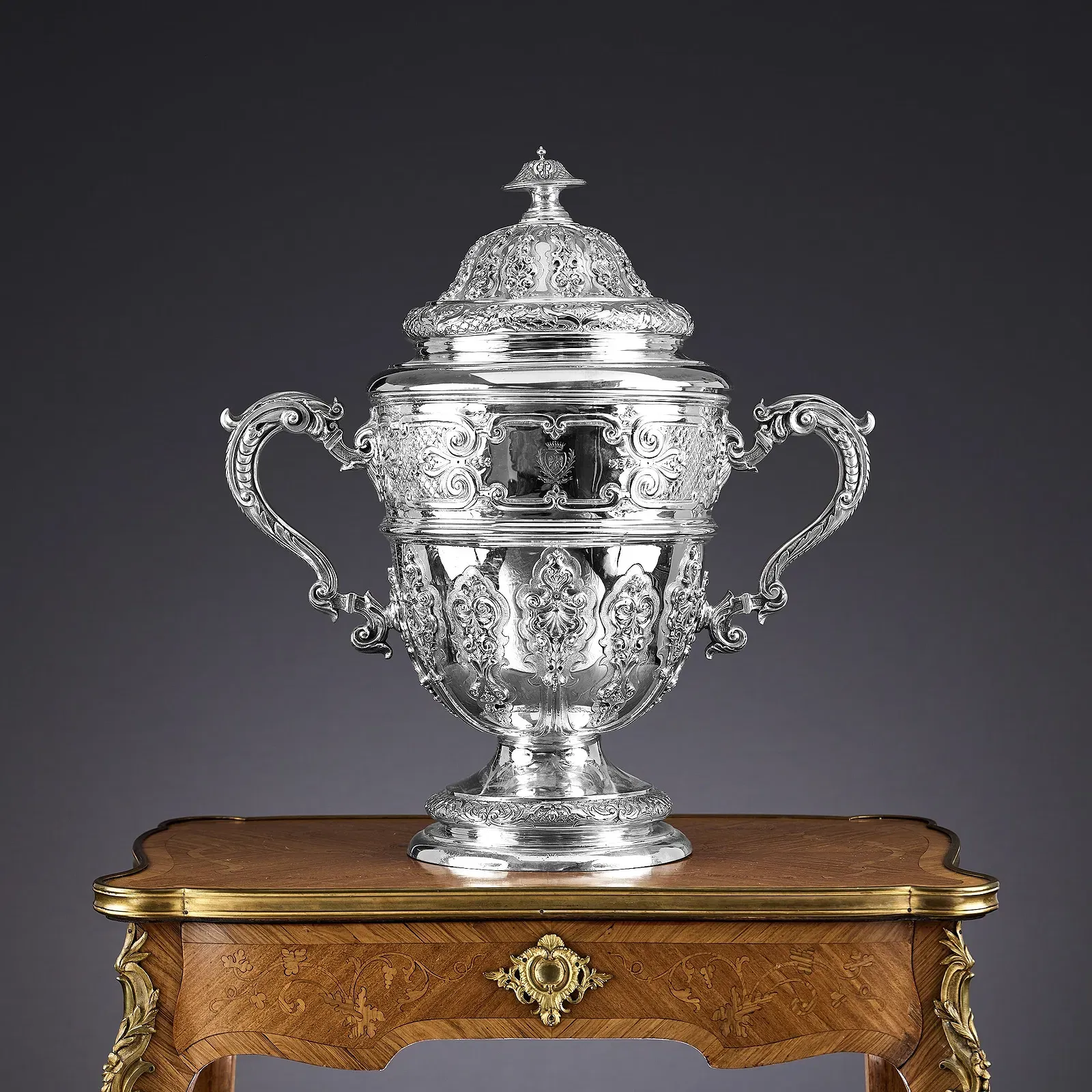
Here we have a grand Victorian Rococo Revival silver-plated two-handled covered urn — the sort of object that was made to impress across a dining table or in a presentation setting. Its bold scrolling handles, pierced domed cover, and swelling body give it that unmistakably theatrical 19th-century flair. Stylistically, this belongs to the great Victorian love affair with revival design, when silversmiths and plate manufacturers looked back to the lush curves of the 18th century and made them bigger, brighter, and more elaborate. The engraved armorial reserve suggests it may have been intended as a presentation piece or made for a family of standing. The craftsmanship appears consistent with quality English silverplate: richly embossed ornament, chased details, and a cast-and-assembled structure rather than hand-raised sterling work. The marks shown are the real clue — they point to plated ware, not solid silver, and that distinction matters enormously in value. Condition appears generally very good, with visible age-related wear and some rubbing to the plated surface. In my view, that wear is actually reassuring; it argues against a recent decorative copy. Still, I’d want a crisp underside mark photo before going any further. Authenticity score: 72%. I believe it is likely a genuine Victorian-period silver-plated urn, circa 1860 to 1885. Conservative auction estimate: $400 to $900 if period and correctly catalogued as silverplate; if a later reproduction, more like $75 to $200. Elegant, showy, and very Victorian indeed... Charles here, signing off: Let the Mink have a Think!
Used for this report's TTS and avatar presentation.
Item Report
Victorian Rococo Revival Silver-Plated Two-Handled Covered Trophy Urn
By: Maker not firmly identified; pseudo-hallmarked/Newcastle-style marked silverplate manufacturer
Style: Victorian Rococo Revival
Origin: England
Materials: Silver plate over base metal, likely Britannia metal or copper alloy
Age: circa 1860-1885
Condition: Very Good (visible surface wear and likely plate rubbing, no major deformation seen, not fully examined underneath)
Value: If authentic period Victorian silver plate: auction estimate $400-$900. If later reproduction: auction estimate $75-$200.
Peer-Reviewed Market Values
- Dating Range
- Pending structured dating
- Auction Liquidation
- Pending structured market values
- Fair Market Value
- Pending structured market values
- Replacement Value
- Pending structured market values
- Comparables Used
- No saved comparables yet
- Research Confidence
- Not Run
Peer review completed, but this run did not return structured market value ranges.
Maker's Marks / Writing: Engraved armorial with motto appearing to read "NIL EA..." and partial pseudo-hallmarks/marks including "NEW..." plus shield devices; insufficiently clear for firm maker identification.
Date: 2026-03-19 11:57:08.082419
Description:
A large, highly ornate two-handled covered urn or presentation vase in Victorian Rococo Revival taste, richly decorated with repoussé and chased scrollwork, pierced domed cover, foliate handles, pedestal foot, and an engraved armorial. The marks shown indicate silver plate rather than solid silver.
Curator Questions
Curated by Jade
Assessment:
This appears to be a genuine 19th-century English Victorian silver-plated covered urn or presentation vase in the Rococo Revival manner, rather than a modern fake. The exuberant scrolling handles, pierced lid, armorial engraving, and dense surface ornament are all consistent with mid- to late-19th-century British electroplate. The close-up marks are not those of sterling silver; instead they resemble the sort of pseudo-hallmarks used on quality plated wares. Visible rubbing, scattered wear to the plated surface, and the slightly softened details support age and use. A word about copies.. Victorian revival silver and silverplate are widely reproduced, and many modern decorative urns borrow this same grand manner, so one must be careful not to mistake plated wares or later copies for solid silver or earlier Georgian work. Fakery check: I do not see the glaring red flags of a recent reproduction—there is honest wear, some plating loss, and period-appropriate construction and ornament—but without a full clear set of marks and base view, the attribution must remain cautious.
Individual Images:
- whole urn catalog view
- whole urn front view
- whole urn with lid off
- detail of engraved armorial
- detail of underside marks
- detail of marks closeup
Provenance:
No provenance documentation shown in the images.
Condition:
Very Good (visible surface wear and likely plate rubbing, no major deformation seen, not fully examined underneath)
Identification Score: 93%
The form, pierced cover, foliate handles, pedestal base, armorial reserve, and visible plated-metal marks strongly indicate a Victorian British silver-plated covered urn/presentation vase.
Authenticity Score: 72%
I believe this is likely a period 19th-century object, but I am deliberately conservative. The wear, softened chasing, and old silverplate marks support age; however, only partial marks are visible and no underside construction photo is provided, so I cannot push the score higher. It should not be catalogued as sterling silver on this evidence.
Image Memory Note
None None
Keywords
Victorian Rococo Revival silver-plated urn, covered trophy urn, presentation vase, English silverplate, electroplate, armorial, pedestal urn, England
Peer Review Summary
Peer Review
Key Visible Evidence
The subject item is a highly ornate, two-handled covered urn, consistent with the Rococo Revival style, featuring elaborate repoussé and chased scrollwork, foliate handles, a pierced domed cover, and a pedestal foot (Image 1, 2, 3). An engraved armorial crest with a partial motto, appearing to read 'NIL EA...', is visible on the body (Image 4). Close-up examination of the marks (Image 5, 6) reveals a series of pseudo-hallmarks. The most legible characters appear to be 'MAW' or 'MNW', followed by several indistinct shield-shaped devices, and then a mark resembling 'lh' or '1h' within a cartouche. Visible rubbing and some loss to the plated surface are apparent on raised decorative elements, consistent with age and use (Image 5). The overall construction and decorative density align with typical mid-to-late 19th-century British electroplate production. The marks do not correspond to standard sterling silver hallmarks, which typically include a lion passant, assay office mark, date letter, and duty mark for the period (1784-1890).
Market and Source Support
The identification of the object as a Victorian Rococo Revival silver-plated urn is well-supported by numerous comparables and general knowledge of 19th-century decorative arts. The Rococo Revival style, characterized by its ornate, curvilinear forms and elaborate surface decoration, was highly popular in England during the Victorian era. The use of pseudo-hallmarks on electroplated wares was a common practice among British manufacturers to emulate the appearance of sterling silver hallmarks, particularly during the Victorian period, as there was no legal requirement to mark electroplated goods with official hallmarks. The potential maker's mark 'MAW' could correspond to M.A. Webster & Co., a known manufacturer of Victorian silver plate, which is supported by a comparable item found with this attribution. The presence of a date letter, even in pseudo-hallmarks, was also a common feature on electroplated items. The value range suggested by the report for a genuine Victorian silver-plated urn ($400-$900) is generally consistent with prices realized for similar items at auction, which typically fall within a range of $100-$300 for comparable silver-plated Rococo Revival urns and trophy cups.
Needs Verification
The precise reading of the maker's mark remains somewhat ambiguous; while 'MAW' is a strong possibility, 'MNW' cannot be entirely ruled out from the provided images (Image 5, 6). The full interpretation of the pseudo-hallmarks, particularly the indistinct shield devices and the 'lh' or '1h' mark, requires clearer, higher-resolution imagery to definitively ascertain their meaning (e.g., specific quality marks, date codes, or additional maker's symbols). The report's claim of 'partial pseudo-hallmarks/marks including "NEW..."' is not visibly supported by the provided close-up images of the marks (Image 5, 6), which instead show 'MAW' or 'MNW'. This discrepancy requires clarification. Confirmation of the underlying base metal (Britannia metal or copper alloy) would necessitate examination of areas of significant plate loss or non-destructive material analysis. A clear, unobstructed photograph of the underside construction would further aid in assessing manufacturing techniques and confirming age, as noted in the original report's assessment.
Audit Conclusion
The report accurately identifies the object as a Victorian Rococo Revival silver-plated two-handled covered urn, and the stylistic dating to circa 1860-1885 is well-supported by visual evidence and historical context. The assessment of the material as silver plate, based on the pseudo-hallmarks and visible wear, is correct. However, the specific reading of the maker's mark in the report ('NEW...') appears to be an error when compared to the visible 'MAW' or 'MNW' in the images. While the overall authenticity assessment as a genuine 19th-century piece is reasonable given the visible wear and period-appropriate construction, a more definitive attribution and higher authenticity score would benefit from clearer images of all marks and an underside view to fully resolve the ambiguities in the pseudo-hallmarks and confirm manufacturing details.
Comparables (Similar Items)
No archived comparables matched this report yet.
Share: