Value:$400–$900 at auction (higher if pre-1950 with solid provenance)
Maker's Marks / Writing:No visible maker’s marks or inscriptions.
Date:2025-08-15 11:29:38.743810
Description:
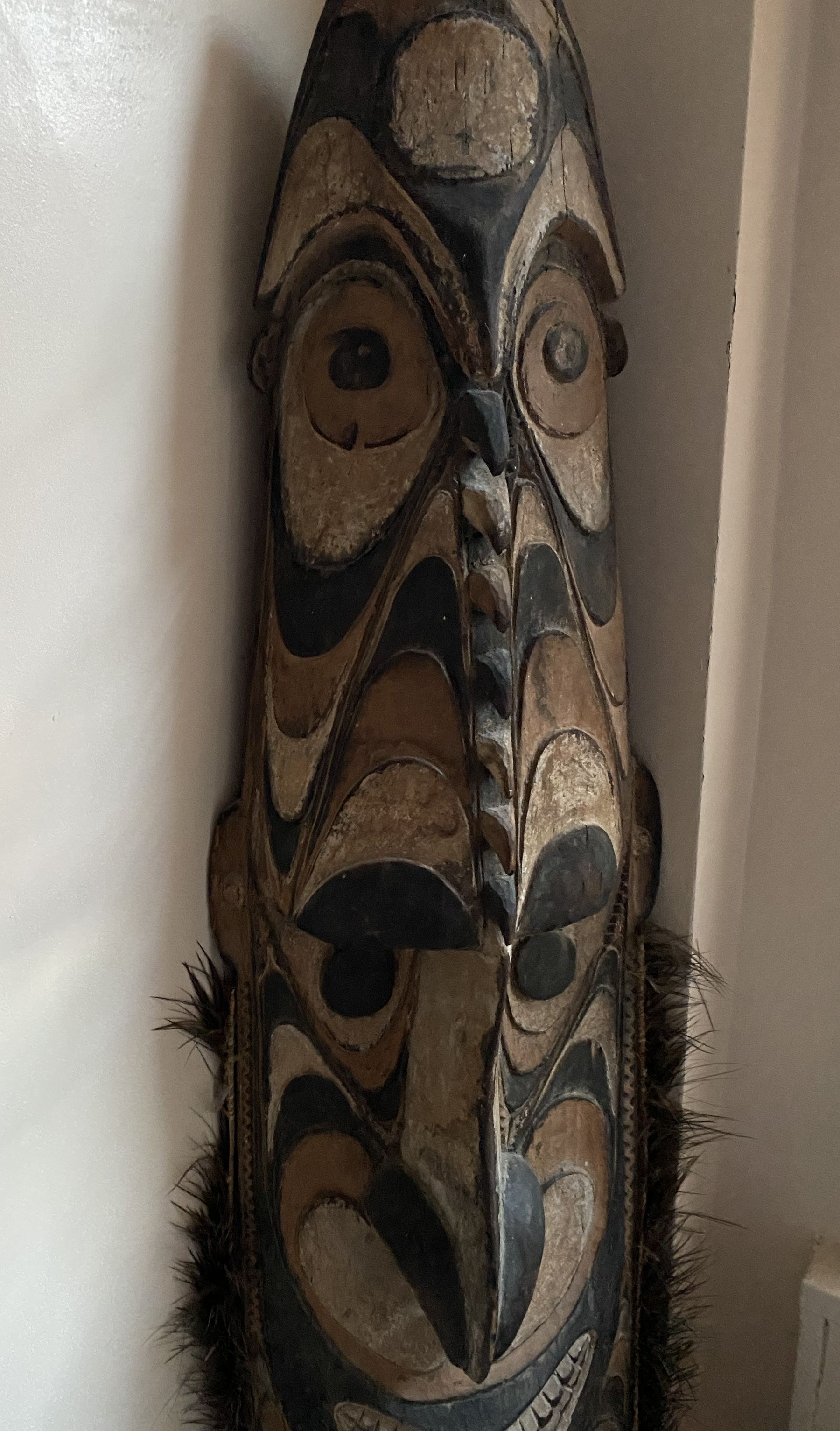
Tall, hand-carved wooden mask from the Sepik River region of Papua New Guinea, worked from a single board with a pronounced, beak-like nose, stacked ovoid eyes, and a central raised ridge with small fin-like projections. The surface is decorated in black, white and brown natural pigments with incised borders; the perimeter is trimmed with dark bristles/feathers bound into the edge. The carving shows asymmetry and tool marks, with age-consistent wear and pigment losses.
Curator Questions
Curated by Jade
Assessment:
This appears to be a Sepik River spirit or ceremonial mask, likely associated with men’s spirit houses (haus tambaran) or performance use. The long hooked nose, concentric eye motifs, chalky mineral pigments, incised borders, and feather/bristle edging are all characteristic of Middle Sepik carving. Surface abrasion, pigment flake, a shrinkage crack at the crest, and irregular hand-carved details suggest some age and non-industrial manufacture. Without a rear view, fiber bindings, or collection history, it is prudent to regard the piece as a mid-20th-century carving, possibly used locally and later sold, or made expressly for trade. A word about fakes.. Oceanic masks—especially from the Sepik—are widely reproduced; many late-20th-century workshop carvings are artificially aged. Accordingly, authenticity should be confirmed by physical examination.
Individual Images:
Close-ups show: 1) A vertical shrinkage crack running down from the top crest; 2) central raised spine with small triangular/finned projections; 3) thick
beak-like nose with drilled nostril and worn pigment
including micro-craquelure in the black; 4) incised teeth-like mouth element; 5) edge detail with zigzag incisions and inserted dark bristles/feathers bound along the perimeter; 6) surface abrasion and encrusted mineral-looking residue consistent with lime/kaolin pigment. These details support hand-carved manufacture and some age. No maker’s mark visible.
Provenance:
Not provided.
Condition:
Good (age-consistent wear, pigment loss, crest shrinkage crack; fringe worn; not officially graded)
Identification Score: 85%
Form, iconography (beak-like nose, stacked ovoids), pigments, incised borders, and feather/bristle edging strongly match Sepik River masks from Papua New Guinea; while the specific subgroup (Iatmul/related) cannot be pinned down with certainty from photos, the regional type is clear.
Authenticity Score: 45%
Hand-tool marks, asymmetry, chalky mineral pigments, and honest-looking wear are encouraging; however, the Sepik market has extensive 20th-century trade pieces with induced patina. Absence of a back view, suspension holes, and provenance limits certainty; lab analysis (pigment/wood), inspection of the rear, and UV/microscopy for artificial aging would raise confidence.
Image Memory Note
Object: very tall vertical wooden mask, single-board construction. Dominant features include a long beak-like nose projecting outward; paired, large ovoid eyes carved in relief with concentric outlines; a central vertical ridge from forehead to midface with repeating small fin-like protrusions; and a stylized mouth with incised, tooth-like pattern below the nose. Palette is black, off-white/chalk, and warm brown/ochre. Surface shows abrasion, pigment losses/flake, and a notable vertical shrinkage crack at the top crest (slightly right of center). Edges have a zigzag/incised border and an applied fringe of dark bristles/feathers attached along both sides. Close-up images show micro-craquelure in black pigment on the nose, minor chips to fin-like projections, and accumulated grime in recesses. No text, numbers, or stamps visible on the front; back not shown. No metal hardware visible from front. Overall impression: Sepik River PNG mask for ceremony or trade, mid-20th century.
Keywords
Papua New Guinea, Sepik River mask, Oceanic tribal art, spirit house mask, wooden mask, mid-20th century, ethnographic art, Iatmul
The report was edited after initial Artmink draft. Original AI draft preserved in Artmink audit history.

Share: