
Monique : French Fine and Decorative Arts
Monique Presents

Original Presentation Script
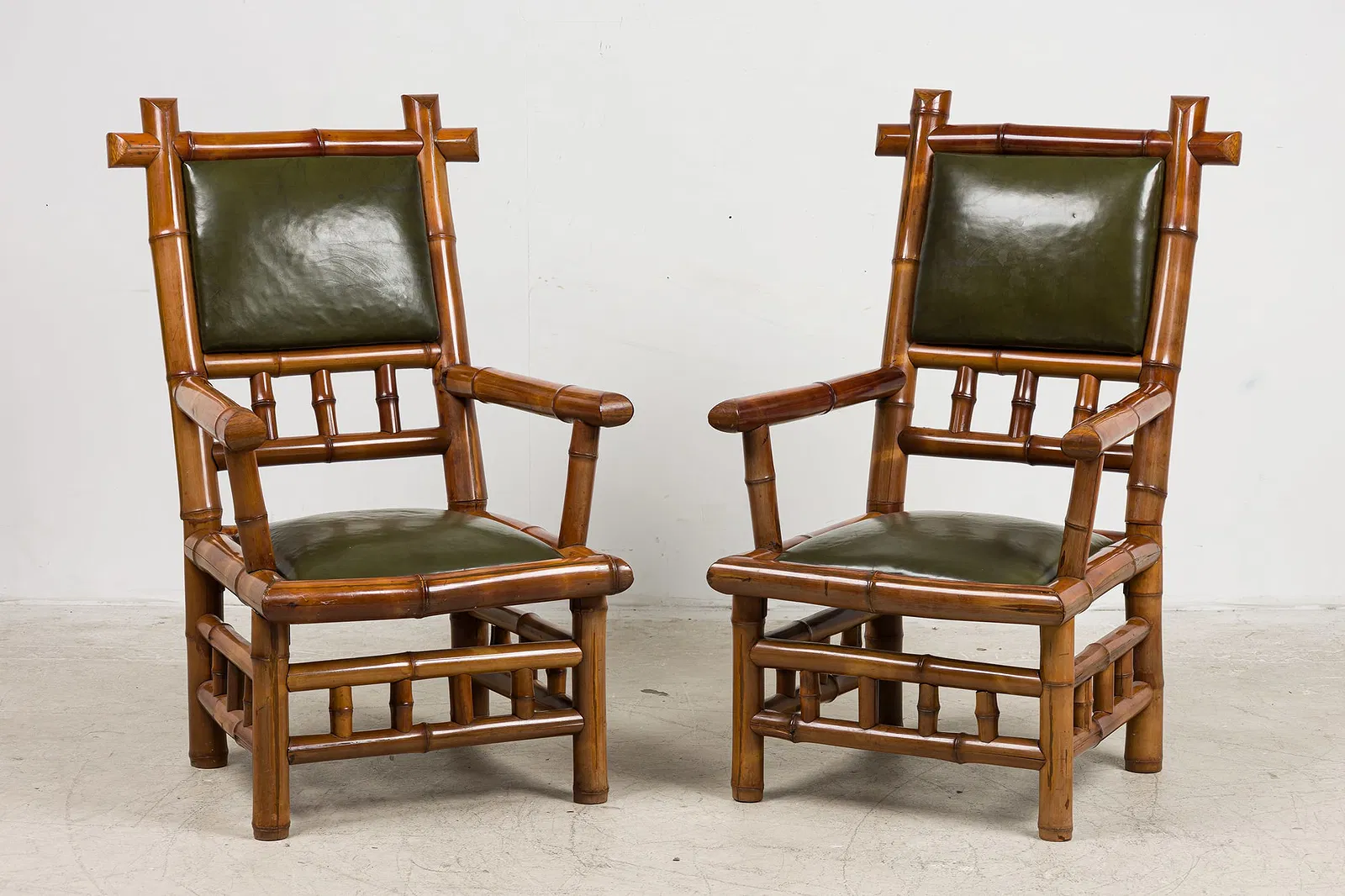
Here we have a delightful pair of French Japonisme armchairs by Perret & Vibert of Paris, dating to circa 1885–1900—exactly the sort of furniture that flourished when late 19th-century Paris fell in love with all things East Asian. Airy, graphic, and slightly theatrical, they capture the spirit of the Aesthetic Movement with remarkable clarity. The frames are not natural bamboo, but finely turned wood carved to simulate bamboo nodes—a technique widely employed by Perret & Vibert in their Asian-inspired lines. The oval plaque at 33 Rue du 4 Septembre firmly anchors them to the firm’s documented address during its most active decades. Proportions are elegant and restrained, with projecting crest rail ends, open arm supports, and a light architectural stance. Condition is honest and appealing. Rubbing and surface wear appear where hands and movement would naturally leave their mark, and the plaque shows appropriate aging. The leather upholstery has developed creasing consistent with use and may be later, though it harmonizes well with the warm brown finish. Because bamboo-style furniture has been widely copied, caution is always wise. In this case, however, the documented maker, correct construction, and convincing age wear combine to make a strong case for period authenticity. A conservative auction estimate would be $1,500 to $3,000 for the pair if offered in a regional sale. In short: stylish, collectible, and distinctly Parisian in their embrace of the exotic.
Used for this report's TTS and avatar presentation.
Item Report
French Japonisme Bamboo-Form Wood and Leather Armchairs, Pair
法国日本主义风格仿竹木与皮革扶手椅(一对)
Merge Reports: Yes (reconciled). Approval remains manual.
By: Perret & Vibert, Paris
Style: French Aesthetic Movement / Japonisme (Faux-Bamboo Furniture)
Origin: France
Materials: turned and carved wood simulating bamboo, leather upholstery, metal maker's plaque
Age: circa 1885-1900
Condition: Good (period wear, surface scratches and rubbing to frame, leather creasing; upholstery possibly later)
Value: Auction estimate if authentic: $1,500–$3,000 for the pair; if later reproduction: $300–$800 for the pair.
Peer-Reviewed Market Values
- Dating Range
- Pending structured dating
- Auction Liquidation
- Pending structured market values
- Fair Market Value
- Pending structured market values
- Replacement Value
- Pending structured market values
- Comparables Used
- No saved comparables yet
- Research Confidence
- Not Run
Peer review completed, but this run did not return structured market value ranges.
Maker's Marks / Writing: Oval metal plaque reading: "PERRET & VIBERT / FABRICANTS / 33, Rue du 4 Septembre / PARIS".
Date: 2026-03-24 01:08:06.161845
Description:
A matched pair of late 19th-century French armchairs in the Japonisme taste, constructed in turned wood carved to simulate bamboo and upholstered in dark olive-green leather. The design reflects the fashion for Asian-inspired interiors, with faux-bamboo turnings, projecting crest rail ends, open arm supports, and a light, geometric silhouette. An oval metal maker's plaque for Perret & Vibert, 33 Rue du 4 Septembre, Paris, supports an authentic period French production rather than a later revival copy. 一对19世纪晚期法国日本主义风格扶手椅,采用车制木材雕刻成仿竹节造型,并配以深橄榄绿色皮革软垫。整体设计体现了当时流行的东方风格室内装饰风潮,具有仿竹车木构件、外挑式顶枋、开放式扶手结构以及轻盈而富有几何感的轮廓。椅背所见“PERRET & VIBERT / 33 Rue du 4 Septembre / PARIS”金属椭圆铭牌,有力支持其为当时法国原厂制作,而非后期仿制品。
Curator Questions
Curated by Jade
Assessment:
This appears to be a genuine late 19th-century French pair of bamboo-form armchairs in the Japonisme/Aesthetic Movement taste, produced by Perret & Vibert of Paris. The clearly legible oval plaque at 33 Rue du 4 Septembre corresponds to the firm's documented address during its most active period in the 1880s and 1890s. The faux-bamboo construction—turned wood with carved node details—is entirely consistent with the maker’s known production of sculpted wood furniture in the Asian style. Surface wear is visible along the arms, legs, and stretchers, including rubbing, minor scratches, and finish variation consistent with long use. The aging of the plaque and the honest handling wear support period manufacture rather than modern distressing. The leather upholstery shows creasing and use; it may be later but is sympathetic in color and character and does not detract from the integrity of the frames. Bamboo-style seating was widely reproduced in the 20th century, so careful scrutiny is always warranted. In this case, the combination of documented maker, correct proportions, appropriate materials, and consistent age wear argues strongly for authenticity as late 19th-century French production. 这对扶手椅应为19世纪晚期法国日本主义/唯美主义风格作品,由巴黎Perret & Vibert制作。铭牌所示33 Rue du 4 Septembre地址与该公司在1880至1890年代的主要经营时期相符。其仿竹结构为车制木材雕刻竹节纹样,完全符合该公司已知的东方风格雕刻木家具生产特征。 扶手、腿部及横撑处可见自然磨损、细微划痕与漆面变化,呈现长期使用所形成的真实岁月痕迹。铭牌氧化程度亦与年代相符。皮革座面有使用褶皱,可能为后期更换,但色调协调,并不影响整体框架的历史价值。 鉴于仿竹家具在20世纪曾被广泛仿制,审慎评估尤为重要。本例在制造商铭牌、比例结构、材料运用及自然磨损方面均表现出一致性,强烈支持其为19世纪晚期法国原作。
Individual Images:
- Front and three-quarter views of both chairs; detail of crest rail joint; detail of lower stretcher wear; close-up of oval maker's plaque; arm joint wear; back spindles; seat corner leather creasing; rear view showing plaque placement.
Provenance:
No documentary provenance provided beyond the original maker's plaque affixed to the chair.
Condition:
Good (period wear, surface scratches and rubbing to frame, leather creasing; upholstery possibly later)
Identification Score: 96%
The clearly legible Perret & Vibert plaque with documented Paris address, combined with the characteristic faux-bamboo turned wood construction and Japonisme styling, make the maker and type identification highly secure. 清晰可辨的Perret & Vibert巴黎地址铭牌,加之典型的仿竹车木结构与日本主义风格特征,使制造商与类别判断具有极高可信度。
Authenticity Score: 88%
The maker’s plaque, historically correct address, period-appropriate turned wood faux-bamboo construction, and consistent surface wear all support authenticity as late 19th-century production. Minor uncertainty remains regarding the upholstery’s originality and the possibility of later refinishing, but no clear indicators of modern reproduction are evident. 制造商铭牌及其历史地址、符合时代特征的仿竹车木结构,以及自然一致的使用磨损,共同支持其为19世纪晚期原作。关于座面皮革是否原装及是否曾有后期翻新仍存一定不确定性,但未见明显现代仿制迹象。
Image Memory Note
Frames are turned wood carved to imitate bamboo rather than natural bamboo; oval Perret & Vibert plaque present. 框架为车制木材雕刻仿竹造型,而非天然竹材;可见Perret & Vibert椭圆铭牌。
Keywords
Perret & Vibert, Paris, 33 Rue du 4 Septembre, Japonisme, Aesthetic Movement, faux bamboo, bamboo-form wood, French armchairs, 19th century, pair Perret & Vibert, 巴黎, 日本主义, 唯美主义, 仿竹家具, 19世纪, 法国扶手椅, 一对
Peer Review Summary
Peer Review
Key Visible Evidence
The provided images clearly depict a matched pair of armchairs constructed from bamboo-form wood, not natural bamboo, as evidenced by the consistent diameter, smooth surfaces, and incised rings mimicking nodes (Images 2, 3, 5, 7). The finish is a glossy, medium-brown tone. The upholstery is a dark olive-green leather, showing some creasing and surface wear consistent with use (Image 8). A prominent oval metal plaque is affixed to the back of one chair, clearly legible as 'PERRET & VIBERT / FABRICANTS / 33, Rue du 4 Septembre / PARIS' (Image 4). The overall construction exhibits traditional joinery for this style of furniture (Images 2, 5). Surface wear, including rubbing and minor scratches, is visible on the frame members, particularly on the legs and armrests (Images 3, 5, 8), which appears consistent with genuine age rather than artificial distressing. The plaque itself shows appropriate aging and oxidation (Image 4).
Market and Source Support
Historical research confirms that Alfred Perret and Ernest Vibert established their business at 33 Rue du 4 Septembre in Paris in 1872, initially offering 'natural bamboo furniture and cane seats'. Their focus expanded to Japanese-style furniture around 1884, and the company was formally listed as 'Perret et Vibert' by 1894, later becoming 'La Maison des Bambous' in 1895. They were known for both natural bamboo and 'sculpted wood furniture' in the Asian style, exhibiting at the Universal Exhibitions of Paris in 1889 and 1900. The address on the plaque (33 Rue du 4 Septembre) was their primary headquarters until after World War I. This historical context strongly supports the report's attribution to Perret & Vibert and the dating of 'circa 1880-1900' for these chairs. The style is consistent with the French Aesthetic Movement and Japonisme, a popular trend in late 19th-century Parisian decorative arts.
Needs Verification
While the report states 'bamboo or bamboo-form wood,' visible evidence strongly suggests the frames are entirely of turned wood mimicking bamboo, rather than natural bamboo. A definitive determination would require close examination of cross-sections or areas of damage to confirm the material's cellular structure. The report notes the upholstery 'may be later,' which is a reasonable assessment. Without detailed examination of the upholstery's underside, tacking methods, or fabric composition, its originality or date of replacement cannot be definitively confirmed from images alone. UV/blacklight examination of the upholstery and frame could potentially reveal repairs, touch-ups, or different ages of materials not apparent under normal light.
Audit Conclusion
The report's attribution of these armchairs to Perret & Vibert of Paris, and the dating to circa 1880-1900, are well-supported by the clear maker's plaque and corroborated historical information regarding the firm's period of operation and address. The 'Japonisme' style and 'faux-bamboo' construction (turned wood) are consistent with the Aesthetic Movement and the known output of Perret & Vibert. The visible wear appears genuine and commensurate with the stated age. The claim regarding the upholstery being 'likely later' is plausible but remains an area for further physical inspection if a definitive date is required. Overall, the chairs appear to be authentic period examples by the attributed maker, with the primary clarification being the material of the frame as bamboo-form wood rather than natural bamboo.
Comparables (Similar Items)
No archived comparables matched this report yet.
Share: