Premium upgrade: Jade delivers your appraisal as a guided podium narration with synced visuals and voiceover.
Output is a narrated, animated slideshow with video intro and outro, sandwiching the autoplay voiceover sequence in actual video.
Chinese Ming Style Blue-and-White Porcelain Boys Bowl中国明代风格青花婴戏图瓷碗
LANGUAGE UNLOCK
Glossary Roundup
Original Presentation Script
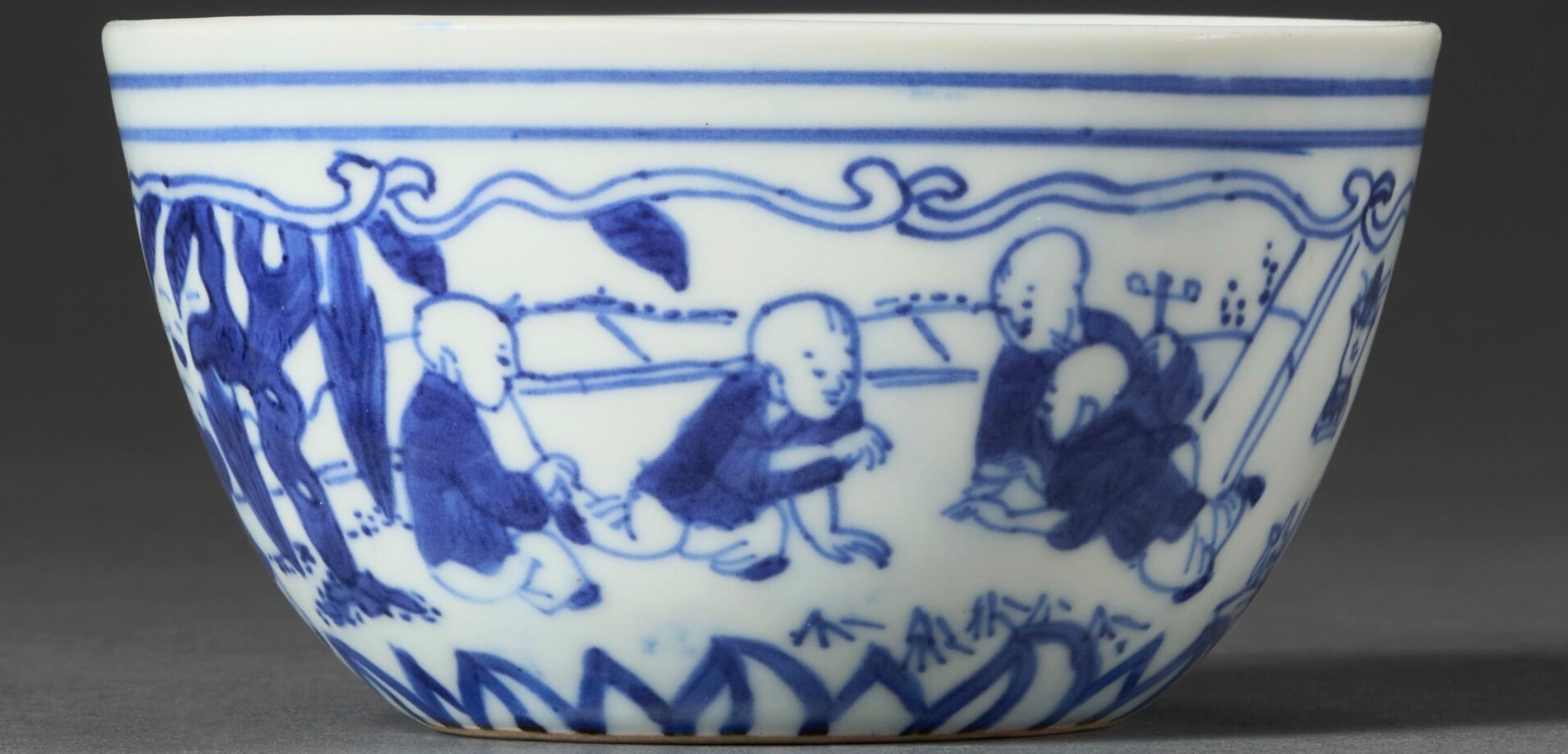
Here we have a Chinese Ming Style Blue-and-White Porcelain Boys Bowl, a charming object that lives in one of the most beloved visual traditions of Chinese ceramics: children at play. These scenes were prized for their auspicious associations with prosperity, lineage, and domestic happiness, so the bowl is doing more than decorating a table—it is broadcasting a cultural wish.
The base bears the six-character mark for Xuande, one of the most admired Ming reigns for blue-and-white porcelain. But collectors should pause right there. Marks like this were copied for centuries, often as respectful homage, sometimes as commercial enhancement. In this case, the visible calligraphy, bright white body, and overall painted style point not to the 15th century itself, but more likely to a later revival example—probably late Qing to early Republic.
The material is porcelain with underglaze cobalt blue, and the decoration appears hand painted, which is encouraging. The footrim shows some wear and the bowl does not read as a brand-new fake. Still, it lacks the deeper material authority one hopes for in a true Xuande piece.
Condition appears very good from the photos, with no obvious major chips or cracks visible, though a hands-on examination under strong light would still be wise.
So: attractive, Chinese, collectable, and likely old—but not, in my view, Xuande period. I’d place the authenticity score at 48%. Conservative auction estimate as a later Ming-style work: $300 to $800. If it were genuinely Xuande, we would be talking a dramatically different universe of value. In Chinese ceramics, the mark may whisper—but the body tells the truth.
Used for this report's TTS and avatar presentation.
Item Report
Chinese Ming Style Blue-and-White Porcelain Boys Bowl
中国明代风格青花婴戏图瓷碗
By:Unknown maker
Style:Ming Style Chinese blue-and-white porcelain
Origin:China
Materials:Porcelain with underglaze cobalt-blue decoration
Age:Probably late 19th to early 20th century, possibly Republic period
Condition:Very Good (minor wear and firing irregularities visible; no major damage apparent from provided photos)
Value:Auction estimate: if this later Ming-style example is correctly identified, approximately $300-$800; if it were a true Xuande-period bowl of comparable quality and condition, the value would be vastly higher, potentially $50,000+ to well into six figures depending on authenticity, rarity, provenance, and condition.
Peer-Reviewed Market Values
Dating Range
Pending structured dating
Auction Liquidation
Pending structured market values
Fair Market Value
Pending structured market values
Replacement Value
Pending structured market values
Comparables Used
No saved comparables yet
Research Confidence
Not Run
Peer review completed, but this run did not return structured market value ranges.
Maker's Marks / Writing:Underglaze blue six-character mark: 大明宣德年製 / 大明宣德年制 ('Made in the Xuande reign of the Great Ming'). In this context it appears likely apocryphal rather than period-definitive. There is also a collector/dealer sticker reading 'LALLY & CO. NEW YORK.'
Date:2026-04-18 21:21:34.761526
Description:
A blue-and-white porcelain bowl painted with playful boys in garden and terrace settings, with an interior roundel of two boys and an underglaze-blue six-character Xuande mark on the base. The decoration, bright white body, and neatly written mark suggest a later homage to early Ming blue-and-white rather than a 15th-century period example.
一件青花瓷碗,外壁绘婴戏庭院人物图,内心圆形开光内绘两童子对坐场景,底部书青花六字宣德款。其纹饰、胎釉的洁白度以及较整齐的书款,更像是对明初青花风格的后期仿作,而非十五世纪同期原作。
Curator Questions
Curated by Jade
Assessment:
This appears to be a Chinese blue-and-white bowl in early Ming taste, likely a later decorative or scholarly revival piece bearing an apocryphal Xuande reign mark. The footrim wear and hand-painted decoration support age, but the visible features do not support a confident attribution to the actual Xuande period. It is nevertheless an attractive and collectable Chinese porcelain bowl.
此碗应为一件中国青花瓷器,仿明初风格,较可能为晚期文人趣味或装饰性仿古作品,并带有寄托性的宣德年款。足圈磨痕与手绘纹饰显示其并非全新,但现有可见特征不足以支持将其断为真正宣德本朝之作。尽管如此,它仍是一件颇具观赏性与收藏价值的中国瓷碗。
Individual Images:
whole bowl side view
detail of boys decoration
whole bowl side view
detail of boys and tree
whole bowl side view
detail of figures
underside of bowl
detail of Xuande mark
detail of Chinese mark
interior of bowl
detail of interior roundel
Provenance:
Dealer notes report purchase at a Massachusetts auction, with an unverified claim that it came from the home of a prominent Boston professor. A Lally & Co. New York sticker is visible on the base, indicating later handling by that firm, but this alone does not establish age or authenticity.
Condition:
Very Good (minor wear and firing irregularities visible; no major damage apparent from provided photos)
Identification Score: 93%
The form, underglaze-blue palette, figural 'boys at play' decoration, and six-character Chinese reign mark make the object readily identifiable as a Chinese blue-and-white porcelain bowl in Ming taste. The exact date is less certain than the object type.
根据器形、青花釉下彩、婴戏人物纹以及六字中国年款,可以较有把握地判断此物为一件中国明风青花瓷碗。其具体断代的不确定性,高于器物类别本身的判断。
Authenticity Score: 48%
The bowl looks hand-painted and not newly made, but the reign mark 'Da Ming Xuande Nian Zhi' is most likely apocryphal. The clean white ground, relatively even cobalt, and overall decorative character are more consistent with a later 19th- or early 20th-century revival piece than a true Xuande-period bowl. Without seeing stronger period traits in paste, glaze, and foot, I would not call it Xuande period.
此碗应为手绘,且并非现代新烧之物,但“ 大明宣德年制 ”款大概率属于寄托款。其胎釉较白净、青花发色较均匀、整体装饰气息也更接近十九世纪末至二十世纪初的仿古器,而非真正宣德本朝瓷。若无更明确的胎土、釉面与足底时代特征,不宜断为宣德时期真品。
Image Memory Note
None
None
Keywords
Chinese porcelain bowl, Ming style, blue and white, boys bowl, figural decoration, Xuande mark, apocryphal mark, underglaze blue, China
中国瓷碗,明代风格,青花,婴戏图碗,人物纹,宣德款,寄托款,釉下青花,中国
The report was edited after initial Artmink draft. Original AI draft preserved in Artmink audit history.
Peer Review Summary
Dating Range
Probably late 19th to early 20th century, possibly Republic period
Fair Market Value
Pending structured market values
Replacement Value
Pending structured market values
Archived Matches
No archive matches yet
Research Confidence
Narrative peer review only
Peer Review
Key Visible Evidence
The subject item is a blue-and-white porcelain bowl decorated with a 'boys at play' motif in garden and terrace settings (Images 1-6). The interior features a roundel with two boys. The underglaze cobalt blue is applied with a relatively even tone, lacking the characteristic 'heaping and piling' and varied tones often associated with true early Ming blue-and-white. The porcelain body appears bright white and clean. The footrim is unglazed, revealing a fine-grained, off-white paste with some minor wear and firing irregularities (Image 7). The base bears a six-character underglaze blue mark in regular script (Kaishu), which reads 大明宣德年製 (Dà Míng Xuāndé Nián Zhì), translating to 'Made in the Xuande reign of the Great Ming' (Image 8). A 'LALLY & CO. NEW YORK' sticker is also present on the base (Image 7). The calligraphy of the mark is neat and well-formed, but the overall execution of the decoration and the characteristics of the paste and glaze are more consistent with later production than with the 15th-century Xuande period.
Market and Source Support
The 'boys at play' (百子圖, bai zi tu) motif is a traditional and auspicious theme in Chinese ceramics, popular across various dynasties. The six-character mark, 大明宣德年製, correctly identifies the Xuande reign (1426-1435). However, as per RAG guidance, reign marks, especially those of famous periods like Xuande, were frequently copied as homage or for commercial purposes on later wares. The visual characteristics of the subject item, such as the evenness of the cobalt blue and the bright white body, do not align with the typical material and aesthetic qualities of genuine Xuande imperial porcelain. Multiple comparables from reputable auction houses (Christie's, Bonhams, Sotheby's, Doyle New York via LiveAuctioneers) feature blue-and-white 'boys' bowls with apocryphal Xuande marks, consistently dated to the 19th or early 20th century (Qing Dynasty or Republic period). These comparables realized prices in the range of $300-$1,000, which strongly supports the report's valuation for a later Ming-style piece.
Needs Verification
The report's dating of 'probably late 19th to early 20th century, possibly Republic period' is visually plausible and supported by comparables, but a more definitive dating would require further technical analysis. Specifically, a microscopic examination of the paste and glaze could reveal more precise firing characteristics and wear patterns. UV light examination would be beneficial to detect any subtle repairs or restorations not visible in the provided images. The provenance claim regarding a 'prominent Boston professor' is noted as unverified in the report and would require documentary evidence for substantiation.
Audit Conclusion
The report provides a well-reasoned and appropriately skeptical assessment of the 'Chinese Ming Style Blue-and-White Porcelain Boys Bowl'. The identification of the form, decoration, and materials is accurate. The report correctly transcribes the six-character Xuande reign mark and, crucially, identifies it as likely apocryphal rather than period-definitive, based on visual evidence that contradicts genuine Xuande characteristics. The proposed dating to the late 19th to early 20th century (late Qing to Republic period) is strongly supported by the visual evidence and corroborated by numerous market comparables of similar style, mark, and quality. The value estimate is consistent with the market for such later revival pieces. The report demonstrates a commendable adherence to critical evaluation, avoiding overconfident claims of authenticity based solely on the presence of a reign mark.

Share: