Chinese Qing Period Famille Verte Porcelain 'Lady and Boys' Dish中国清代五彩瓷仕女童子图盘
LANGUAGE UNLOCK
Glossary Roundup
Original Presentation Script
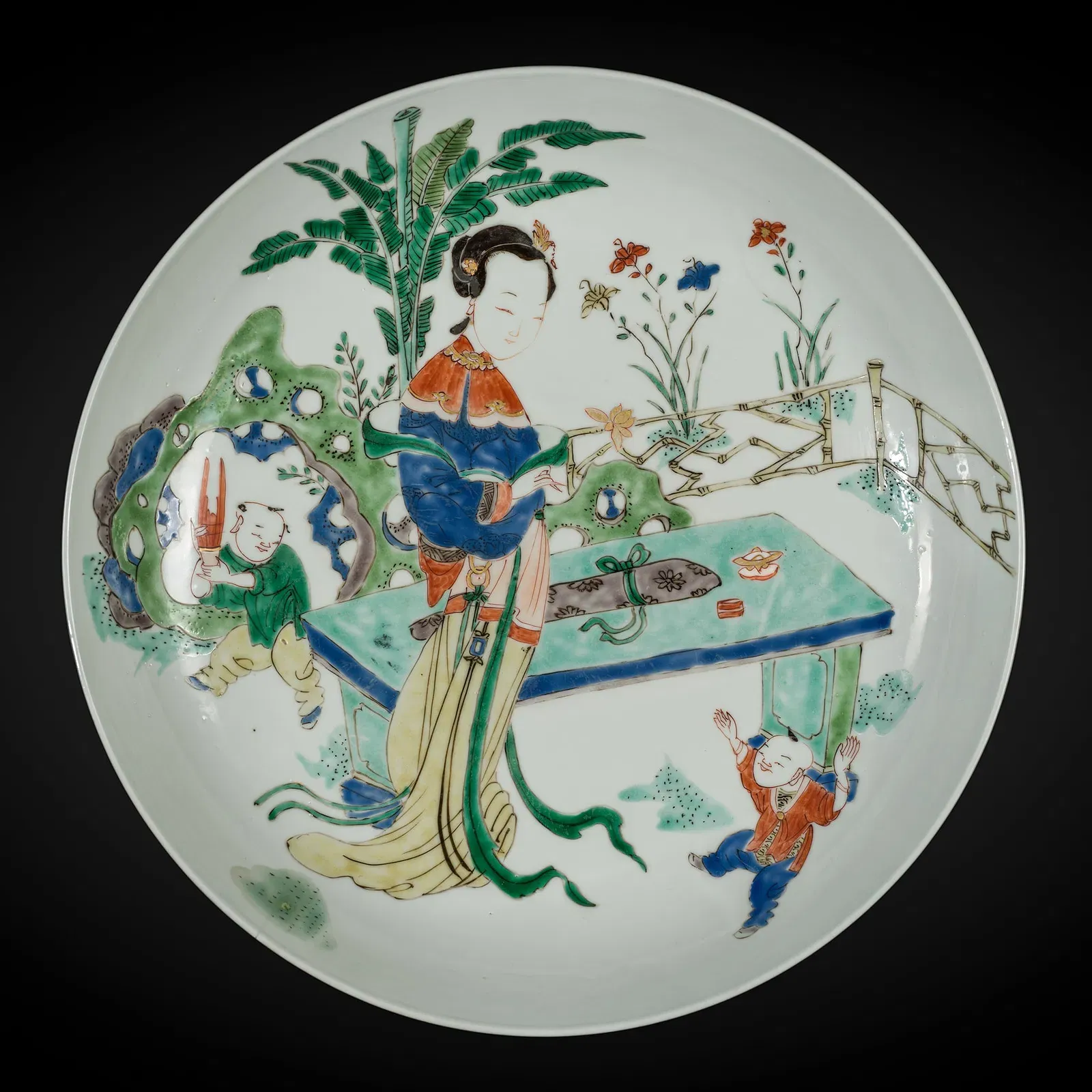
Here we have a Chinese Qing period famille verte porcelain 'Lady and Boys' dish — a deceptively quiet object with a lot going on. At first glance it’s a graceful shallow plate, but the subject is full of auspicious meaning: an elegant lady, playful children, garden imagery, and objects associated with refinement, fertility, and cultured life.
Stylistically, this sits very comfortably in the Kangxi orbit. The famille verte palette — those lively greens, iron reds, blues, and aubergine tones — feels right, and so does the airy, confident drawing. The dish itself is thinly potted and neatly proportioned, and the reverse shows a simple leaf mark in underglaze blue inside double circles, exactly the sort of modest mark one hopes to see on a non-imperial piece of this type.
Condition-wise, the photos show light wear, kiln specks, and minor firing irregularities rather than suspicious perfection. That is good news. I do not see glaring evidence of a modern forgery. The publication and provenance material shown with Feng-Chun Ma is encouraging, though in this field paperwork is garnish, not the meal — the porcelain has to convince on its own.
So my view is cautiously positive: identification confidence is high, and authenticity looks probable, with an authenticity score of 81%. Conservatively, I’d place the auction estimate at GBP 4,000-8,000 if period, versus roughly GBP 200-800 if later. In other words: a scholarly little dish with real charm — and, quite possibly, real age.
Used for this report's TTS and avatar presentation.
Item Report
Chinese Qing Period Famille Verte Porcelain 'Lady and Boys' Dish
中国清代五彩瓷仕女童子图盘
By:Unknown Jingdezhen kiln workshop
Style:Qing dynasty famille verte export/domestic decorative porcelain
Origin:China
Materials:Porcelain with overglaze famille verte enamels and underglaze cobalt-blue mark/rings
Age:Late 17th to early 18th century, circa 1680-1720
Condition:Very Good (minor glaze/firing imperfections and light wear visible; no major damage seen in provided photos)
Value:If authentic period: GBP 4,000-8,000 at auction. If later reproduction/decorative copy: GBP 200-800 at auction.
Maker's Marks / Writing:Underside bears an underglaze-blue leaf mark within double circles. Publication page shown in images reads 'A FAMILLE-VERTE DISH, Kangxi period (1662-1722)' and includes Chinese text: '清康熙 五彩仕女童子纹盘' (Qing Kangxi, famille verte lady-and-boys dish). A Feng-Chun Ma Chinese & Japanese Art label and a green inventory sticker marked '26' are visible.
Date:2026-04-11 21:01:09.414157
Description:
A shallow circular Chinese porcelain dish painted in famille verte enamels with an elegantly dressed lady in a fenced garden terrace accompanied by two boys, one holding a sheng-like mouth organ. The scene includes scholar’s objects on a table, ornamental rockwork, plantain leaves, and flowers. The palette, draftsmanship, and underglaze-blue leaf mark are consistent with Kangxi-era decorative wares, though the attribution remains subject to the limits of photographic review.
此件为中国浅腹圆形瓷盘,以五彩设色绘庭院仕女童子图:一位衣饰雅致的仕女立于栏杆花园之中,身旁有两名童子,其中一名似持笙。画面并见案几上的文房清供、湖石、芭蕉与花卉。其设色、笔意以及底部青花叶形款,与康熙时期外销及陈设瓷的风格大体相符,但最终断代与真伪判断仍受限于照片观察。
Curator Questions
Curated by Jade
Assessment:
This appears to be a Chinese famille verte dish of the 'lady and boys' type, very likely made at Jingdezhen in the Kangxi era or close to it. The visible evidence is generally encouraging: the porcelain body looks appropriately thin and neatly potted, the shallow dish form is right for the period, the famille verte palette has the soft yet vivid iron-red, green, aubergine and blue expected of late 17th/early 18th century wares, and the drawing has the ease and sparseness often seen in Kangxi figural decoration. The reverse shows a simple underglaze-blue leaf mark within double circles rather than an imperial reign mark, which is plausible for a non-imperial export/domestic piece. I also note small kiln/grit imperfections, light wear, and minor firing irregularities that are more reassuring than suspicious. Provenance and publication references shown in the image package are supportive but not conclusive on their own; labels and catalog associations can be copied, so the strongest evidence remains the object itself. On balance, I think the dish is probably authentic and of the period, though I would still prefer in-hand inspection under magnification and UV before making a fully definitive catalog-level endorsement.
从现有照片判断,此盘应为中国景德镇烧造的五彩“仕女童子”题材瓷盘,大概率属于康熙时期或与之相近的年代。可见依据总体较为积极:胎体显得轻薄规整,器形为当时常见的浅盘式样;五彩设色中的铁红、翠绿、茄皮紫与蓝彩,均与十七世纪末至十八世纪初的面貌较相符;人物线描较为流畅,留白疏朗,也符合康熙人物纹饰的常见笔意。背面所见为双圈内青花叶形款,而非官窑年款,这对一件非御窑的陈设或外销器而言是合理的。我也注意到若干细小窑粘、轻微使用磨痕与烧造不匀等现象,这类自然工艺痕迹通常比“过于完美”的表面更令人放心。图片中展示的出版与来源信息具有一定支持作用,但本身并不能单独构成定论;标签与著录亦可能被移用,因此最关键的仍是器物本身。综合而论,我倾向认为此盘很可能为真且属本时期之作,但若要达到拍卖图录级别的最终定论,仍建议在实物上手、放大镜与紫外光下进一步检视。
Individual Images:
overhead dish
detail of lady painting
side view of dish
detail of publication page
detail of boy and rockwork
detail of provenance page
detail of auction comparison
detail of boy under table
detail of painted scene
underside dish
detail of leaf mark and labels
side view of dish
Provenance:
The photos include a publication/provenance presentation identifying the dish with Feng-Chun Ma and illustrating it in 'A Thousand Years of Hundred Boys in Chinese Art' (Hong Kong, 2024), p. 113, no. 26. These references appear visually plausible from the provided images, but as always such provenance should be independently verified against the actual book, sale catalog, and object labels.
Condition:
Very Good (minor glaze/firing imperfections and light wear visible; no major damage seen in provided photos)
Identification Score: 94%
The form, famille verte palette, figural subject, and leaf mark clearly identify this as a Chinese Qing-type porcelain dish in the Kangxi decorative tradition. The subject is especially legible as a 'lady and boys' / auspicious fertility theme.
其器形、五彩设色、人物题材以及底部叶形款都很明确地指向中国清代康熙风格的瓷盘,辨识度很高。画面主题也可较清楚地归入“仕女童子”或寓意多子的吉祥题材。
Authenticity Score: 81%
The strongest positive indicators are the convincing Kangxi-style enamels, relaxed line work, correct shallow potting, plausible underglaze-blue leaf mark, and age-consistent minor firing and surface imperfections. The main caution is that the appraisal relies on photographs, and the provenance/publication material shown is supportive but still secondary to physical examination. I do not see obvious signs of a modern fake in the provided images.
支持真品判断的关键因素包括:较具康熙风格的五彩设色、自然松弛的线描、合乎时代的浅盘成型、合理的青花叶形款,以及与年代相符的轻微烧造与表面瑕疵。主要保留意见在于此次判断依赖照片,且图中所示来源与出版信息虽然有帮助,但仍次于实物检验本身。就目前提供的图片而言,我未见十分明显的现代伪作迹象。
Image Memory Note
None
None
Keywords
Chinese porcelain dish, Qing period, famille verte, lady and boys, Kangxi type, Jingdezhen, leaf mark, figural dish, Chinese export porcelain, garden scene, China
中国瓷盘, 清代, 五彩, 仕女童子, 康熙类型, 景德镇, 叶形款, 人物纹盘, 中国外销瓷, 庭院图, 中国
The report was edited after initial Artmink draft. Original AI draft preserved in Artmink audit history.

Share: