
Sienna : African and Oceanic Art
Sienna Presents

Original Presentation Script
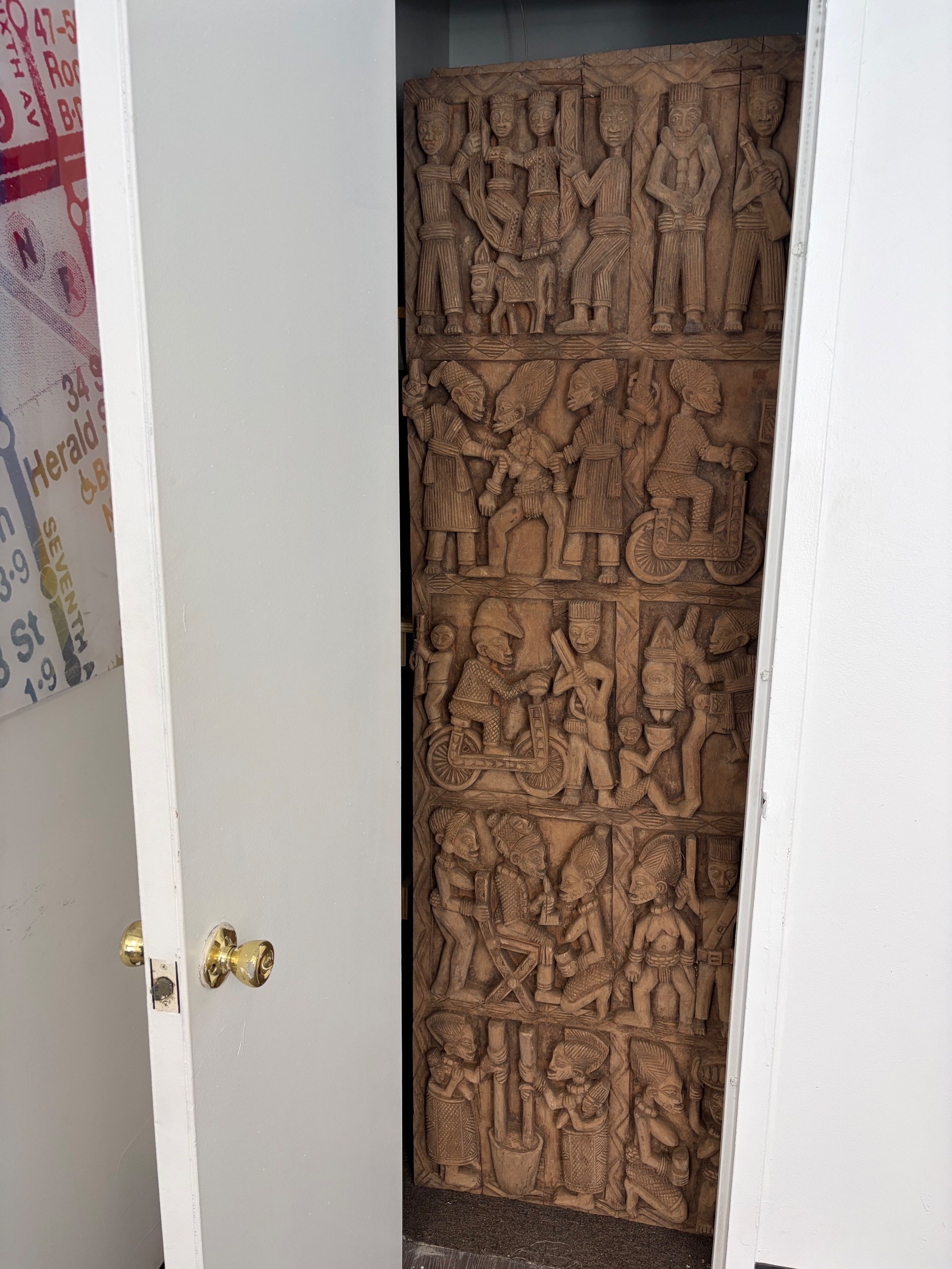
What we have here is a striking West African Yoruba style carved wooden door or architectural panel—tall, theatrical, and packed with narrative energy. Like many figural palace carvings from Nigeria, it unfolds in stacked registers of attendants, musicians, riders, and courtly or domestic scenes, turning a functional panel into a visual chronicle. The imagery is especially telling. Some figures feel traditional and ceremonial, while others introduce modern life—most notably the bicycle or scooter-like rider. That mix usually points not to great antiquity, but to a 20th-century carving that keeps traditional Yoruba visual language alive while updating the story. Collectors actually find that fascinating: it shows a living tradition, not a frozen one. The panel appears hand-carved from a dense African hardwood, probably iroko or something comparable. The relief is bold rather than ultra-refined, with rhythmic patterning in coiffures, scarification, textiles, and borders. It has decorative authority and scale, which matter a great deal in the market. Condition is honest. There are visible shrinkage cracks, wear to raised areas, and iron repair elements at the top—important detail images that suggest age and use, though also later stabilization. Those repairs do not automatically disqualify it; in fact, they support that the wood has moved over time. A word about copies.. West African carvings are heavily reproduced, especially for export, so one must be strict. My view: likely a genuine African mid-20th-century hand-carved panel, but probably not an early palace masterpiece. Authenticity score: 42%. Conservative auction estimate: $400 to $1,200 as a later Yoruba style carving; if proven earlier and more important, perhaps $2,500 to $6,000. A commanding piece—more storyteller than relic, and all the better for knowing the difference.
Used for this report's TTS and avatar presentation.
Item Report
West African Yoruba Style Carved Wooden Palace Door Panel
By: Unknown
Style: West African, Yoruba style figural architectural carving
Origin: Nigeria, likely Yoruba region, or possibly a later West African workshop piece made for export
Materials: Carved hardwood, likely iroko or a similar African hardwood; iron staple/strap repair elements visible
Age: Mid-20th century to late 20th century, circa 1950-1985
Condition: Good (visible age cracks, old iron repairs, surface wear, structurally presentable)
Value: Auction estimate if authentic earlier palace/shrine carving: $2,500-$6,000. Auction estimate as a later Yoruba style decorative/workshop carving: $400-$1,200.
Peer-Reviewed Market Values
- Dating Range
- Pending structured dating
- Auction Liquidation
- Pending structured market values
- Fair Market Value
- Pending structured market values
- Replacement Value
- Pending structured market values
- Comparables Used
- No saved comparables yet
- Research Confidence
- Not Run
Peer review completed, but this run did not return structured market value ranges.
Maker's Marks / Writing: No maker's mark or readable inscription visible in the provided images.
Date: 2026-03-20 13:20:16.343796
Description:
Large vertical high-relief carved wood panel depicting multiple registers of human figures, attendants, musicians, riders, and domestic scenes. The composition strongly recalls Nigerian Yoruba palace or shrine door carvings associated with narrative court imagery, though the execution and visible construction suggest a later decorative work or workshop piece rather than an early period door.
Curator Questions
Curated by Jade
Assessment:
This appears to be a substantial Yoruba style narrative carved panel, probably conceived as a door or architectural wall element. The subject matter—hieratic standing figures, attendants, musicians, a horse rider, and scenes that include notably modern motifs like a bicycle or scooter—suggests a 20th-century work reflecting continuity of traditional carving vocabulary adapted to contemporary life. The carving has real decorative power and convincing hand work, but the relative uniformity of the surface, repetitive figure treatment, and visible iron reinforcements make me cautious about calling it a 19th-century palace door. It is more likely a genuine African carving of the mid-to-late 20th century than a tourist-market fake made yesterday, but probably not a rare early ritual or palace masterwork.
Individual Images:
- whole carved panel
- upper half relief figures
- middle relief with seated figure
- upper right figures
- detail of bicycle rider
- detail of vessel and attendant
- detail of female figure
- lower middle seated group
- lower section figures
- upper left figures
- detail of carved faces
- detail of iron crack repair
Provenance:
No provenance documentation shown.
Condition:
Good (visible age cracks, old iron repairs, surface wear, structurally presentable)
Identification Score: 88%
The iconography, stacked figural registers, and overall format align closely with Yoruba architectural door panels from Nigeria. Confidence is slightly reduced because only the front and detail views are shown, without reverse, joinery, or full structural context.
Authenticity Score: 42%
A word about copies.. Yoruba and broader West African figural carvings have been widely reproduced for the decorative and export market, especially in the mid- to late-20th century, so caution is essential. I do think this is likely an actual African hand-carved object rather than a resin or machine-made imitation, but I am not convinced it is an early period palace door. The inclusion of modern imagery, the somewhat formulaic carving, the broad dry surface, and the visible iron crack stabilizers point toward a later workshop production with some age and use. Without reverse images, tool-mark study, and wood analysis, authenticity as an older ceremonial or architectural original remains unproven.
Image Memory Note
None None
Keywords
Yoruba style, carved wood panel, palace door, Nigerian carving, West African art, figural relief, architectural carving, hardwood panel, narrative carving, Nigeria
Peer Review Summary
Peer Review
Key Visible Evidence
The subject item is a tall, vertical carved wood panel featuring multiple registers of human figures in high relief, consistent with West African Yoruba narrative carving traditions. The wood exhibits a light to medium brown tone with a dry, matte surface. Prominent vertical shrinkage cracks are visible throughout the panel (Images 2, 3, 4, 5, 6, 7, 8). Iron staple or strap repair elements are clearly visible at the top of the panel, suggesting historical stabilization (Image 2). A key visual detail is the depiction of a figure riding what appears to be a bicycle or scooter (Images 3, 5), indicating a post-19th-century creation date. The carving style appears consistent across the panel, with a degree of uniformity in figure treatment and patterning. No maker's marks, inscriptions, or signatures are discernible in the provided images. Crucially, no images of the reverse side of the panel are available.
Market and Source Support
The report's identification of the panel as 'Yoruba style' is well-supported by the iconography, multi-register composition, and figural style, which align with known examples of Yoruba architectural carvings from Nigeria. The dating of the panel to the 'Mid-20th century to late 20th century, circa 1950-1985' is strongly corroborated by the inclusion of modern motifs such as the bicycle/scooter. This reflects a living tradition where contemporary elements are integrated into traditional artistic forms, a characteristic often seen in 20th-century Yoruba workshop productions. Comparables found, such as a 'Yoruba door panel, 20th century' and an 'African Nigerian 20th-Century Yoruba Carved Wood Panel', further support this dating and stylistic classification. The material claim of 'hardwood, likely iroko' is plausible for West African carvings, as iroko is a commonly used dense wood in the region.
Needs Verification
The specific identification of the wood as 'iroko' cannot be confirmed solely from visual evidence and would require scientific wood analysis. While the overall style is consistent with Yoruba art, a definitive determination of its original function as a 'palace door' versus a 'later decorative work or workshop piece' remains uncertain without further contextual evidence. This would ideally include detailed provenance documentation, images of the reverse side to assess joinery, mounting mechanisms, and tool marks, and potentially UV/blacklight examination to detect any hidden repairs or alterations. A macro-level study of tool marks could also provide insights into carving techniques and age. The precise nature and age of the 'iron staple/strap repair elements' could be further investigated to understand their historical context and impact on the panel's structural integrity.
Audit Conclusion
The report provides a largely accurate and appropriately skeptical assessment of the subject item. The identification as a West African Yoruba-style carved wood panel is well-grounded in visible evidence and supported by general knowledge of the art form. The dating to the mid-to-late 20th century is strongly supported by the visible modern motif (bicycle/scooter), which is a critical piece of evidence. The report's cautious stance regarding the panel being an 'early period palace door' and its inclination towards a 'later decorative work or workshop piece' is justified given the available visual evidence and the commonality of such productions. The condition assessment is consistent with the visible cracks and repairs. The proposed value estimate range appropriately reflects the distinction between an earlier, more significant piece and a later workshop production. The identified areas for further verification, particularly regarding wood analysis, reverse views, and detailed tool-mark study, are pertinent for a more definitive assessment of age, authenticity, and original context.
Comparables (Similar Items)
No archived comparables matched this report yet.
Share: